

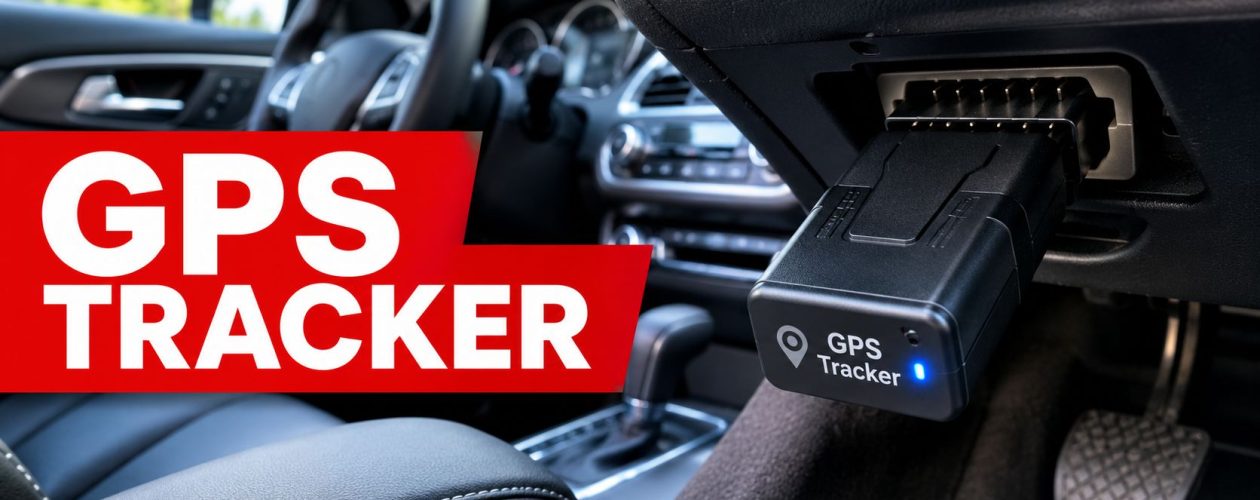
Driver’s Desk
Best GPS Tracker Device for Car: 2026 Buyer’s Guide
Vehicle theft in the United States reached 1.1 million incidents in 2023, and the average cost of a stolen vehicle exceeded $3,500, according to the background cited on vehicle tracking systems. That number changes the conversation. A gps tracker device for car use isn't just a convenience add-on anymore. For many owners, it's part of basic risk management.
The initial inquiry often poses the wrong question. They ask, “Which tracker is cheapest?” The better question is, “Which system still helps me when the car is gone?” That's where the gap between a real GPS security device and a simple Bluetooth item finder becomes obvious.
A dedicated vehicle tracker uses satellite positioning plus cellular communication. A Bluetooth tag does not. One is designed to help recover a moving vehicle. The other is designed to help you find misplaced belongings.
Why Your Car Needs More Than Just an Alarm
Building on the theft risk mentioned earlier, the practical question is no longer whether your car can make noise. It is whether you can locate it and respond while there is still time to act.
A basic alarm works like a smoke detector with no phone alert. It may sound nearby, but if you are asleep, inside a store, or miles away, that warning does not help much. Car thieves know this. Many thefts happen fast enough that a siren becomes background noise, especially in apartment lots, airport parking, and city streets where false alarms are common.
Why alarms often fall short
Traditional alarms are reactive. Someone opens a door, breaks glass, or disturbs the vehicle, and the system makes noise. What it usually does not do is answer the questions that matter after the first minute: Where is the car now? Did it start moving? When did it leave? Which direction did it go?
That gap matters because modern theft is not always dramatic. A vehicle can be relayed, towed, or driven away with a copied signal, and the owner may discover the loss only after the car is already out of view.
A useful security system sends information to you, not just noise into a parking lot.
That is why a tracker belongs in a different category from a standard car alarm solution. An alarm tries to interrupt the theft. A connected tracker helps you verify movement, check location, review recent activity, and share details with police or a recovery service.
The real security difference is visibility
Consider two common outcomes.
At 2:13 a.m., an alarm sounds. No one checks it, or nearby drivers ignore it because they have heard too many false triggers before. By morning, you have a missing car and no trail to follow.
Now compare that with a system that alerts your phone when the engine starts unexpectedly or the vehicle leaves a set area. You can open the app, confirm whether the movement is legitimate, and act while the event is still unfolding. Recovery is never guaranteed, but timing improves your odds.
That is also the point many owners miss when comparing dedicated GPS products with "no-subscription" tags. A Bluetooth item finder can help locate keys, luggage, or a backpack left nearby. It is not built to track a stolen car across town. For anti-theft use, the difference is simple. A dedicated GPS unit is designed to report the vehicle's location through a mobile network. A Bluetooth tag depends on another device being close enough to notice it.
If your goal is actual vehicle security, visibility beats volume. The same principle helps fleet teams boost supply chain operations by monitoring where assets are instead of waiting to discover something went wrong after the fact. Your car benefits from that same shift in thinking. You need proof, location data, and a fast alert, not just a siren.
How GPS Trackers Pinpoint Your Vehicle Location
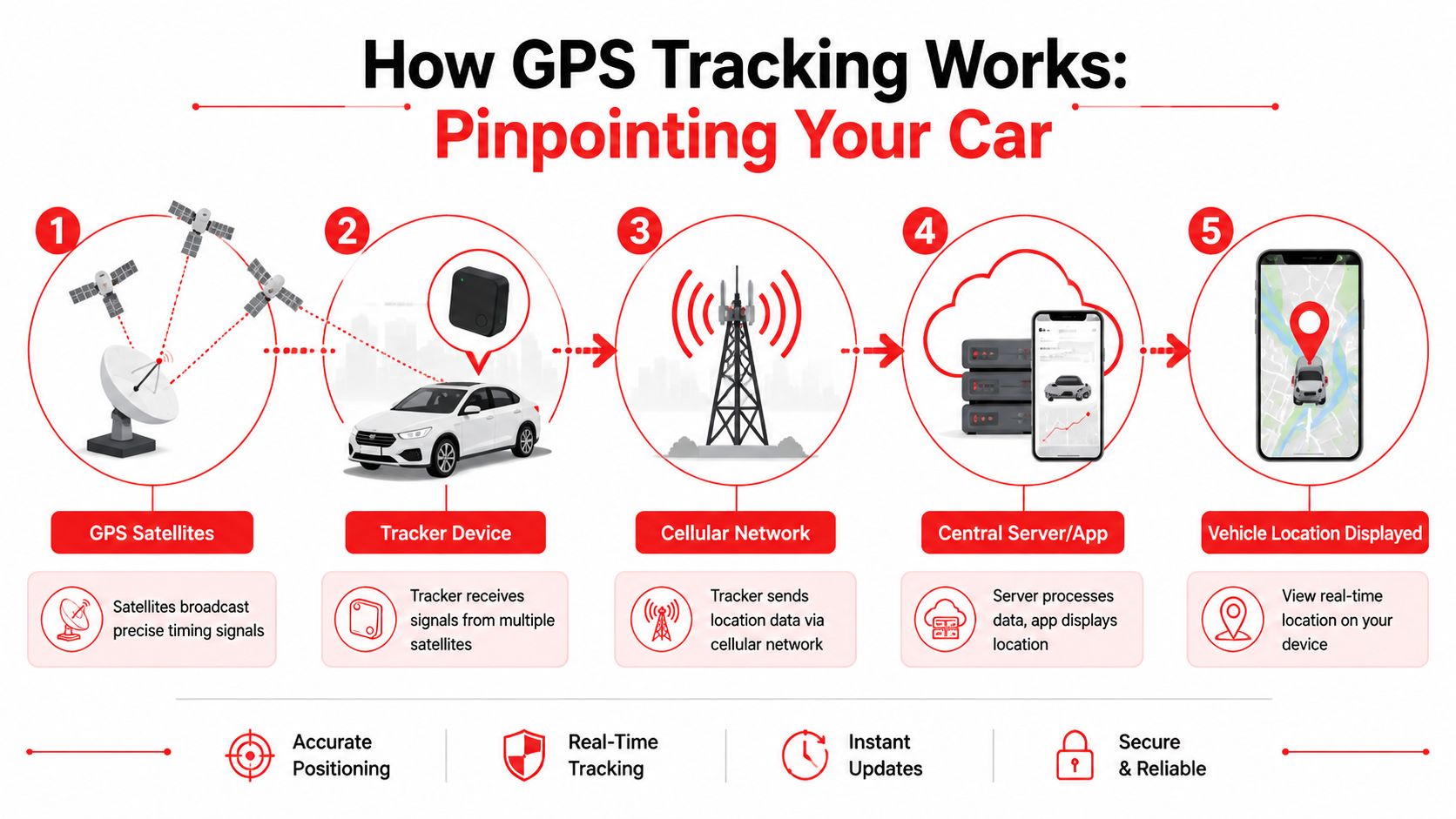
The simplest way to understand GPS is to think of three friends standing far apart, each telling you how far you are from them. One distance isn't enough. Two narrow it down. Three or more let you identify a position.
That's the core idea behind trilateration. GPS tracking technology uses signals from three or more satellites from the Global Navigation Satellite System (GNSS) to calculate latitude, longitude, elevation, and time, which is why it can keep working where Bluetooth trackers don't, including remote areas and underground garages, as explained by Lytx's overview of GPS tracking.
What the tracker is actually doing
Inside the car, the tracker listens for timing signals from satellites. It uses those signals to calculate position. Then, if it's a real connected vehicle tracker, it sends that location through a cellular network so you can see it in an app.
That process has two separate parts:
- Finding the car's position through satellite signals.
- Sending that position to you through the mobile network.
People often confuse those steps. A device can know where it is and still fail to show you anything live if it can't transmit the data.
Why Bluetooth is a different tool
A Bluetooth item finder doesn't work like this. It doesn't independently report its position to you from anywhere. It depends on nearby compatible phones to help update location, which means coverage is situational.
That's fine for keys left under a couch cushion or a backpack left at a café. It's weak for vehicle theft.
A stolen car can end up in a quiet industrial area, a concrete garage, a shipping yard, or a rural lot. In those places, a Bluetooth-only finder may not report in time, or at all. A true car locator system is built around independent positioning and network transmission.
GPS answers, “Where is the vehicle?” Cellular answers, “How does that information reach you right now?”
Why this matters beyond theft
The same location logic powers dispatch, route verification, and operational visibility. In logistics, companies use live tracking to boost supply chain operations because delayed or missing location data creates immediate business problems. For a car owner, the stakes are different, but the principle is the same. Reliable tracking depends on reliable communication.
If you're choosing a gps tracker device for car security, the key distinction is simple. Bluetooth helps with proximity. GPS plus cellular helps with recovery.
Evaluating Core Features for True Car Security
A spec sheet can look impressive and still leave you exposed. For theft protection, the feature list matters less than how the system behaves under pressure.
Start with the features that answer real questions. Can it show movement quickly? Will it alert you if someone unplugs it? Can it keep reporting without depending on a small battery pack?
Real-time tracking means update speed
“Real-time” is one of the most abused phrases in this category. Some devices update fast enough to follow a moving vehicle smoothly. Others feel closer to periodic check-ins.
Verified industry data shows that premium plans can refresh as often as every 3 to 10 seconds, while standard plans often run at 15 to 60-second intervals. That difference matters in theft recovery, towing events, and unauthorized use. A slower refresh may still help with daily monitoring, but a faster one gives you a clearer picture when time matters.
Tamper alerts are not optional
This is the feature many buyers overlook until it's too late. A thief who finds the tracker will often try to disconnect it first.
A 2024 study found that 78% of magnetic GPS trackers in high-theft zones were disconnected within 48 hours of theft attempts, yet fewer than 15% of consumer guides mention tamper sensors or disconnection alerts. That makes anti-disconnect protection one of the most practical features to evaluate.
Cheap tracking hardware can fail at the exact moment a thief notices it.
A stronger setup should warn you if the device is unplugged, loses vehicle power unexpectedly, or detects suspicious vibration associated with towing or tampering. If you're comparing products, review the listed device security features before you focus on cosmetic extras.
Power source changes reliability
Not all trackers stay alive the same way. Here's the practical trade-off:
| Tracker type | Main advantage | Main limitation |
|---|---|---|
| OBD-II powered | Continuous vehicle power and easier ongoing monitoring | Depends on access to the OBD-II port |
| Hardwired | More concealed installation and stable power | Usually needs more installation effort |
| Portable battery-powered | Flexible placement | Can run out, fall off, or stop reporting |
A portable unit can be useful in some scenarios, but for continuous anti-theft monitoring, many owners prefer a device tied to the vehicle's power source.
The app matters more than the brochure
The mobile app is where security becomes usable. A tracker can have solid hardware and still fail the owner if the app is confusing.
Look for basics that support action:
- Clear alert types so you can tell engine start from towing or low battery.
- Readable trip history when you need to retrace where the car went.
- Fast map access because extra taps waste time during a live incident.
- Notification control so the device stays useful instead of becoming background noise.
Here's a quick product walkthrough that shows what this kind of monitoring looks like in practice:
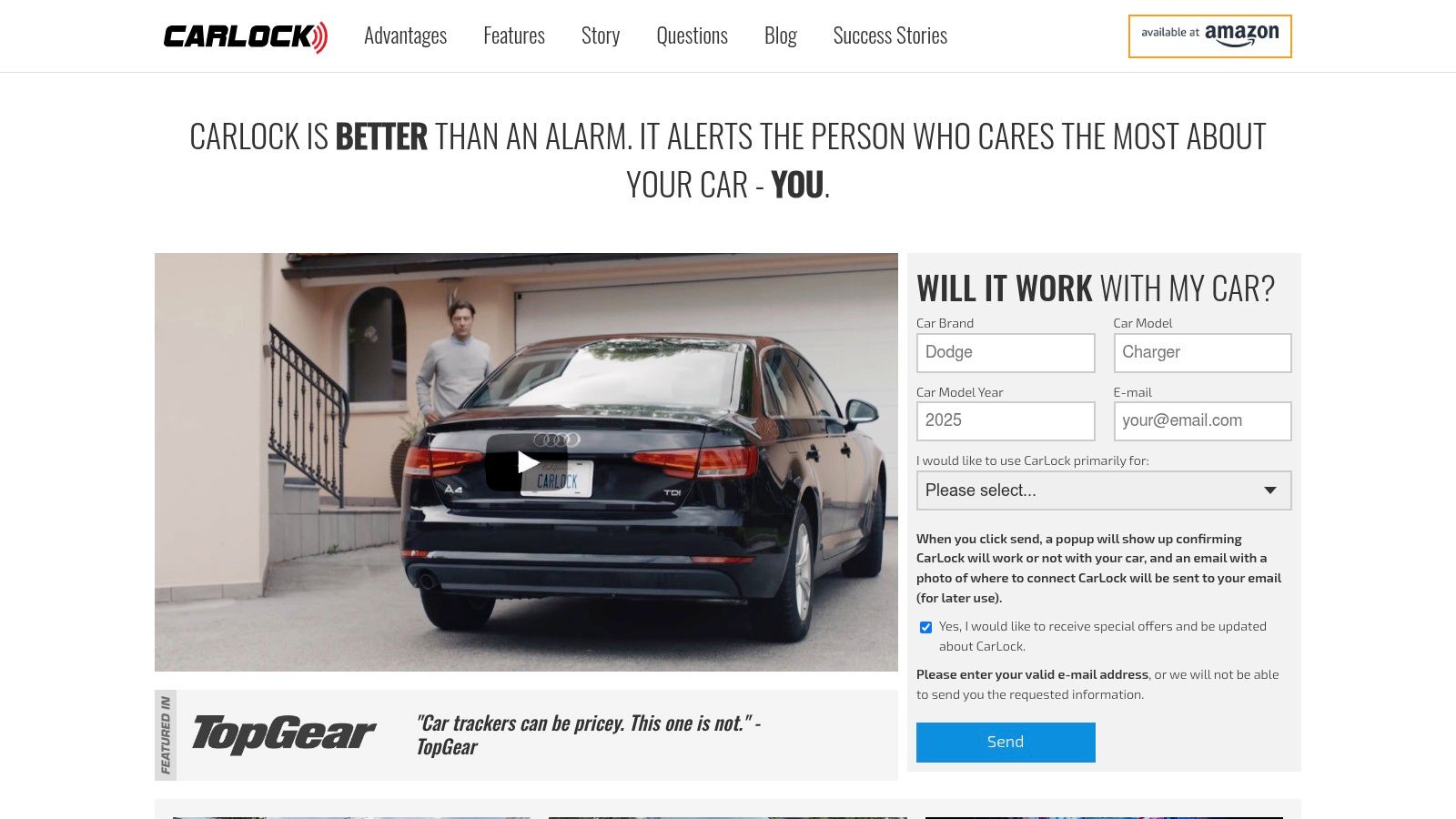
One example is CARLOCK, which uses an OBD-II connection and supports alerts for movement, engine start, vibration, disconnection, and trip history through a smartphone app. That combination is what separates a security system from a simple location gadget.
Practical Use Cases Beyond Theft Prevention
Theft recovery gets most of the attention, but many owners end up using their tracker most often for ordinary life.
A parent installs one because a teenager has just started driving alone. The first week isn't about spying. It's about reducing uncertainty. You want to know whether the car left school on time, whether there was unusual driving behavior, and whether the vehicle is where it's supposed to be. A connected tracker can add context that a simple text message can't.
Three common everyday scenarios
A small business owner sees the value differently. One delivery van covers a lot of ground in a day, and a missed stop or unauthorized detour can turn into customer complaints and wasted fuel. The owner doesn't need a lecture from the driver. The owner needs a clean record of trips, stops, and movement patterns.
Then there's the service scenario. You drop your car with a valet, body shop, or mechanic. Most of the time, everything is fine. But if you're already uneasy, location visibility changes the experience. You don't have to wonder whether the car stayed put or took an unexpected trip.
A tracker earns its keep long before a theft ever happens.
Security plus awareness
A useful gps tracker device for car monitoring often ends up doing two jobs at once. It helps with security, and it helps with accountability.
That second role is why many owners also pay attention to maintenance and battery-related alerts. If you're using a connected system for everyday oversight, features tied to vehicle health monitoring can be just as valuable as the map itself.
These use cases also change how people think about installation. A device that stays connected and reports consistently becomes part of the car's daily operating picture, not just an emergency tool hidden in the background.
The Subscription Debate GPS vs Bluetooth
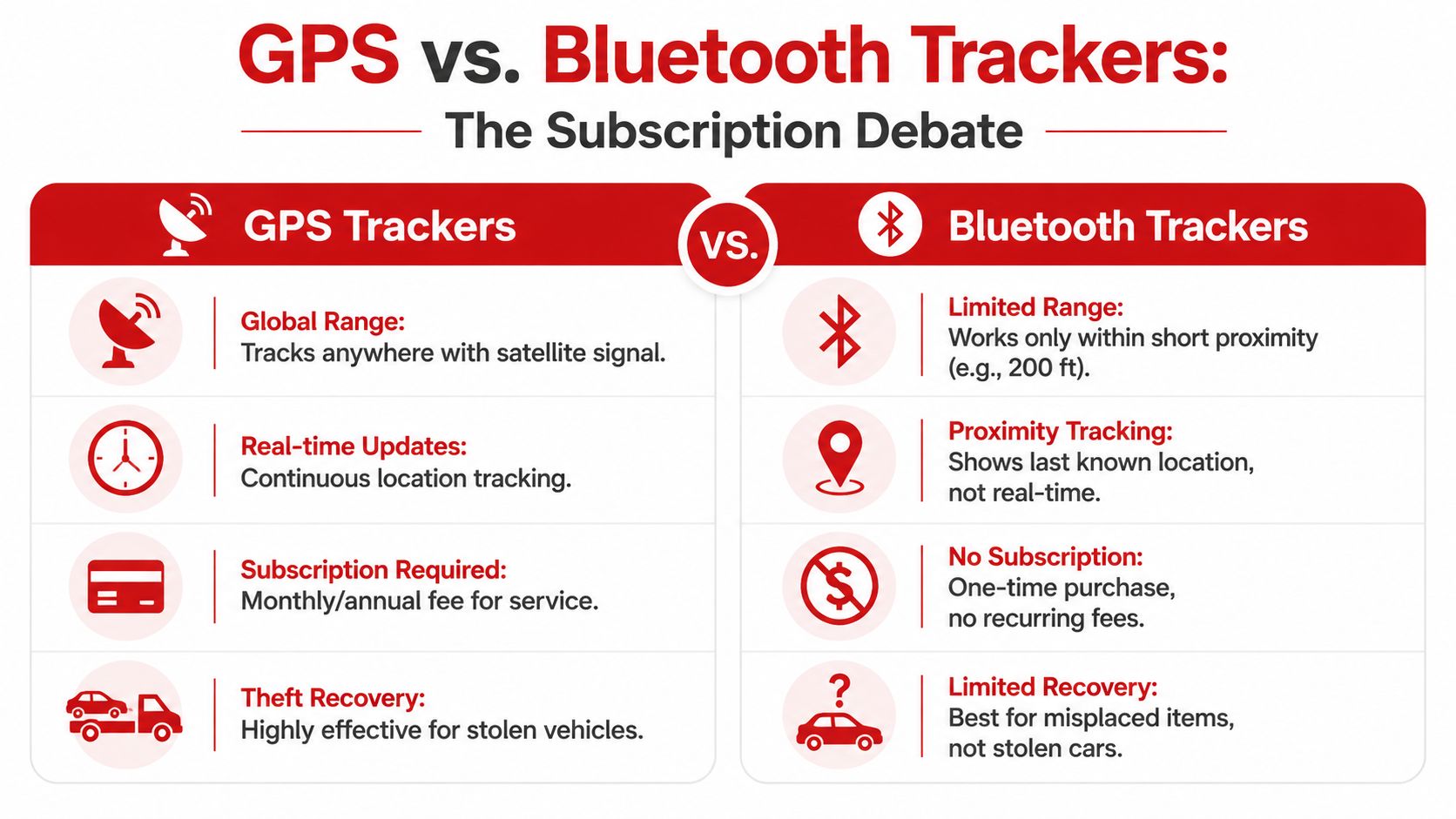
Many buyers become confused. They see a Bluetooth tag with no monthly fee and assume it's a smarter deal than a GPS tracker with a subscription.
That comparison only works if both devices provide the same service. They don't.
GPS tracker devices for cars usually rely on a monthly subscription that ranges from $5 to $25 per vehicle because that fee pays for the 4G LTE network connection required to transmit GPS coordinates in real time. Without that subscription, the device cannot provide live location updates. The fee isn't arbitrary. It's the communication layer that turns location data into a usable security service.
What you're paying for
A subscription covers the part many people never see. Satellites help determine location, but the tracker still needs a way to send that information back to your phone. That happens over the cellular network.
If you remove the network service, the device may still calculate a position internally, but it can't reliably relay that position to you in real time. For anti-theft use, that's the whole point.
Gadget versus service
The easiest way to frame it is this:
| Question | GPS tracker | Bluetooth finder |
|---|---|---|
| Can it show live location remotely? | Yes, if the device has active cellular service | Not independently |
| Does it work as a vehicle security tool? | Yes, that's what it's designed for | Only in limited proximity situations |
| Can it support live alerts? | Yes, with a connected platform | Not in the same way |
| Why the monthly fee? | It funds network transmission and app service | No network service is built into the device |
A Bluetooth finder is a gadget. A subscription-based vehicle tracker is a service tied to hardware.
Buyer test: If the product has no cellular service, ask how it sends you live location when the car is moving miles away from you.
Why “no subscription” usually means “not real-time”
When marketers say “no subscription,” they're usually highlighting the absence of ongoing network cost. That sounds attractive, but it also reveals the limitation. If there is no paid network path, there is no independent long-range real-time reporting.
For a wallet, keyring, or suitcase, that may be acceptable. For a stolen car, it usually isn't.
This is why the monthly fee shouldn't be treated as a penalty. It's part of the system's function. In vehicle security, you're not just buying hardware. You're buying the ongoing ability to receive location, alerts, and event data when the car is out of sight.
Understanding Legal and Privacy Rules
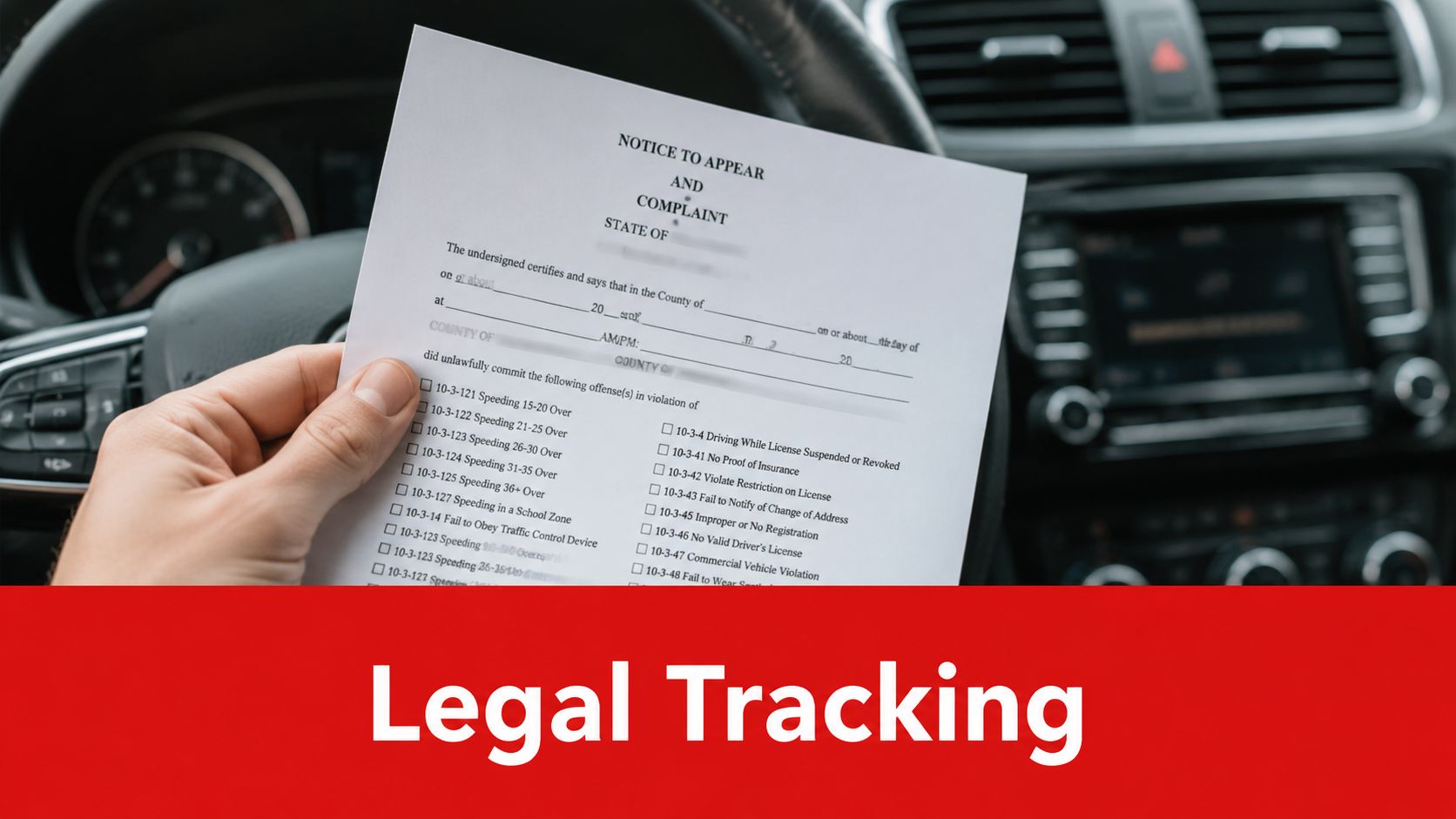
Many owners are comfortable tracking their own vehicle but get uneasy when someone else also drives it. That's the right instinct. Legality often depends on ownership, consent, and how the vehicle is shared.
In the U.S., over 60% of parents use telematics to monitor teen driving, but the American Bar Association notes that tracking a vehicle without consent in shared-use situations can violate privacy statutes in 12 states. That makes permission and transparency central, not optional.
A practical way to stay on the right side of the law
If you own the car and your teenage child drives it, monitoring is often treated differently from tracking another adult in a shared-use arrangement. The closer the situation gets to shared possession, employment use, rentals, spouses, or borrowed vehicles, the more important explicit consent becomes.
Use this simple checklist:
- Own the vehicle clearly: Ownership generally gives you a stronger basis for installing a tracker.
- Tell regular drivers: Notice and consent reduce legal and ethical risk.
- Document company policy: If employees use work vehicles, put tracking terms in writing.
- Don't assume household access equals permission: Shared use can trigger privacy issues under state law.
Privacy isn't only a legal issue
Even when tracking is lawful, secrecy can damage trust. That's especially true in families and small businesses. A tracker should support safety and accountability, not create unnecessary conflict.
For that reason, it's smart to review the provider's privacy practices and data handling policies before installation.
Clear notice solves more problems than clever concealment.
If your situation involves a spouse, adult child, employee, or jointly used vehicle, local legal advice is worth considering. The rules can vary, and assumptions create avoidable risk.
Your Final Checklist for Choosing a Tracker
A good buying decision comes down to a short list.
Choose a gps tracker device for car security if it has real GPS positioning, cellular connectivity for live reporting, and alerts that tell you about movement, engine activity, and tampering. If the product skips the network connection, it isn't a true substitute for anti-theft tracking.
Also check the power method. A device connected to the car's power supply is usually more dependable for ongoing monitoring than a portable battery unit that can die or be removed unnoticed. The app should also be simple enough that you can act on alerts quickly, not hunt through menus.
If you're comparing GPS against Bluetooth, don't compare price tags alone. Compare outcomes. The right system isn't the one that looks cheapest on day one. It's the one that still helps when the vehicle is missing, being towed, or used without permission.
If you want a dedicated vehicle security system rather than a basic item finder, take a look at CARLOCK. It combines real-time GPS tracking, smartphone alerts, trip history, and anti-tamper monitoring in a setup designed for everyday car owners who want clear, practical visibility into what their vehicle is doing.