

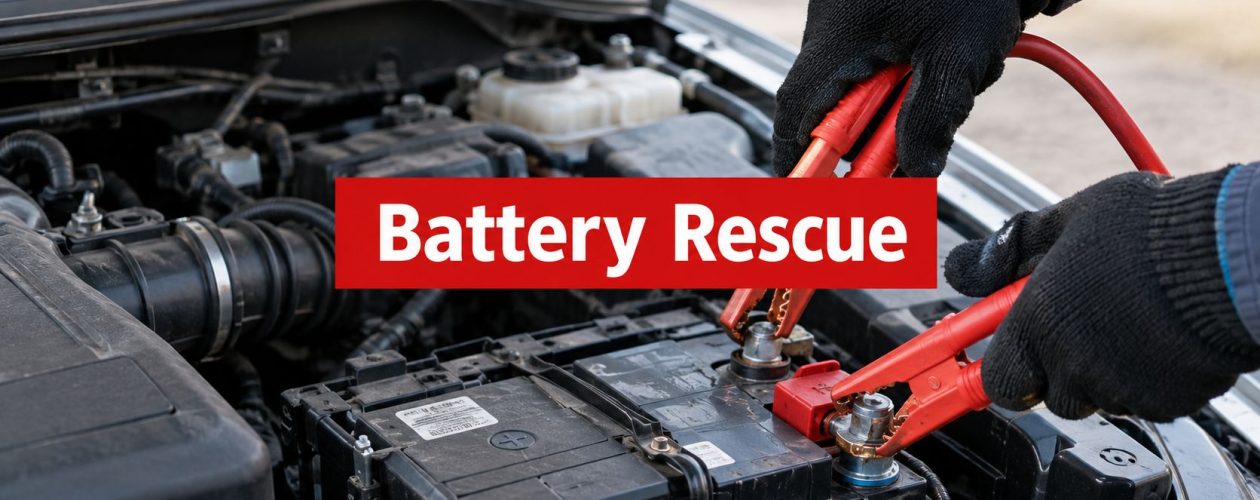
Driver’s Desk
Car Battery Drained What to Do Jump Start and Fix Guide
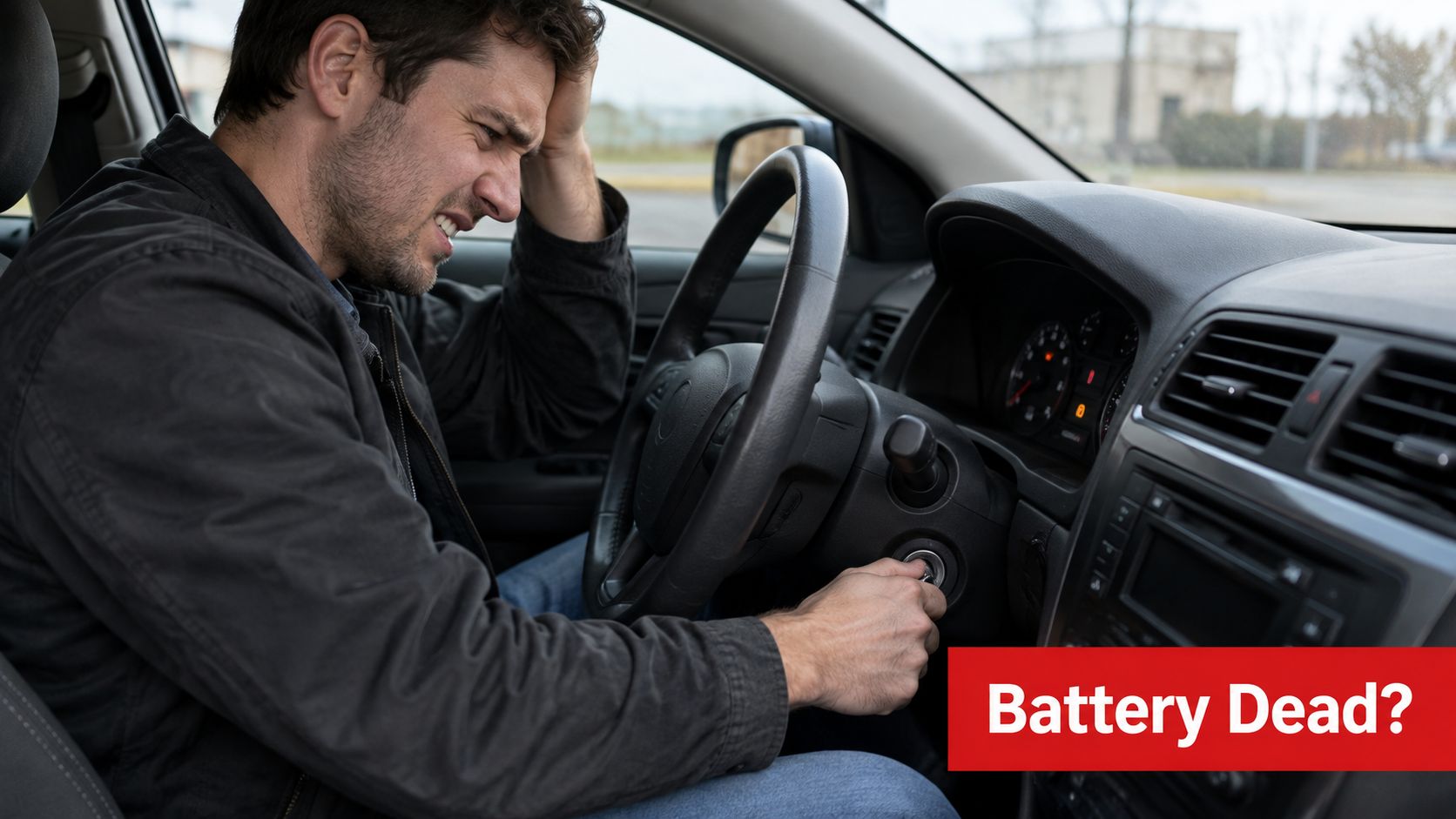
You turn the key and hear rapid clicks. The dashboard lights fade, the starter barely moves, or the car stays completely silent. If you're searching for car battery drained what to do, the safest response is to treat the dead battery as a clue, not a diagnosis.
A jump-start may get you away from the curb, but it won't tell you whether the battery has failed, the alternator isn't replenishing it, or a hidden electrical load is draining it while parked. The practical sequence is simple: make the scene safe, start the car without damaging anything, recharge the battery properly, then test why it went flat.
When Your Car Battery Dies Without Warning
A dead battery often appears without warning because the failure happens while the vehicle is unattended. The car may have started normally earlier in the day, then refused to crank after a short stop. A glovebox light, a stuck relay, an infotainment module that never sleeps, or an aging battery can all produce the same frustrating result at the driver's seat.
Modern vehicles carry more electronics than older cars. Clocks, memory settings, security systems, telematics, body-control modules, and connected accessories continue using a small amount of power after you lock the doors. That background demand is normal within limits, but a module that stays awake can turn a minor electrical load into a no-start condition.
The three likely causes
Battery failure is the first possibility. A battery can lose its ability to store energy, especially after repeated deep discharges or prolonged service. A jump-start may produce enough immediate power to start the engine, but the battery can still fail the next time you switch the car off.
Charging-system trouble is different. A faulty alternator, poor belt drive, damaged wiring, or a charging-control problem can leave the battery undercharged after every trip. If the engine starts with assistance but the battery repeatedly goes flat during normal driving, the charging system needs attention.
Parasitic drain occurs when something continues consuming power after shutdown. Common examples include interior or trunk lights, aftermarket wiring, faulty relays, infotainment systems, body-control modules, and an alternator diode allowing reverse current flow. The battery is then the victim, not necessarily the cause.
Key takeaway: Jump-starting solves the immediate lack of cranking power. Measuring the battery, charging system, and off-state current draw prevents the second stranding.
A vehicle-health monitoring system can add useful context between visits to the car. The vehicle health monitoring features can help owners watch for battery-related changes before a parked vehicle becomes impossible to start.
Immediate Safety Checks Before You Try to Start
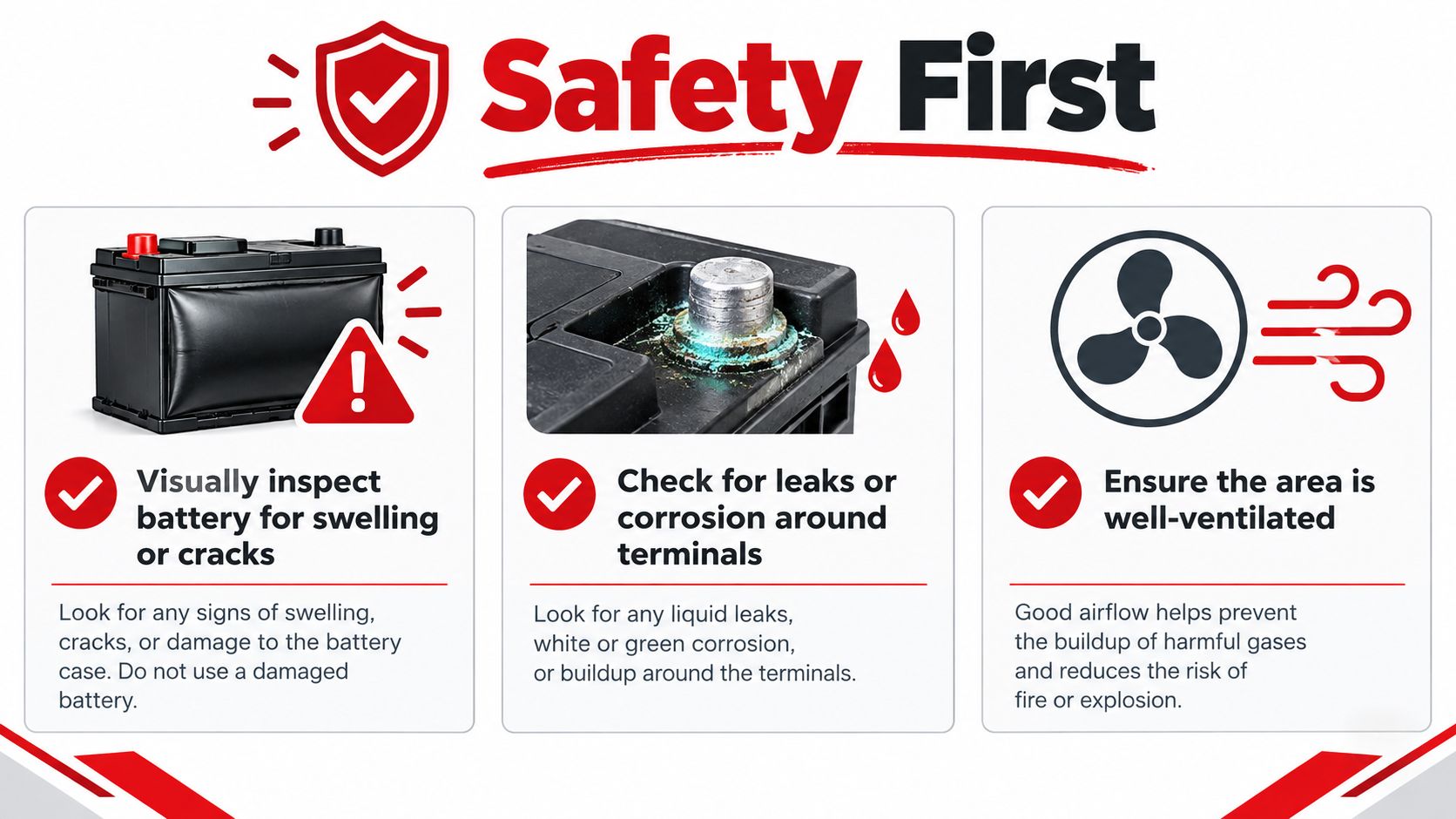
Before connecting a charger, jump pack, or cables, take two minutes to inspect the battery and the surrounding area. Don't start with the assumption that every flat battery is safe to boost.
Look for a swollen, cracked, or distorted case. Check for liquid around the battery, heavy corrosion at the terminals, and damaged cables. A strong sulfur smell is also a reason to stop. These signs can indicate a battery that's venting, leaking, or internally damaged.
AAA warns that battery work can involve severe shock and possible explosion, including sulfuric acid and battery fragments. Its jump-start guidance also says to switch off the ignition and electrical accessories before beginning the process. Read the AAA jump-start safety guidance before attempting the procedure if you're unfamiliar with it.
Stop when the scene isn't suitable
Move away from traffic if you can, apply the parking brake, and keep both vehicles from touching if you're using another car. Work in an open or well-ventilated area. Don't smoke, use an open flame, or place metal tools across the battery terminals.
Turn off lights, climate controls, audio equipment, heated seats, and other accessories. If a glovebox light has drained the battery, removing the cause matters as much as restoring power. If the vehicle was parked in freezing weather and the case looks damaged, don't force a jump. A roadside technician can inspect it safely.
Keeping the engine bay clean also makes corrosion, loose cables, and leaks easier to spot. A practical reference on pristine engine bay steps can help, but never spray water directly onto an exposed battery, fuse box, alternator, or electrical connector.
Have these items within reach:
- Eye protection: Safety glasses reduce exposure risk if a battery vents or splashes.
- Hand protection: Insulated gloves help protect against grime, sharp brackets, and accidental contact.
- Correct cables or a rated jump pack: Inspect clamps for damaged insulation before use.
- A multimeter: This lets you verify voltage after the emergency start.
- A flashlight: You'll need to see terminal markings and cable placement in poor light.
A conventional alarm or a connected security device can also affect how you think about parked-vehicle events. Review your car alarm options carefully, particularly if an aftermarket installation has added wiring near the battery or fuse box.
How to Jump Start Safely and Get Moving Again
A jump-start gets you out of a parking lot. It does not prove the battery is healthy or explain why it went flat. Use it to reach a safe location or repair shop, then charge and test the battery. A repeat failure can point to a weak battery, a charging fault, or a hidden drain.
Park the donor vehicle close enough for the cables to reach without letting the vehicles touch. Switch off both ignitions and electrical accessories. Confirm the battery voltage and terminal markings if there is any uncertainty, especially on vehicles with sensitive electronics.
Follow the clamp order
Connect the cables in this sequence:
- Attach the positive clamp to the disabled vehicle's positive battery terminal.
- Attach the other positive clamp to the donor battery's positive terminal.
- Attach the negative clamp to the donor battery's negative terminal.
- Attach the remaining negative clamp to a clean, solid, unpainted metal grounding point on the disabled vehicle, away from the battery.
The final ground connection keeps any spark away from the battery. Keep the clamps separated throughout the process. Reversed polarity can damage electronic control units, fuses, batteries, and charging components.
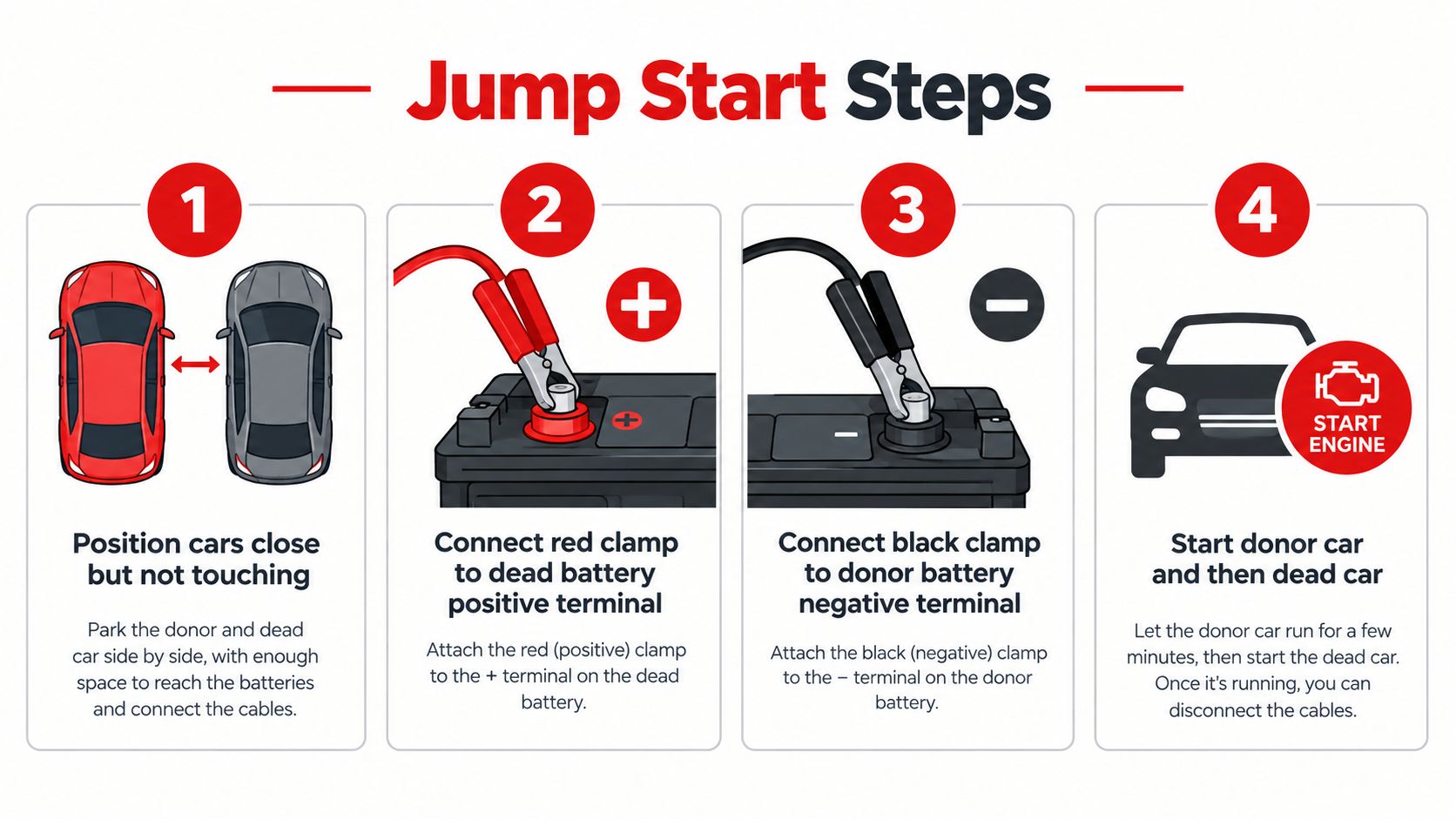
Start the donor vehicle and let it run briefly, then try the disabled vehicle. Do not hold the key or start button continuously if the engine does not respond. Recheck cable placement, and stop if you smell sulfur, see smoke, or notice heat or swelling.
Once the disabled vehicle starts, remove the clamps in reverse order. Disconnect the grounding point first, followed by the donor negative terminal, donor positive terminal, and finally the disabled vehicle's positive terminal. Keep the engine running for at least 20 to 30 minutes so the alternator can begin restoring charge, as outlined in this jump-start technical discussion.
Jump-starting requires full attention. Clamp order and grounding reduce the risk of sparks, short circuits, and electronic damage. If the vehicle starts but struggles again after being switched off, do not keep repeating the jump.
The alternator can maintain a battery while the vehicle operates, but it is not a substitute for a controlled charger recovering a discharged battery. Arrange a proper charge and electrical diagnosis. A battery that fails again may be the failed component, or the vehicle may be drawing power while parked. Continuous monitoring can alert you to that drain before the next roadside breakdown.
Testing Whether Your Battery Will Hold a Charge
After the emergency start, separate recovery from diagnosis. A battery that accepts enough energy to crank once may still have poor capacity, and a battery that tests well may be repeatedly drained by the vehicle.
For a 12 V lead-acid battery, the reliable recovery method is a smart charger matched to the battery chemistry. Connect it with the correct polarity, select the appropriate flooded or AGM setting, and use a low-current setting when available. Watch the battery during charging. Discharged batteries should be monitored for heat, with 125°F/51°C a common upper safety threshold in manufacturer guidance. Battery recovery details and safety benchmarks provide useful context.
A practical AGM recovery benchmark is approximately 8 hours of charging with an automatic charger using an AGM setting around 14.7 V, followed by approximately 12 hours of open-circuit rest. A full-charge result should exceed 12.9 V under that procedure. For a generally healthy fully charged battery, a resting reading of about 12.6 V or higher is a useful benchmark after charging and rest.
Read the result, not just the number
| Test | Pass Threshold | What It Means |
|---|---|---|
| Resting voltage after charging and rest | About 12.6 V or higher | The battery has a healthy full-charge reference reading. |
| AGM recovery benchmark | Exceeds 12.9 V after the stated charge and rest procedure | The battery meets that practical full-charge benchmark. |
| Temperature during deep recovery | Stay below 125°F/51°C | Higher heat is a stop-and-investigate warning. |
| Load test at 70°F | Above 9.6 V after a 15-second load | The battery meets a widely used service-test threshold. |
| Voltage after load removal | At least 12.4 V | The battery recovers to a serviceable post-load reference. |
The load-test benchmark commonly applies a load equal to 50% of the battery's CCA rating for 15 seconds, with voltage staying above 9.6 V at 70°F and recovering to at least 12.4 V after the load is removed. This battery load-test checklist explains those pass and fail points.
If the voltage falls quickly after charging, the battery fails the load test, or the car needs another jump soon afterward, replacement may be more sensible than repeated recovery attempts. If the battery passes but goes flat while parked, stop blaming the battery and measure the vehicle's off-state draw.
A connected vehicle device can provide another view of battery behavior between manual tests. The device features page describes the kind of vehicle information owners can review when investigating electrical problems.
Finding Hidden Parasitic Drain That Kills Batteries Overnight
A parked vehicle should enter a sleep state. Its clock, memory, security functions, and other essential systems still use some electricity, but the draw should settle to a low level after the car has shut down and the modules have had time to sleep.
A healthy off-state draw is typically about 25 to 50 mA, and anything above roughly 75 mA is commonly treated as a fault requiring investigation. The car battery drain calculator illustrates how a continuous load changes the outcome. At 385 mA, its modeled estimate is about 2 days and 16 hours to reach a dead condition, with consumption of about 9.1 Ah per day while parked and approximately 1.8 hours of driving to recover charge under those modeled conditions.
Measure after the vehicle sleeps
Use a multimeter capable of measuring current, but don't connect it in series incorrectly or attempt to start the engine while the meter is carrying current. Many modern vehicles also wake up when you open a door, press a remote button, or touch a control, so prepare the test carefully and allow the vehicle to settle before interpreting the reading.
A technician typically connects the meter in series with the negative battery cable, waits for the vehicle's systems to go to sleep, and records the stable draw. Follow the meter manufacturer's instructions and vehicle-specific service information. If the initial number is high but gradually falls, wait for the modules to finish their shutdown cycle before deciding there's a fault.
When the reading remains excessive, remove fuses one at a time and watch for a meaningful drop. Record each fuse position and reinstall fuses methodically. This process narrows the problem to a circuit, after which the technician can inspect the relevant relay, lamp switch, infotainment module, body-control module, trailer wiring, alarm installation, or alternator diode.
Common faults that hide in plain sight
A glovebox or trunk light can stay on because a switch no longer registers closure. Aftermarket stereos, dash cameras, remote starters, and security systems can be wired incorrectly or prevent the vehicle from sleeping. A relay can remain closed even after the ignition is off, while a software-heavy module can repeatedly wake itself.
That's why “battery drained what to do” shouldn't end with a replacement battery. If the same circuit remains active, a new battery only postpones the next failure.
Continuous monitoring can help catch the pattern between diagnostic visits. A vehicle security system with battery-related monitoring can alert an owner to low voltage, abnormal drain, movement, tampering, or disconnection, giving them a chance to investigate before the next start attempt fails.
Preventing the Next Dead Battery and Staying Alerted
Prevention starts with reducing avoidable loads and making sure the battery gets a proper recharge. Short trips, long periods of parking, forgotten accessories, and loose or corroded connections can all leave the battery below its useful reserve without producing an obvious warning.
After the vehicle has fully gone to sleep, a typical parasitic draw on many passenger vehicles is about 20 to 50 mA. Draws above that range are commonly considered suspicious, and around 50 mA is often used as a practical upper limit for normal off-state current. This parasitic-drain reference explains why a small reading can matter over time.
Use a battery maintainer when a vehicle sits for extended periods, but choose one designed for the battery chemistry. Keep terminals clean and tight, inspect visible wiring, and remove accessories that remain powered when the vehicle is parked. If an alarm, tracker, dash camera, or aftermarket stereo was installed before the problem began, include that installation in the diagnostic search.
Build a simple decision rule
- DIY is reasonable: The battery looks sound, the environment is safe, you have suitable cables or a jump pack, and the vehicle only needs enough power to reach a charger or workshop.
- Use a smart charger: The battery accepts charge without overheating and you want to establish whether it can hold a resting voltage and pass a load test.
- Visit a shop: The battery repeatedly fails, the charging system is suspect, or an off-state draw remains high after fuse isolation.
- Call roadside assistance: The battery is swollen, cracked, leaking, hot, smells strongly of sulfur, or the vehicle is stopped in an unsafe location.
Monitoring adds value when you don't see the car every day. A battery-health alert can reveal a gradual decline, while an abnormal-drain alert can point to a problem that only appears after the vehicle has been parked for several hours. The CarLock app features show how smartphone notifications can fit into that kind of parked-vehicle awareness.
The right fix depends on the evidence. Charge and test a recoverable battery, repair the alternator or wiring when the charging system is responsible, and isolate the circuit when current continues flowing after shutdown. Don't replace parts at random, and don't treat repeated jump-starts as a maintenance plan.
CARLOCK monitors vehicle location, movement, tampering, disconnection, low battery, and abnormal battery drain, helping you spot electrical trouble before it leaves you stranded. Visit CARLOCK to add real-time vehicle security and battery alerts to your prevention plan.