

Driver’s Desk
Car Theft Protection App Guide 2026: Features That Work
In the United States, 850,708 vehicles were stolen in 2024, according to the National Insurance Crime Bureau data cited in Canada's national auto-theft report. That was a meaningful decline from the previous year, but it still represents an enormous recovery problem. A car theft protection app can help, but only if the hardware behind the app detects movement quickly, keeps transmitting after tampering, and gives you usable information before the vehicle disappears.
A polished map interface isn't enough. The system must shorten the time between an unauthorized event, your first alert, and a police-ready location. That means separating purpose-built GPS security from Bluetooth item finders, checking how the device handles towing and power loss, and understanding where privacy rules, cellular coverage, subscriptions, and installation can limit results.
What a Car Theft Protection App Actually Does
A car theft protection app is the smartphone interface for a vehicle tracking and security system. The phone app displays the vehicle's location, records trips, and sends alerts. The physical device installed in or on the vehicle collects the information that makes those functions possible.
The operating loop is straightforward:
- A sensor detects an event, such as movement, ignition, vibration, towing, battery loss, or device disconnection.
- The tracker determines location and packages the event data.
- The device transmits the information, usually through cellular connectivity.
- The cloud platform processes it and sends a push notification.
- The owner acts, by checking the map, contacting law enforcement, or sharing the vehicle's current coordinates.
That sequence matters because passive deterrence only tells you that something happened. A traditional alarm may make noise, while a dash camera may record what occurred. Neither necessarily gives an owner a live location after the vehicle leaves the driveway. A factory remote app can provide convenience features, but its theft functions depend on the vehicle manufacturer's design, permissions, and network service.
The useful parts of the app
A serious system should give you more than a dot on a map. Look for real-time location, movement alerts, ignition alerts, geofences, trip history, tamper warnings, and battery notifications. Each feature answers a different operational question:
- Is the vehicle moving?
- Did someone start it?
- Is it still within its expected area?
- Has the tracker been unplugged?
- Is the car battery being disconnected or drained?
- Can I provide a current location to police?
The CarLock car tracking overview is a useful example of how a vehicle-security platform connects mobile alerts with tracking hardware. The larger principle is more important than any interface: the app is only as effective as the event detection and communications hardware feeding it.
A tracking app won't physically stop every theft. Its job is to detect unauthorized activity early, preserve location data, and support a faster response. Buyers should judge systems by that recovery workflow, not by decorative dashboards, social features, or a long list of disconnected app functions.
The Three Technologies Behind Car Theft Apps
Vehicle trackers fall into three practical hardware families: GPS and cellular devices, Bluetooth-only tags, and hardwired telematics units. They may share similar app screens, but they behave very differently once a thief starts driving.
A GPS and cellular device receives satellite positioning data, then sends that location through a mobile network to a cloud platform. It can work while the car is far from the owner because it doesn't need the owner's phone nearby. This is the category that supports live movement alerts and remote monitoring during an active theft.
Bluetooth-only trackers work differently. They broadcast a short-range signal and depend on nearby compatible phones to relay an approximate location. That can help find a lost key ring or bag, but it isn't a dependable theft-response system. Once the vehicle moves beyond nearby phones, the tag may stop producing useful location updates.
Hardwired telematics systems connect to the vehicle's wiring or a diagnostic connection and draw power from the car. Depending on the model, they can monitor ignition state, voltage, movement, vibration, and disconnection. Concealed installation also makes removal harder than pulling a visible plug or searching under a seat.
What happens during a theft
Suppose a thief loads a vehicle onto a flatbed. A cellular GPS system can detect vibration, displacement, or towing and send an alert while the vehicle is still moving. A Bluetooth tag may remain silent unless a compatible phone passes close enough to detect it. A removable plug-in unit can be pulled out, while a concealed hardwired device can continue reporting and flag the tampering event.
Practical rule: Choose the hardware according to the first five minutes of a theft, not according to how attractive the app looks in a product demonstration.
| Technology | Range | Power Source | Works During Theft? |
|---|---|---|---|
| GPS and cellular tracker | Broad cellular coverage, subject to network and signal conditions | Vehicle power, often with backup power | Yes, when powered and connected |
| Bluetooth-only tracker | Short-range connection to nearby phones | Small internal battery | Unreliable once the vehicle leaves nearby devices |
| Hardwired telematics | Cellular coverage with vehicle-level sensor access | Vehicle wiring, ideally with backup power | Yes, with stronger tamper resistance |
The GPS car tracker features page illustrates the type of sensor and alert capabilities buyers should examine. The key decision isn't the label on the box. It's whether the system can detect an event, communicate independently, and keep producing actionable data after the thief interferes with the vehicle.
Key Features That Separate Real Protection From Noise
Security features deserve a scenario-based test. Ask what each function does when the vehicle is parked, moved, tampered with, or driven by someone who shouldn't have the keys.
Detection comes before recovery
Real-time GPS tracking matters when a car starts moving out of a garage or parking structure. A live map can show direction and current position, while trip history helps establish where the vehicle has traveled. A system that only records a delayed location may leave you chasing an old position.
Instant push alerts turn an app into an active warning system. Configure notifications for unauthorized movement, ignition, and device disconnection. An alert that arrives while the vehicle is still near home gives you a better opportunity to verify the event and contact police.
Geofencing creates a virtual boundary around a home, workplace, storage yard, or regular parking area. If the vehicle leaves that expected zone, the app can notify you without requiring constant map checks. Geofencing is particularly useful for detecting an unauthorized trip that doesn't begin with a dramatic alarm.
Tow and vibration alerts address a different theft pattern. A thief may not start the engine at all. They may tow the vehicle, load it onto a transporter, or manipulate a door and ignition system. Vibration and displacement detection can identify that activity earlier than engine-only monitoring.
Control and continuity
Ignition monitoring helps distinguish a genuine trip from a vehicle being moved by a flatbed. Driving-behavior scoring, including harsh acceleration, hard braking, and aggressive cornering, is more useful for parents and fleet managers than for an active recovery event. It can expose unsafe driving, unauthorized use, or a cloned-key incident after the trip begins.
Remote immobilization or engine-kill functions can reduce the chance of continued driving, but they require careful engineering and professional installation. They shouldn't be treated as a universal emergency button. Poorly designed remote controls can create safety problems, and legal authority matters when the vehicle is being used by an authorized driver.
Battery backup and power-loss alerts are essential. Telematics reporting can identify device removal or disabling as a theft indicator, as described in this telematics theft-pattern analysis. If a thief disconnects the main vehicle battery or removes the tracking unit, the system should tell you that the power state changed.
The CarLock app feature guide shows the type of alert architecture worth evaluating. Shared family maps, social leaderboards, and fuel-economy reports may be convenient, but they aren't core theft protection. Count features that detect, transmit, notify, or preserve evidence. Everything else is secondary.
Bluetooth Trackers vs Purpose-Built GPS Security
Bluetooth trackers such as AirTag-class, Tile, and SmartTag devices are useful item finders. They aren't designed to maintain a vehicle's live theft trail.
A Bluetooth tag generally relies on nearby phones to detect its signal and relay a location. Its practical range is limited, and it doesn't maintain continuous cellular communication with a cloud server. The tag may eventually produce a clue if the stolen vehicle is parked near an unrelated phone user, but that outcome depends on circumstances outside the owner's control. Audible notifications and visible placement can also make consumer tags easier for a thief to locate and disable.
A purpose-built GPS security system uses a different architecture. The tracker receives satellite positioning data and sends it over cellular networks. A hardwired unit can draw continuous vehicle power, monitor ignition and voltage, detect vibration or displacement, and continue operating through an internal backup source when the main power connection is interrupted.
Capability comparison
| Capability | Bluetooth Tracker (AirTag-class) | Purpose-Built GPS (CarLock-class) |
|---|---|---|
| Location method | Nearby-phone relay | Satellite positioning with cellular transmission |
| Update behavior | Intermittent and dependent on nearby devices | Designed for connected vehicle monitoring |
| Power source | Small internal battery | Vehicle power, with suitable backup hardware |
| Geofencing | Limited or not vehicle-focused | Built around vehicle movement and zones |
| Theft alerts | Limited item-finding notifications | Movement, ignition, tamper, tow, and power alerts |
| Recovery value | Possible clue after the vehicle stops near a compatible phone | Actionable location data during vehicle movement |
The CarLock device feature information reflects the distinction between a vehicle security device and a portable item tag. A purpose-built system doesn't depend on a stranger's phone to create the next location update.
A Bluetooth tracker can be a last-resort clue. It shouldn't be your primary recovery plan.
For a vehicle that matters financially or operationally, hardwired GPS with cellular uplink is the best choice. Bluetooth tags can supplement that system in limited situations, but they can't replace independent power, cellular communication, tamper detection, or vehicle-specific alerts.
Who Gets the Most Value From These Apps
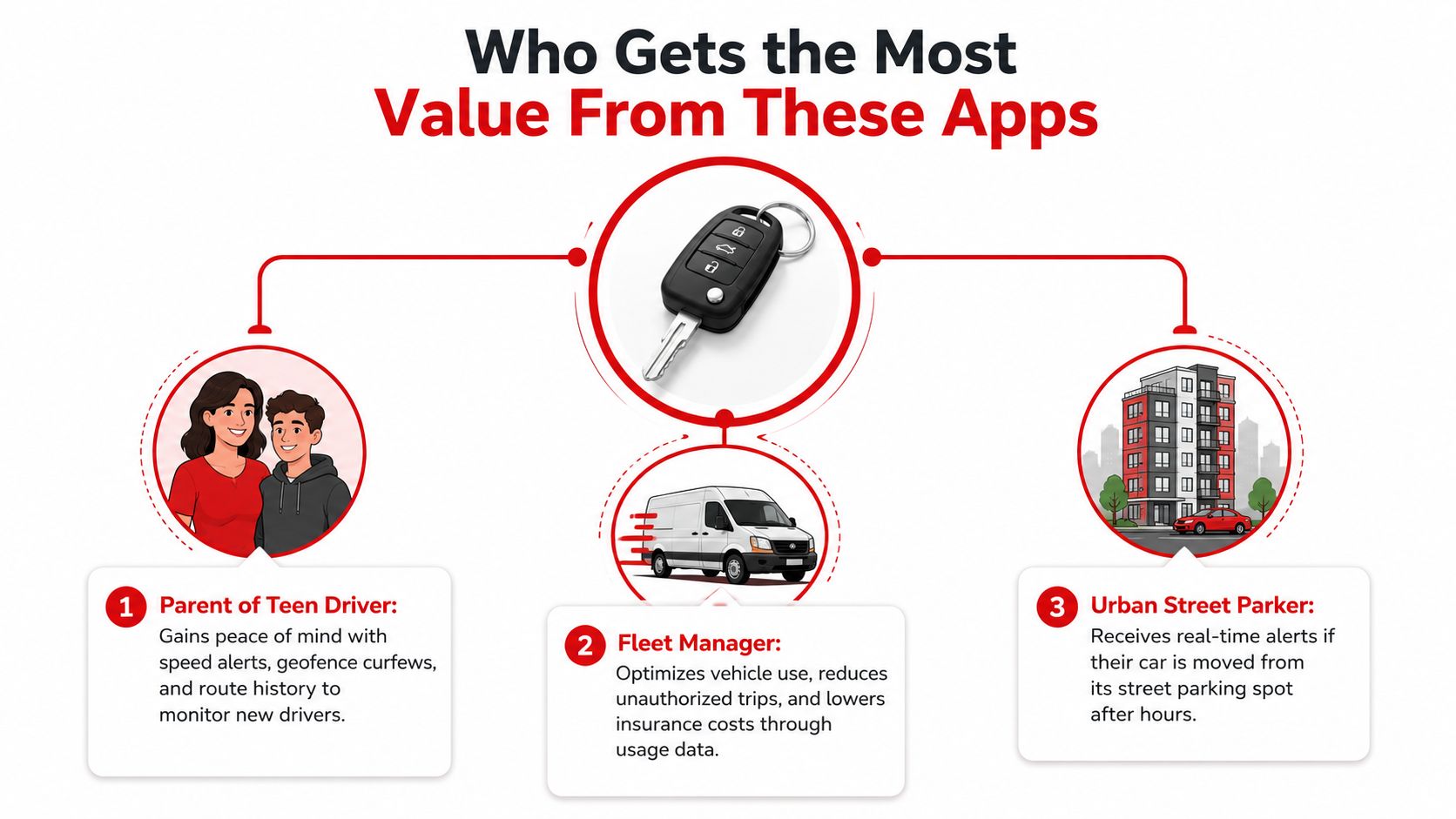
The same tracking platform can solve three different problems. The value depends on who needs the information and what decision they must make after an alert.
Parents of teen drivers
A parent doesn't need to watch a map all evening. Speed alerts, geofenced curfews, and route history create specific conversations. If a vehicle leaves the expected area late at night or the driver repeatedly brakes harshly, the parent has concrete information instead of relying on a vague impression.
That same system can identify an unauthorized trip. A movement alert while the family is asleep deserves immediate attention, whether the cause is theft, a cloned key, or an adult borrowing the car without permission.
Small-business fleet operators
A fleet manager needs more than theft recovery. A multi-vehicle dashboard can show where vans are, while route history and driver scoring can identify unauthorized trips, inefficient driving, and operational problems. Maintenance reminders and usage records can support better scheduling, although those functions shouldn't distract from power-loss and tamper alerts.
Fleet owners also need account controls. Decide who can view location data, who receives security notifications, and who can share coordinates with police or an insurer. A portable tag that depends on nearby phones creates an unacceptable visibility gap for working vehicles.
Drivers in high-theft areas
A resident who parks on the street needs an immediate movement warning and a location that can be shared quickly. Canada recorded 57,359 stolen private passenger vehicles in 2024, with a national recovery rate of 59.3%, according to Équité Association figures reported in Canada's auto-theft update. The recovery gap makes early detection more than a convenience.
All three users benefit from an always-on system with cellular communication. Their priorities differ, but a portable tag remains the wrong primary tool for a vehicle that must be found during an active theft.
Where Car Theft Protection Apps Fall Short
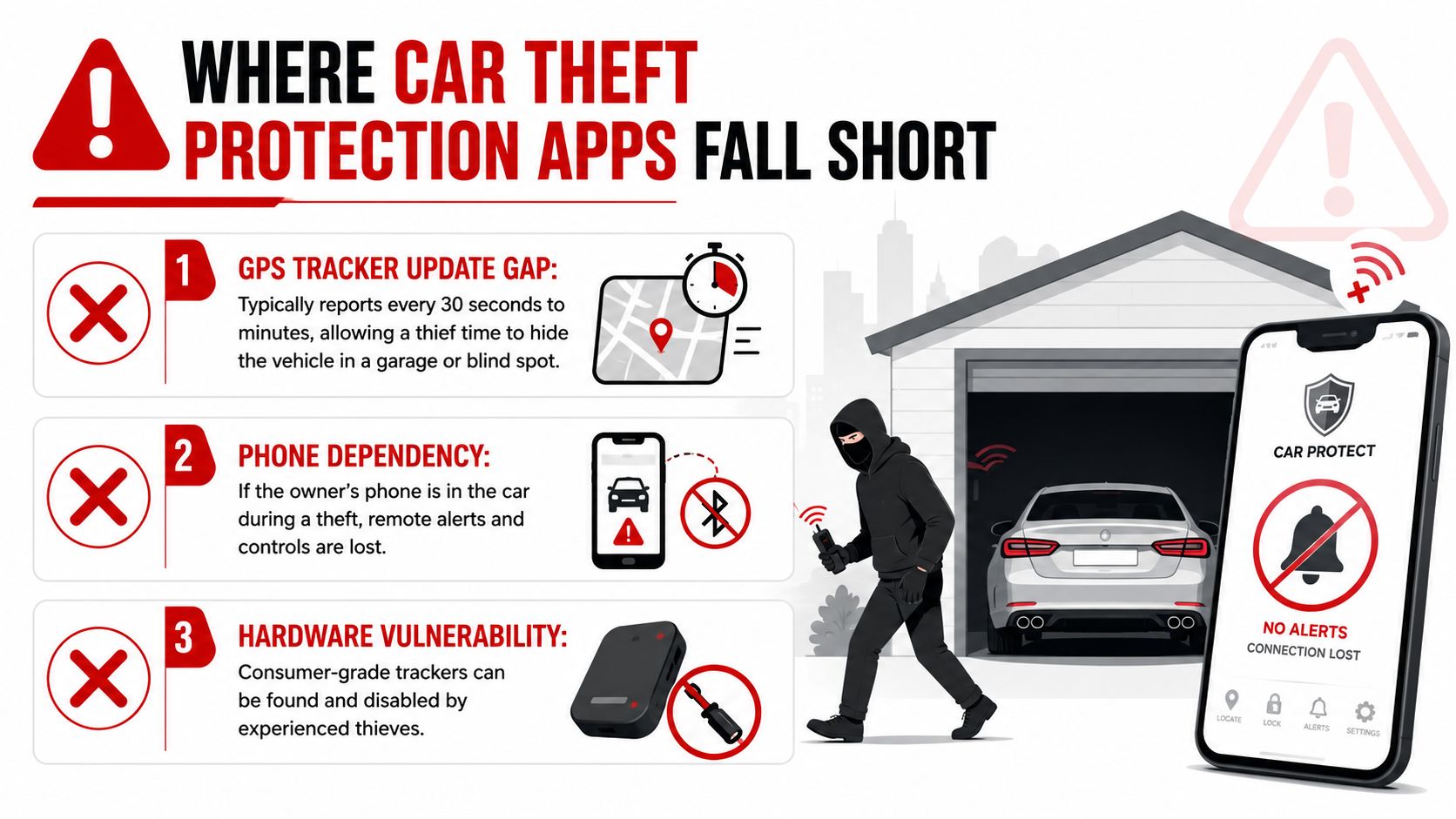
A tracking app doesn't guarantee recovery. It improves visibility, but every part of the chain can fail, from the sensor and power supply to cellular coverage, legal authority, and the owner's notification settings.
Signal and hardware limits
A tracker may report frequently during normal movement and then lose contact inside a metal garage, shipping container, underground structure, or other signal-blocking location. Once the vehicle leaves coverage, the last known coordinate may be all you have until communication resumes.
Portable battery-powered units bring another weakness. Their batteries can run down, and an OBD-II device can be removed quickly if the thief checks under the dashboard. A concealed hardwired system is harder to find, but no installation is impossible to tamper with.
Software maintenance creates a newer risk. UC San Diego reported a vulnerability affecting 2 million dealer-installed anti-theft systems, with the fix delivered through a firmware update in the owner's app, as described in its report on vehicle anti-theft system security. Buyers should ask how vendors deliver security updates and what happens when an owner ignores them.
Permissions and legal boundaries
An owner must configure push notifications correctly. Ford support documentation, discussed in BBC reporting on connected-car tracking limits, shows that theft alerts can depend on notification permissions and that authorized account users may receive them. A silent phone setting can erase the advantage of an otherwise capable system.
Privacy law also affects live recovery. A connected-car app may be intended as a convenience service rather than a certified security tracker, and live stolen-vehicle tracking can face legal restrictions. Track only vehicles you own or are authorized to monitor, and provide police with the theft report and coordinates rather than attempting a private recovery.
Insurance is a separate issue. A useful explanation of comprehensive vs liability coverage for theft can help clarify what a tracker can and can't do for the financial loss. The app supports detection and recovery. It doesn't replace appropriate insurance coverage.
How to Evaluate and Install the Right System
Start with the vehicle's exposure and recovery needs, not the brand name. A car left overnight on a public street needs a different setup from one kept in a locked garage. A personal vehicle, family fleet, and commercial fleet also require different dashboards, user permissions, and alert workflows.
Run the buying audit
Use this order before purchasing:
- Map the parking risk. Record where the vehicle spends time: public streets, garages, work sites, and lots. Review local theft patterns without treating a decline as proof that the risk has disappeared. The FBI recorded a U.S. motor vehicle theft rate of 283.5 incidents per 100,000 people in 2023, compared with 199.4 in 2019. Cars accounted for 78.1% of stolen motor vehicles during 2019 to 2023, according to national data referenced in Canada's auto-theft report.
- Define the vehicle context. Choose the alerts and access controls that match the use case. A parent may need teen-driver reports, a fleet manager may need separate permissions, and an individual owner may need movement, ignition, and tamper alerts only.
- Confirm hardware independence. Select vehicle-connected power, internal backup power, cellular communication, and concealed installation. A tracker that depends entirely on the owner's phone or a nearby stranger's phone cannot provide dependable stolen-vehicle recovery.
- Read subscription terms. Check activation fees, network coverage, roaming rules, cancellation conditions, and which functions stop when service expires.
- Test the signal. Request a live location demonstration from a vehicle parked in the same type of garage or lot you use. A specification sheet cannot establish coverage at your property.
- Verify installation quality. Use a certified 12V installer who can conceal the harness, confirm ignition sensing, and calibrate motion detection during a test drive.
The CarLock car security system information offers a useful reference for comparing alert and installation architecture. Test any system in your own parking environment before depending on it.
Simulate the emergency
Arm the system, open a door, move the vehicle, and disconnect its expected power source under controlled conditions. Confirm that alerts reach the right people, the map displays a usable position, and every authorized user knows the next action.
Recovery depends on reducing the delay between movement, notification, and police response. Treat alerts taking longer than 30 seconds as a serious performance concern. Check phone permissions, cellular coverage, cloud access, and account recovery before deployment.
Final Verdict and Frequently Asked Questions
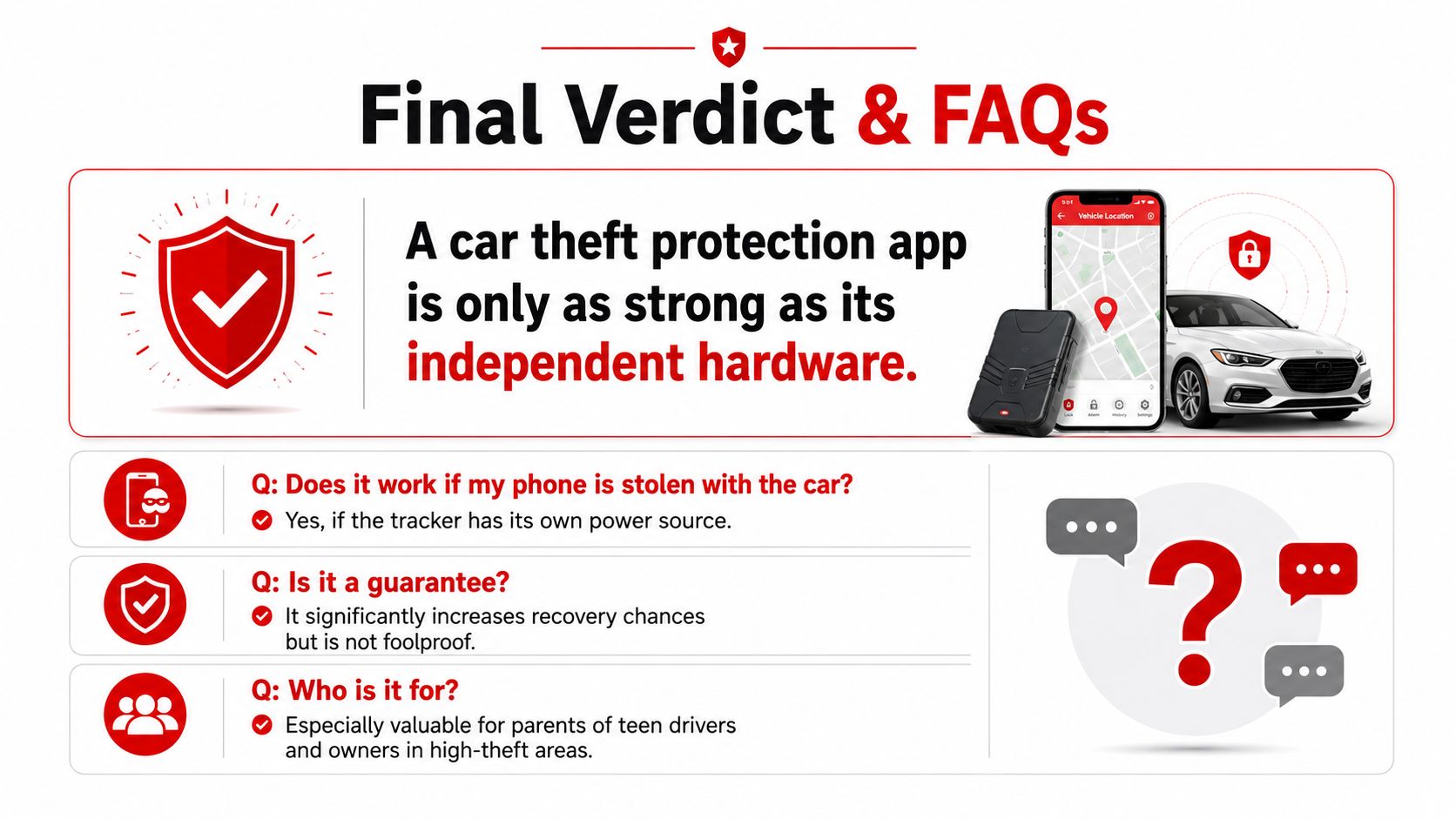
A car theft protection app is only as strong as its independent hardware. For most drivers, especially parents of teen drivers, rideshare operators, and small fleets, a hardwired GPS telematics unit with cellular communication, backup power, and cloud alerts is more credible for recovery than a Bluetooth tag or an exposed plug-in dongle.
Car theft remains a measurable problem even where recent totals have fallen. In the UK, police-recorded vehicle theft reached 129,159 vehicles between April 2023 and March 2024, an average of about 356 vehicles per day, according to the Office for National Statistics vehicle-theft breakdown. The correct response is not panic. It's selecting hardware that can detect movement, survive tampering, and provide usable coordinates quickly.
Common questions
Does it work if my phone is stolen with the car?
Yes, if the tracker has its own vehicle power connection, cellular link, and backup power. You should be able to sign in from another device and access the account.
Is recovery guaranteed?
No. A tracker can improve detection and provide location evidence, but signal loss, tampering, legal restrictions, and police procedures can still affect the outcome.
Who benefits most?
Parents of teen drivers, owners in high-theft areas, small fleets, and anyone who needs immediate movement or tamper alerts gain the clearest value.
Does a Bluetooth tag replace GPS security?
No. It may offer a possible clue after the vehicle stops near a compatible phone, but it doesn't provide dependable continuous vehicle tracking.
Should I expect an insurance discount?
Ask your insurer directly. Any discount depends on the policy, insurer, and approved security equipment. Don't buy a tracker assuming a discount will offset its subscription.
For buyers who want a vehicle-specific system, CARLOCK offers GPS location monitoring, cellular-connected alerts for movement, ignition, vibration, towing, disconnection, and battery issues, plus trip history and driving-behavior information through its app. Visit CARLOCK to review the system, confirm compatibility, and choose installation that keeps the hardware concealed and ready to report when a theft starts.