

Driver’s Desk
GPS Tracker on Car: The Ultimate 2026 Security Guide
A gps tracker on car setup used to be seen as a nice extra. It isn't anymore. In 2023, car thefts in the U.S. reached a record high of over 1.2 million incidents, a 15% increase from 2022, and that surge has pushed the vehicle GPS tracker market from $1.8 billion in 2020 to over $3.2 billion in 2024. Those numbers show two things at once. Theft pressure is rising, and owners are actively looking for better protection.
What's changed isn't just the risk. It's the way theft happens. A loud siren might still startle an amateur, but modern thieves often work fast enough that a basic alarm becomes background noise. If your phone gets an alert the moment your car vibrates, starts unexpectedly, or gets towed, you have a chance to react while the theft is still unfolding. That's a very different outcome from discovering an empty parking spot an hour later.
Why Your Car Needs More Than Just an Alarm
A traditional alarm has one job. It makes noise.
That still has value, but it's a weak answer to a modern problem. With over 1.2 million U.S. car thefts in 2023, up 15% from 2022, and a tracker market that grew from $1.8 billion in 2020 to over $3.2 billion in 2024, the security conversation has moved beyond sirens and blinking lights. Owners now want systems that inform them directly and immediately, not just systems that shout into the street. That shift is visible in the broader rise of GPS security solutions as theft has climbed.
What alarms miss
An alarm is reactive. It usually tells you something already happened.
A real-time tracker adds a second layer. Instead of only making noise near the car, it sends information to the person who can act on it. That matters if your car is parked outside overnight, left at an airport lot, or used by a family member during the day.
If you've ever looked into a car alarm with smarter mobile alerts, you've probably noticed the difference right away. The useful question isn't just “Will it scare someone off?” It's “Will I know what's happening in time to respond?”
A siren alerts the neighborhood. A tracker alerts the owner.
The security shift owners are making
Many drivers still think of theft protection as a single device. In practice, it works better as a chain:
- Deterrence: A visible sign that the car is monitored.
- Detection: A warning when the car is bumped, started, moved, or towed.
- Location: A live position if the vehicle leaves.
- Evidence: Trip history and event logs that help explain what happened.
That's why a gps tracker on car systems have become part of everyday security planning. They don't replace common sense, and they don't make theft impossible. What they do is reduce your blind spot. Instead of waiting to discover a loss, you get a chance to intervene while the situation is still developing.
How GPS and Cellular Trackers Pinpoint Your Car
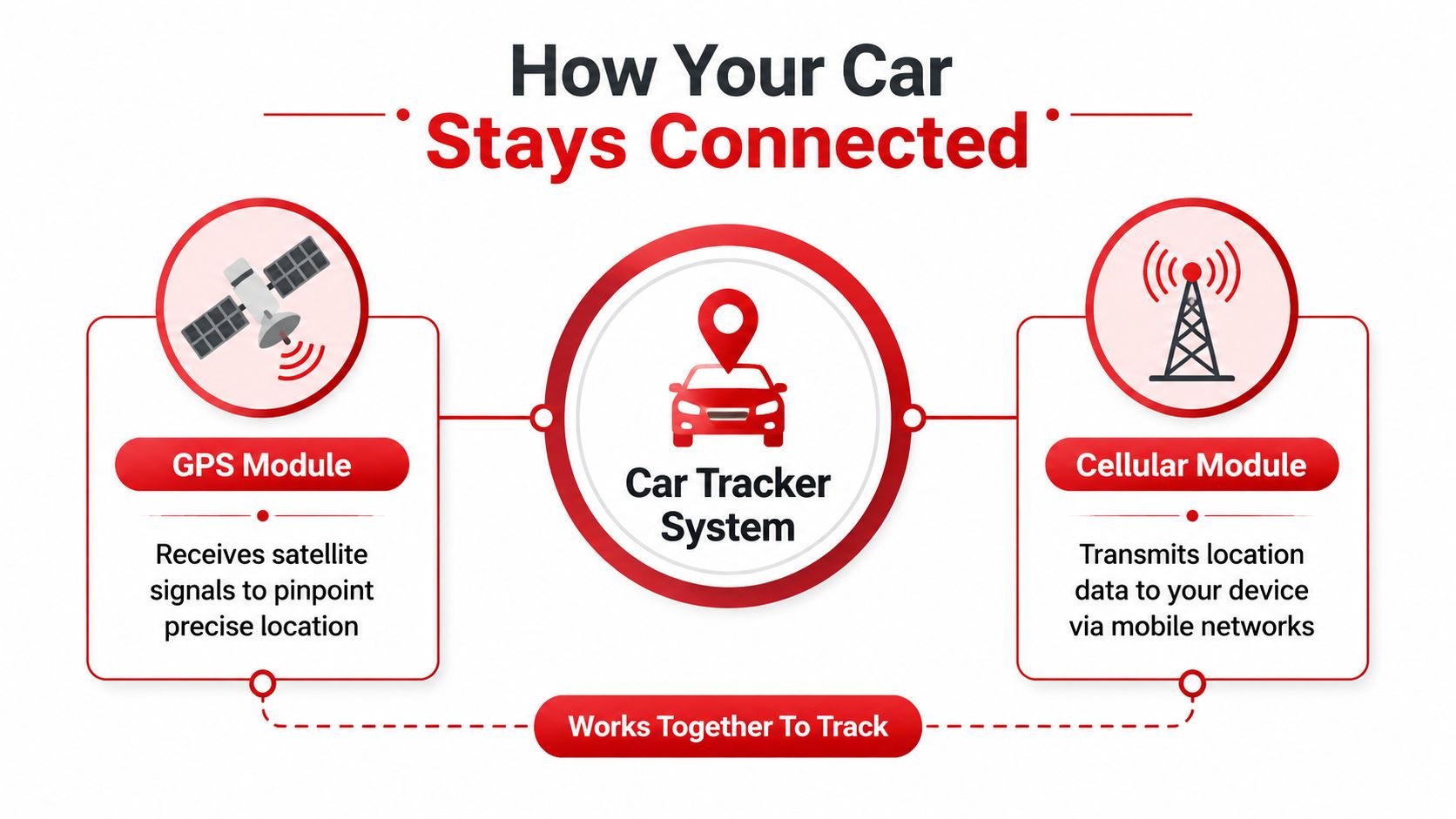
The easiest way to understand a vehicle tracker is to think of it as a two-part system.
The GPS side figures out where the car is. The cellular side sends that location to your app. If either half is missing, the system becomes much less useful.
GPS is the locator
GPS doesn't use the internet to know where your car is. It listens to satellite signals and calculates position from them. Modern hardwired vehicle trackers often go beyond standard GPS and use multiple satellite constellations, including GPS, GLONASS, and often Galileo, to achieve positioning accuracy within 2–5 meters, even in harder environments like underground garages or dense city areas, according to the vehicle tracking system overview on Wikipedia.
That multi-constellation approach matters because cities can confuse weaker systems. Tall buildings bounce signals. Parking structures block parts of the sky. A stronger GNSS receiver has more ways to lock onto a location.
Cellular is the messenger
Knowing the location inside the tracker isn't enough. The device still has to deliver that information to you.
That's where cellular service comes in. A proper car tracker uses a mobile network connection to transmit the car's position, movement alerts, and trip history to your phone. Without that connection, you don't get true remote monitoring.
A useful way to frame it is this:
| Component | What it does | Why it matters |
|---|---|---|
| GPS or GNSS module | Calculates the vehicle's position | Tells the tracker where the car is |
| Cellular module | Sends data to the app or dashboard | Lets you see alerts and live location anywhere |
For drivers who want remote monitoring rather than just local logging, a dedicated car locator shows why both pieces have to work together.
Practical rule: If a device can't determine location on its own and transmit it on its own, it isn't a full vehicle security tracker.
Why this matters in real life
If your vehicle is moved at night, the tracker first determines its position through GNSS. Then it pushes that event over the cellular network so your phone can notify you. That's what makes real-time security possible.
This is also where many buyers get confused. They assume “GPS tracker” means the whole job is done by satellites. It isn't. Satellites help the device know. Cellular helps the device tell you. Once you separate those two functions, the technology becomes much easier to evaluate.
Choosing Your Tracker Hardwired OBD or Battery
Most buyers don't struggle with the idea of tracking. They struggle with the hardware choice.
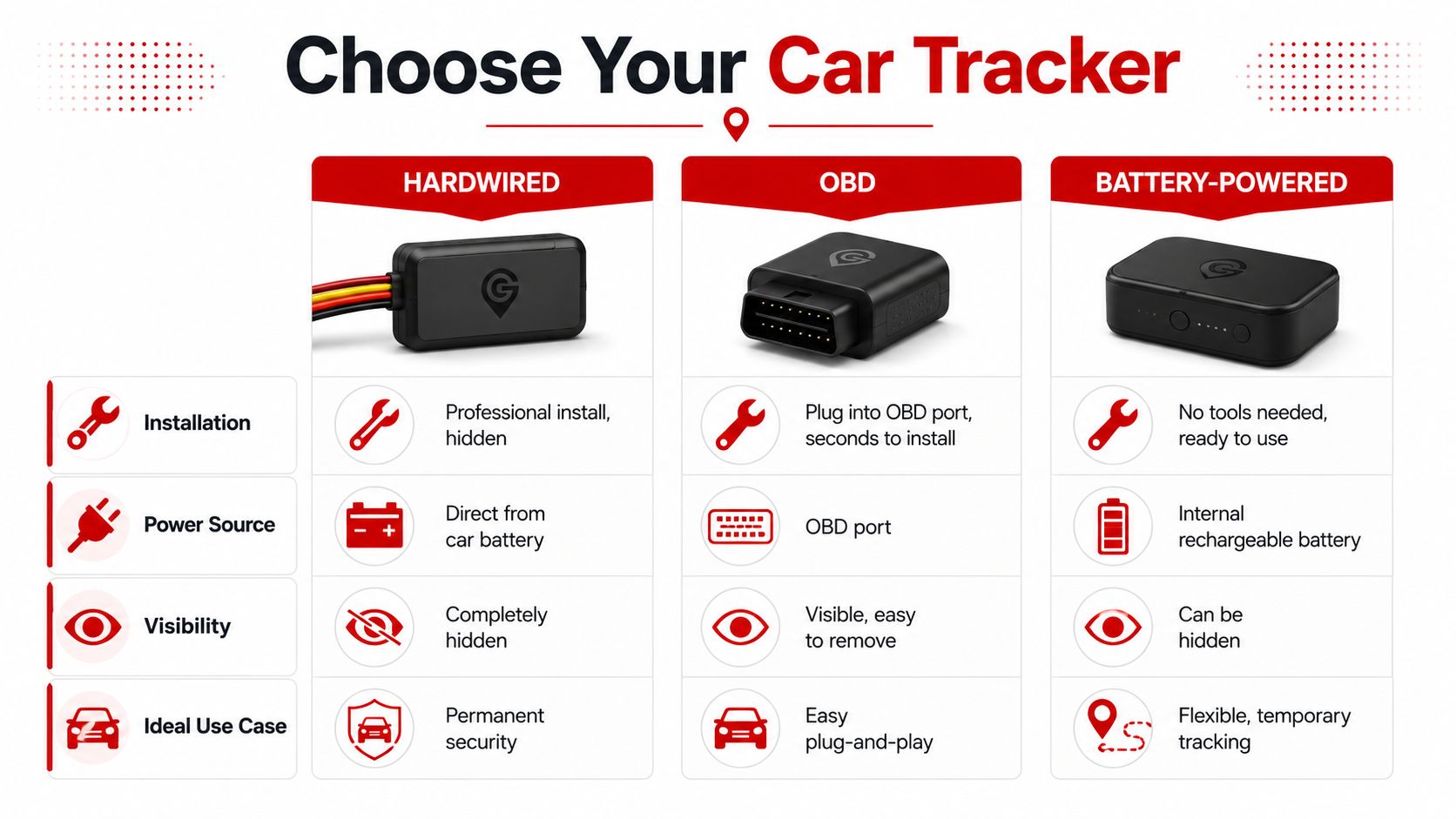
The three main options are hardwired, OBD, and battery-powered trackers. Each solves a different problem. The right fit depends on how much stealth, convenience, and maintenance you're willing to accept.
Hardwired trackers
A hardwired unit connects directly into the vehicle's electrical system. That makes it a strong choice for owners who want a permanent installation and a device that stays out of sight.
Its biggest advantage is concealment. When installed well, it's harder for a thief or unauthorized driver to notice. Its main drawback is installation complexity. Many owners will want professional help.
OBD trackers
An OBD tracker plugs into the onboard diagnostics port, usually under the dashboard. It's fast to install, easy to move between compatible vehicles, and draws power from the car without relying on a separate rechargeable battery.
Many guides still present wired systems as the only serious option, but that misses a practical shift in the market. As noted in this guide to hidden car GPS tracker setup, plug-and-play OBD units can operate in 24/7 monitoring mode without draining the car battery, and advanced models can alert the owner if they're unplugged.
That unplugging concern is the main objection people raise. It's a fair one. If the device can be removed, you want to know immediately.
A feature-focused OBD car tracker device addresses that problem by pairing easy installation with tamper awareness. That combination is why OBD trackers often make sense for personal cars, teen-driver monitoring, and small fleets.
Battery-powered trackers
Battery-powered models are flexible. You don't need access to the OBD port or wiring harness, and you can place them more freely.
But that flexibility comes with tradeoffs. You have to manage charging. The device can be removed more easily. And if it runs out of power, your security layer fails unannounced, which is the worst time to discover a battery problem.
A side-by-side view
| Tracker type | Installation | Power source | Visibility | Best fit |
|---|---|---|---|---|
| Hardwired | More involved | Vehicle electrical system | Usually well hidden | Long-term permanent security |
| OBD | Plug-and-play | OBD port power | More visible unless shielded by placement | Everyday drivers who want easy setup |
| Battery-powered | Flexible placement | Internal battery | Can be hidden, but easier to remove | Temporary or supplemental tracking |
How to choose without overthinking it
Use this quick filter:
- Choose hardwired if you want a more covert setup and don't mind installation work.
- Choose OBD if you want fast setup, continuous power, and app-based alerts with minimal hassle.
- Choose battery-powered if portability matters more than permanence.
If your first question is “Will I actually install this and keep it active?”, an OBD model is often the practical answer.
That's the critical decision point. A perfect tracker that never gets installed protects nothing. A slightly less hidden unit that sends reliable alerts every day is often the better security outcome.
GPS Trackers vs Bluetooth Item Finders
A lot of people try to solve a vehicle security problem with a device built for lost backpacks.
That's the core mistake.
A Bluetooth item finder can help you locate keys left in a couch or a bag left at a café. It isn't the same thing as a true car tracker, because it doesn't independently monitor and transmit a vehicle's location over distance.
Where Bluetooth works
Bluetooth tags are useful when the item is nearby or when another compatible device passes close enough to detect it. For everyday misplaced objects, that can be enough.
If your goal is “Did I leave my wallet at home?” a Bluetooth finder makes sense.
Where Bluetooth breaks down
A stolen car creates a very different scenario. It may be parked in a warehouse, left in a remote lot, hidden in a shipping container, or moved through an area with no nearby participating phones. In those situations, the weakness of Bluetooth becomes obvious. The tag is waiting for help from someone else's device.
A real gps tracker on car setups doesn't depend on that. It uses satellite positioning and cellular communication to report independently. That's what makes it viable when the car is moved far away, hidden out of sight, or parked somewhere isolated.
If you're comparing dedicated security gear with item finders, this breakdown of GPS tracker features versus tags is the distinction to focus on.
A simple comparison
- Bluetooth finder: Good for lost personal items nearby.
- GPS plus cellular tracker: Built for remote vehicle monitoring and theft response.
Use Bluetooth for misplaced keys. Use a real tracker for a car you might need to find under pressure.
That line sounds simple because it is. The confusion comes from marketing, not function. A cheap tag may look like a shortcut, but vehicle security is the wrong place to learn the limits of a shortcut.
Features That Actively Prevent Vehicle Theft
The most important feature in a vehicle tracker usually isn't the map.
It's the alert that arrives before the car is gone.
Many people shop for trackers by asking, “Can I recover my vehicle later?” That matters. But the better question is, “Will I know about the theft attempt while it's still happening?” A tracker becomes far more valuable when it helps you intervene during the preparation phase, not just after the disappearance.
Alerts that create a reaction window
According to BrickHouse Security's discussion of theft prevention trackers, GPS trackers may deliver 90% recovery rates, but the strategic edge comes from instant vibration and tamper alerts, because they let owners respond during the setup phase of a theft. That matters because 60% of non-tracked stolen vehicles are never recovered.
Those early warnings can include:
- Vibration alerts: Useful when someone bumps the car, breaks glass, or starts loading it onto a tow truck.
- Engine start notifications: Helpful if the vehicle starts when you know nobody should be using it.
- Movement alerts: Critical when the car begins rolling unexpectedly.
- Tamper or disconnect alerts: Important if someone tries to disable the tracker itself.
That's the gap many articles miss. Recovery is the safety net. Prevention starts with attention.
Why instant alerts beat delayed discovery
If your phone buzzes because the car moved at 2:14 a.m., you can check the app, call the police, contact a neighbor, or verify whether an authorized driver took it. If you discover the theft at 7:30 a.m., your options are narrower.
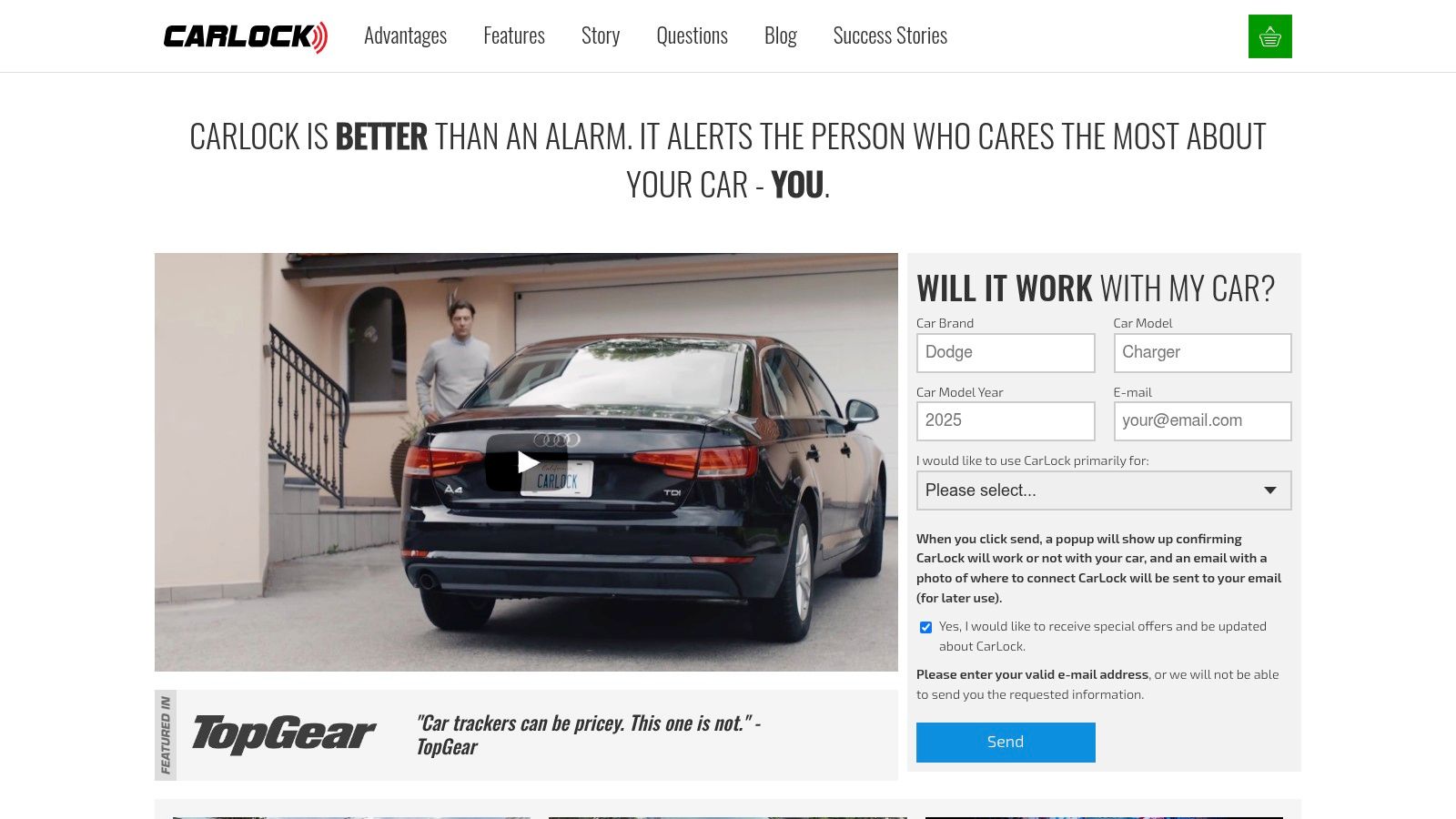
Systems like CARLOCK are pertinent examples. It's a real-time GPS and smart car security system that can alert the owner to unauthorized movement, engine starts, unusual vibration or towing activity, disconnect attempts, and battery issues through a smartphone app. Those functions matter because they turn the tracker from a passive map into an active warning system.
Other features that matter after the alert
A good theft-prevention setup also helps with day-to-day oversight. Look for functions like:
- Geofencing: Set a permitted area and get notified when the vehicle leaves it.
- Trip history: Review where the car went and when.
- Driver behavior monitoring: Spot harsh braking, rapid acceleration, or aggressive cornering.
- Battery monitoring: Know when the car battery is low or draining abnormally.
These aren't just fleet features. Parents use them with teen drivers. Small business owners use them with work vehicles. Everyday drivers use them when a car is parked for long stretches or left with a mechanic.
The most useful alert is often the first one, not the final location ping.
Costs Legality and Privacy Considerations
A vehicle tracker usually has two costs. The device itself, and the ongoing subscription.
That subscription sometimes surprises buyers, especially if they're comparing a real car tracker with a one-time-purchase item finder. But the monthly fee isn't arbitrary. It typically pays for the mobile data connection and cloud service that allow the tracker to send alerts, store trips, and report location in real time.
Why subscriptions exist
If a device needs cellular service to communicate, there has to be an active service layer behind it. That's what turns the hardware from a silent box into a live security system.
A no-subscription option can sound appealing until you ask a more important question: how will the device send data to your phone when the car is far away? For many owners, paying a recurring fee is less about “extra features” and more about keeping the communication path open every day.
Legal use depends on whose vehicle it is
Tracking your own vehicle is generally the straightforward case.
Things get more sensitive when the car is shared, assigned to an employee, or driven by a spouse, partner, or teenage child. Laws vary by location, and consent rules can differ depending on the relationship and use case. If there's any ambiguity, check local legal requirements before installing any monitoring device.
A practical rule is simple. Ownership and legitimate operational need matter. Secret tracking of another person's movements can raise legal and ethical problems very quickly.
Privacy matters as much as security
A tracker collects location history, event logs, and usage patterns. That information is sensitive. Buyers should pay attention to app security, account controls, and how the company handles data.
Before signing up, review the company's privacy policy and data handling approach. The point isn't to become a privacy lawyer. It's to confirm that the service treats location data as something that needs protection, not as an afterthought.
Security tools protect your vehicle. They should also protect your information.
Your Next Step to Total Car Security
A useful tracker does three jobs well. It knows where the vehicle is, it communicates that information reliably, and it alerts you fast enough to matter.
The last point is where many buying decisions go wrong. People focus on the map and overlook the event feed. But in real life, the value of a gps tracker on car systems often comes from the first notification that tells you something unusual is happening.
A simple buyer checklist
Use this checklist when comparing options:
- True GPS or GNSS tracking: The device should determine real vehicle location, not rely on nearby phones.
- Cellular connectivity: It should send alerts and location data remotely.
- Real-time suspicious activity alerts: Look for movement, vibration, engine-start, and tamper notifications.
- Continuous power strategy: Make sure the unit won't cease protecting the vehicle because it ran out of charge.
- Trip history and geofencing: Useful for family vehicles and business oversight.
- Clear privacy terms: Your location data should be handled responsibly.
The outcome that matters
Studies show that vehicles with functioning GPS tracking systems are recovered at approximately 90% or higher, compared with less than 40% for vehicles without such devices, turning what might have been a total loss into a recoverable incident.
That statistic is reassuring, but the stronger position is not having to rely on recovery alone. The right system gives you awareness before, during, and after a suspicious event. That's how you move from hoping your car is still there to knowing what's happening with it in real time.
If you want a practical next step, explore CARLOCK as a real-time vehicle security option. Look closely at its GPS tracking, cellular alerts, movement and engine-start notifications, tamper detection, trip history, and app-based monitoring so you can decide whether it matches how you use and protect your car.