

Driver’s Desk
Gps Tracker With Audio: The Ultimate Car Security Guide – gps tracker with audio
We’ve all imagined it—that heart-stopping moment you walk back to your parking spot and find it empty. That sinking feeling is a nightmare, and unfortunately, traditional car alarms are becoming less and less effective at preventing it. A GPS tracker with audio steps in where old technology fails, giving you a powerful combination of real-time location and live sound—it's like having eyes and ears on your car, 24/7.
Why Old Car Alarms Are No Longer Enough

Let's be factual: when was the last time you saw someone rush to check on a car just because its alarm was blaring? In most urban environments, it's dismissed as background noise. Thieves know this all too well and can often disable a factory alarm in seconds, drawing almost no attention. According to police data, car alarms are so frequently ignored that their effectiveness as a standalone deterrent has plummeted.
The truth is, this outdated tech is no match for today's car thieves. They use sophisticated methods like relay attacks, where a device captures your key fob’s signal from a distance to unlock and start your car without making a sound. The alarm never has a chance to go off, which is why a more active, data-driven security strategy is so critical.
The Stark Reality of Vehicle Theft
The numbers don't lie. Vehicle theft is a massive, ongoing problem for car owners globally. According to the FBI's latest data, over 1 million vehicles were stolen in the United States in 2022 alone, costing owners over $8.9 billion. That figure translates to a car being stolen roughly every 32 seconds. This grim reality is pushing more and more people toward advanced security tools that do more than just make noise.
The Dual Power of Location and Sound
This is where a GPS tracker with audio really changes the game. It’s not just a passive noisemaker; it’s an active intelligence-gathering tool. Instead of simply getting a vague alert that something might be wrong, you get two vital streams of information:
- Real-Time Location: You can instantly pinpoint your vehicle's exact location on a map, giving law enforcement the critical head start they need for recovery.
- Audio Monitoring: You can listen in to what's happening inside your car. This helps you confirm if it's a genuine theft, gather potential evidence, or simply understand the context of an alert.
Think of it this way: a traditional car alarm is like a doorbell that everyone on the street has learned to ignore. A GPS tracker with audio, on the other hand, is like getting a live security camera feed with sound sent straight to your phone. You get immediate, actionable information that could be the difference between getting your car back and losing it for good.
This blend of "sight" (location tracking) and sound provides a security advantage that older systems simply can't offer. If you want to dive deeper into the technical limitations, you can learn more about how car alarms operate and see exactly why they often fall short in today’s world.
How GPS Trackers With Audio Actually Work
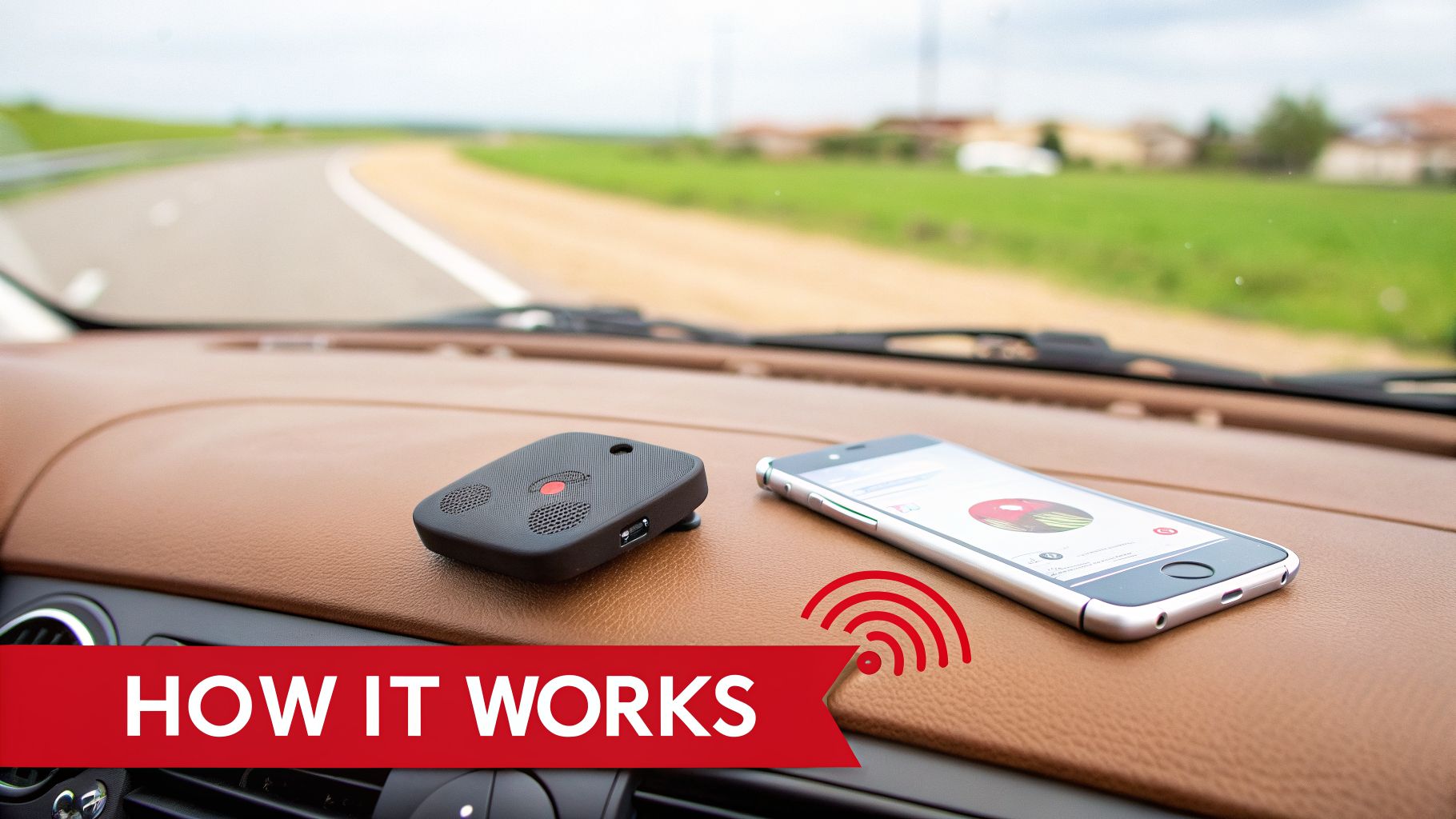
The easiest way to understand a GPS tracker with audio is to think of it as a dedicated, single-purpose smartphone for your car. But instead of letting you check social media, its one and only job is to be your eyes and ears on the ground, blending precise location data with live sound.
This little gadget is a powerful combination of three key technologies, all packed into a tiny, discreet box. It's this trio working in concert that gives you a direct line to your vehicle, no matter where you are.
The Three Core Components
So, what's actually inside one of these devices? It’s not magic, just a clever fusion of established hardware. Once you understand the parts, you'll see how elegantly simple the system really is.
GPS Module: This is what answers the "where." The module constantly communicates with a network of satellites orbiting the Earth to calculate its precise location. High-quality trackers use this to pinpoint your vehicle's coordinates, often with an accuracy of within 5 meters, even in dense urban canyons.
GSM Module: This component answers the "how." It functions just like a cell phone, complete with its own SIM card. Using modern 4G or even 5G cellular networks, it acts as the messenger, transmitting all the location data—and audio—from your car straight to the app on your phone.
Microphone: And this is the "what." A tiny but sensitive microphone is built right into the unit to pick up sounds from inside the car's cabin. The quality of this part makes all the difference in whether you hear muffled noise or a clear, discernible conversation.
Think of it like a team: The GPS module finds the spot on the map, the microphone listens in, and the GSM module calls you up to report what's happening. It’s a complete, self-contained security system in your pocket.
Live Streaming vs. Triggered Recording
Now, not all audio trackers behave the same way. The method they use to capture sound is a major distinction, affecting everything from battery life and data consumption to how you use the device in an emergency. There are two main approaches here.
Live audio streaming is exactly what it sounds like. You can essentially "call" your tracker and listen in to your vehicle’s interior in real time. It’s like having an open phone line directly to your car, giving you immediate situational awareness if you suspect a break-in or want to check on a driver.
On the other hand, triggered audio recording is more automated. The device listens for specific events—like the shock of breaking glass, a loud bang, or the vibration of a door being forced open. When it detects one, it automatically records a short 10-30 second audio clip and sends it to you along with the alert. This is incredibly useful for gathering evidence after the fact without you having to be on high alert 24/7.
The Legal Side of Listening In: What You Need to Know
A GPS tracker with audio can be a game-changer for security, but it also opens a complex area of legal and privacy issues. Before installing one, it is imperative to understand the laws around audio recording. It all comes down to the legal concept of a "reasonable expectation of privacy," which exists even inside a vehicle you own.
Even though it’s your vehicle, anyone borrowing it—your children, a friend, an employee—has a right to believe their private conversations are just that: private. Secretly recording them could result in significant legal consequences. Knowing the rules isn't just a good idea; it's your best protection.
One-Party vs. Two-Party Consent: A State-by-State Puzzle
There’s no single federal law that governs audio recording consent in the U.S. Instead, it’s a patchwork of state laws that generally fall into one of two categories: one-party consent or two-party (often called all-party) consent.
One-Party Consent: In these states (currently 38 states and D.C.), you only need permission from one person in the conversation to legally record. Since you own the car, you can typically be that "one party" and record audio for security purposes, even when you're not present.
Two-Party (All-Party) Consent: This is where things get much stricter. In states like California, Florida, and Pennsylvania (currently 12 states), you need permission from everyone involved in a conversation before you can record it. If you’re using a tracker with audio in one of these locations, you are legally required to inform anyone in the car that they might be recorded.
To make this clearer, here is a general breakdown of how states approach recording consent.
Audio Recording Consent Laws in the U.S. (State Overview)
This table provides a general overview of one-party versus two-party (all-party) consent states for audio recording. This is for informational purposes and is not a substitute for legal advice. Laws can change, so always verify current local regulations.
| Consent Type | Description | Example States |
|---|---|---|
| One-Party Consent | Only one person involved in the conversation needs to consent to the recording. The majority of U.S. states follow this rule. | New York, Texas, Ohio, Georgia, North Carolina |
| Two-Party / All-Party Consent | Every person in the conversation must consent to being recorded. Failure to get consent can result in legal penalties. | California, Florida, Pennsylvania, Illinois, Massachusetts |
Remember, this isn't an exhaustive list. Some states have specific nuances, so think of this as a starting point for your own research, not the final word.
Guidelines for Staying on the Right Side of the Law
Want to use your device responsibly and keep yourself out of legal trouble? Follow these guidelines. They'll help you boost your car's security without crossing any legal or ethical lines.
Check Your Local Laws First. State and even city laws can change. What you read online might be outdated. Before you do anything, check the current, official statutes for your specific area. This guide is a great start, but it's no substitute for proper legal verification.
Focus on Security, Not Spying. The most legally sound reason to use a tracker with audio is to protect your property. Your goal is to capture evidence if your car is stolen, not to eavesdrop on your teenager's conversations. Keeping your intent focused on asset protection is key.
Tell People They're Being Recorded. This is the critical step. If anyone else drives your car, you must inform them that an audio recording device is active. This is absolutely mandatory in all-party consent states, but it is a best practice everywhere. A simple sticker on the dashboard or a clear conversation is all it takes.
The bottom line is simple: your goal should always be theft prevention and recovery, not surveillance. When you stick to that principle, you can use these powerful tools both effectively and ethically.
For a deeper dive into the legal nuances, you can read our detailed guide on car tracking and legal considerations to make sure you're always fully compliant.
Putting Audio Tracking Into Real-World Action
The real value of a GPS tracker with audio isn't about the tech specs on a feature list; it’s about what happens in a real-world crisis. Features on paper don't mean much until they're put to the test. So, how does combining location data with sound actually give car owners a real security advantage?
For a private car owner, the scenario is incredibly powerful. Imagine you get a quiet notification on your phone from your car. Instead of just seeing a pin on a map and wondering what’s happening, you can activate the live audio feed. Suddenly, you hear two voices inside your car discussing their route. This isn't just a generic alert; it's live intelligence that you can relay directly to the police, giving them a huge upper hand for a fast and safe recovery.
For a fleet manager, the use cases are just as critical. Let's say a driver radios in an emergency from a remote job site. Rather than trying to piece together a story from a frantic, unclear description, you can listen in yourself. This lets you instantly verify the threat and dispatch the right kind of help. It’s also a straightforward way to confirm if an employee is bringing unauthorized passengers along after hours, protecting company assets and ensuring policy adherence.
Protecting Your Most Precious Cargo
Parents of new teen drivers often see a different, but equally important, value in audio capabilities. The goal here isn't about spying—it's about adding another layer of safety and gaining some much-needed peace of mind. According to NHTSA data, teen drivers are nearly three times more likely than drivers aged 20 and over to be in a fatal crash. A GPS tracker that flags harsh driving or an engine starting at an odd hour, paired with the option to listen in if something seems wrong, can be a powerful tool for reinforcing responsible habits.
Before you can use these features, though, you have to understand the law. This chart shows the critical differences in audio recording consent laws across the United States.
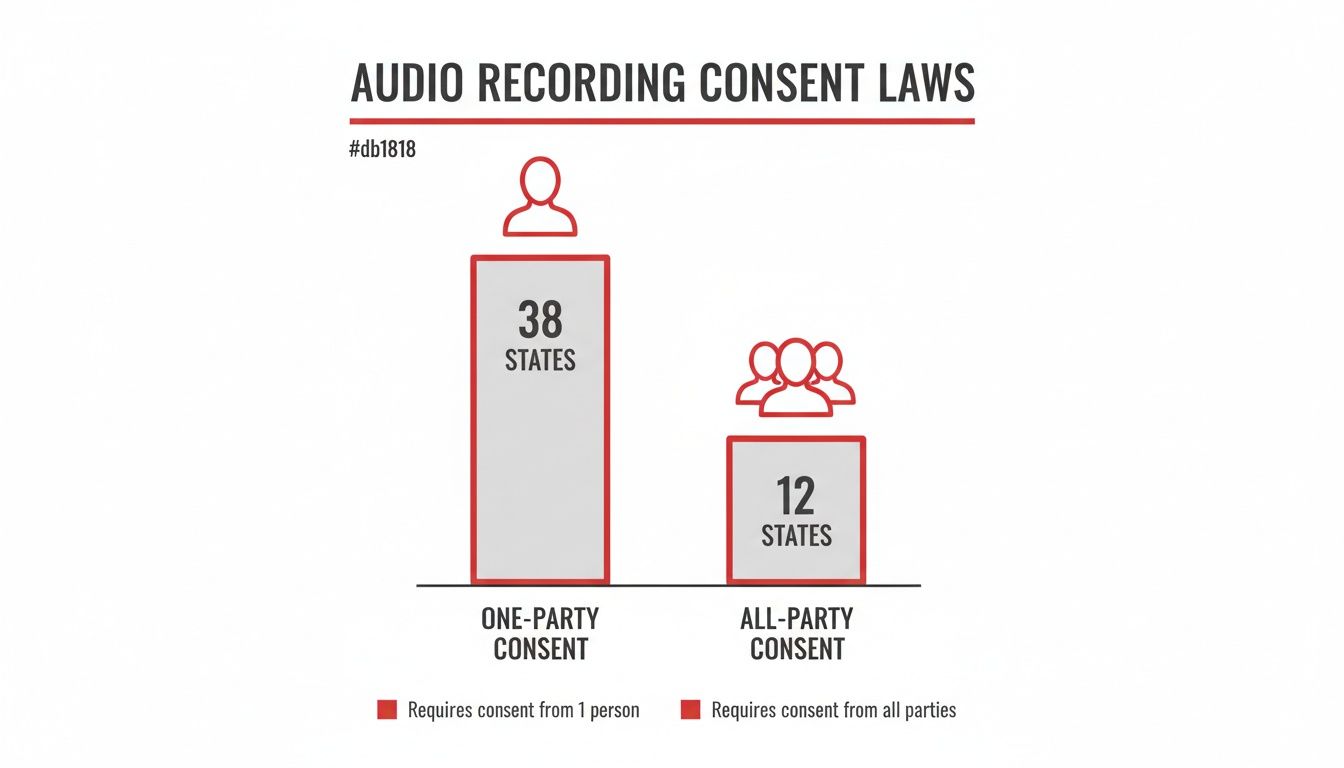
As you can see, most states only require one person in the conversation to consent to the recording. However, a significant number of states require everyone to be aware of it, which is why checking your local laws is an absolute must.
From Alerts to Actionable Evidence
When you combine precise GPS location with audio, you create an incredibly effective tool for recovering stolen vehicles and reducing associated costs. For instance, fleet operators have been documented to reduce operational costs by 15-20% using real-time tracking, as noted in the GPS tracking device market report on Fortunebusinessinsights.com. When you add smart alerts to the mix, the results get even better. Advanced systems like CarLock, for instance, play a direct role in helping recover vehicles in 60% of theft cases within the first 24 hours. That's a significant figure when you consider that global vehicle theft recovery rates often struggle to surpass 40%.
In a theft, having audio evidence completely changes the dynamic. You're no longer just dealing with a location ping on a map. You have undeniable proof of a crime in progress, which can turn a complex insurance dispute into a clear-cut case for law enforcement.
This ability to provide hard evidence is really what sets a GPS tracker with audio apart from standard trackers. A location pin shows where your car is, but hearing the thieves' voices proves why it’s there and what's happening. That context is invaluable for the police and can dramatically speed up the entire recovery process. By understanding how these tools work, you can significantly improve your odds of a positive outcome. You can take a closer look at our approach to advanced car tracking to see how it all comes together to protect your vehicle.
Choosing the Right Device for Your Car
With so many GPS trackers on the market, it’s easy to feel overwhelmed. The trick is to cut through the marketing noise and focus on what you actually need. It really comes down to matching a device's features to your specific security concerns, your budget, and what you’re comfortable with legally.
Here at CarLock, we made a conscious choice to focus purely on immediate theft prevention and driver monitoring. Our system is engineered to give you instant, actionable alerts for the things that matter most—like an engine start, unexpected vibrations, or your car being moved when it shouldn't be. We intentionally decided against including live audio monitoring to protect our users' privacy and steer clear of the legal complexities surrounding audio recording.
This deliberate focus lets us deliver a rock-solid security solution without asking you to navigate a legal minefield. You can see how we deliver peace of mind through smart, non-intrusive monitoring by checking out CarLock's full feature set.
A Checklist for Evaluating Trackers With Audio
If you’ve weighed the pros and cons and decided a GPS tracker with audio is what you need, it's crucial to do your homework. The market for these devices is booming, driven by everything from personal security to commercial fleet management. In fact, projections show the vehicle tracker market is on track to hit a staggering $9.59 billion by 2034. With that much growth comes a lot of options—some good, some not so good. You can get more details by reading the full GPS tracker market analysis from Coherent Market Insights.
Before you buy, run any potential device through this simple checklist:
- Audio Clarity: Can you actually make out what’s being said? If possible, ask for a demo or find reviews that talk specifically about the microphone's quality. Muffled, useless audio won't help you in a real emergency.
- Subscription Costs: Don't forget the recurring fees. Almost every GPS tracker requires a cellular data plan to function, so factor that monthly or yearly cost into the total price. It adds up.
- Battery Performance: How long does it really last? For any tracker that isn't hardwired, you need to know its battery life, both when the car is running and its standby time. A tracker with a dead battery is just a plastic box.
- Installation Type: How is it installed? You’ve got simple plug-and-play OBD devices, portable battery-powered units, and stealthy hardwired trackers. Each one serves a different purpose.
Comparing GPS Tracker Types
Choosing the right tracker depends on your specific needs for security, stealth, and ease of use. This table compares the most common types available.
| Tracker Type | Best For | Installation | Power Source | Common Features |
|---|---|---|---|---|
| OBD-II Port | Ease of use and quick setup in modern cars. | Plug-and-play, takes seconds. | Vehicle's battery (via OBD port). | Location, speed, engine alerts. |
| Hardwired | Discreet, permanent installation for maximum security. | Professional installation recommended. | Directly wired to the car's battery. | Most secure, tamper alerts. |
| Battery-Powered | Portability and use in various assets or older cars. | Place anywhere (magnetic case). | Rechargeable internal battery. | Flexible placement, requires charging. |
At the end of the day, whether you go for a complex device with all the bells and whistles or a streamlined security-first system like CarLock, the goal is the same: protecting your vehicle. By making an informed choice, you'll gain the confidence that comes from knowing your car is truly secure.
Answering Your Top Questions
When you start researching a GPS tracker with audio, it's only natural for a lot of practical questions to pop up. Getting straight, factual answers is the only way to feel confident you're making the right choice for your car's security. Let's walk through some of the most common questions we hear from drivers.
Figuring out these real-world details—from how it’s powered to whether a thief can find it—is how you match the right device to your needs. It's all about making sure the tech actually solves the problem you're worried about.
How Is a GPS Tracker With Audio Powered?
How a tracker gets its power is a critical factor. It directly affects the device's reliability and, just as importantly, its installation method. Most trackers use one of three power sources, each with distinct pros and cons.
OBD-II Port: This is by far the easiest method. You simply plug the tracker into your car’s On-Board Diagnostics port, which is standard on all cars made since 1996 and is usually located under the dashboard. It draws a steady stream of power from your car's battery and takes literally seconds to install.
Hardwiring: For a stealthier, more permanent solution, a tracker can be hardwired into your car's electrical system. This approach ensures it's always powered on and makes it much more difficult for a thief to locate and remove.
Rechargeable Battery: Some trackers are completely self-contained, running on their own internal lithium-ion batteries. This gives you total freedom to hide them almost anywhere inside your vehicle. The trade-off, of course, is that you have to remember to remove and recharge them periodically to maintain functionality.
Can Someone Find a Hidden GPS Audio Tracker?
Let's be blunt: yes, a determined professional with the right equipment can eventually find almost any electronic device. Bug sweeping services use RF (Radio Frequency) detectors specifically designed to sniff out transmitting signals from devices like GPS trackers. But whether they actually find it comes down to two things: the tracker's design and its placement.
A simple OBD plug-in device is obviously the easiest to spot, since it's in a standard, easy-to-reach location. A hardwired tracker that’s been professionally installed deep inside the dashboard, behind interior panels, or within the engine bay? That’s a whole different story. Finding it requires an invasive and time-consuming search that most thieves just won't attempt.
The real goal of a hidden tracker isn't to be invisible forever. It's to stay hidden long enough for you to take action. Even if a thief finds it later, the instant alerts it sent in those first critical minutes are what lead to a successful recovery.
If you have more specific questions about different devices or installation methods, we've put together a resource page with more answers about GPS car trackers to help you out.
What Is the Difference Between Live Audio and Recorded Clips?
This is a key distinction because it changes how you can use the device when something happens. They serve two very different purposes.
Live audio is essentially like having a one-way phone call into your car's cabin. You can open your app and listen in on what's happening in real time. This is incredibly useful for confirming if a break-in is actually in progress or for checking on a driver if there’s been an emergency.
Recorded clips, on the other hand, are short, automatic audio files. The tracker is programmed to listen for specific "trigger" events—like the jolt of an impact, a door being opened, or a loud noise. When one of these triggers is detected, the device automatically records a short snippet of sound (usually 10-30 seconds) and sends it to you along with the alert, giving you a piece of evidence of what just happened.
For drivers who want powerful, no-nonsense security without the legal gray areas of audio recording, CarLock is a fantastic alternative. Our system is laser-focused on giving you immediate, actionable alerts for the things that truly matter—unexpected engine starts, vibrations, and vehicle movement—so you can respond instantly. See how CarLock provides complete peace of mind at https://www.carlock.co.