


Driver’s Desk
How to Be a Good Driver: A 2026 Safety Guide
Passing a driving test proves that you can operate a car at a basic level. It doesn't prove that you can manage risk in traffic, stay calm under pressure, or make disciplined choices when conditions change fast.
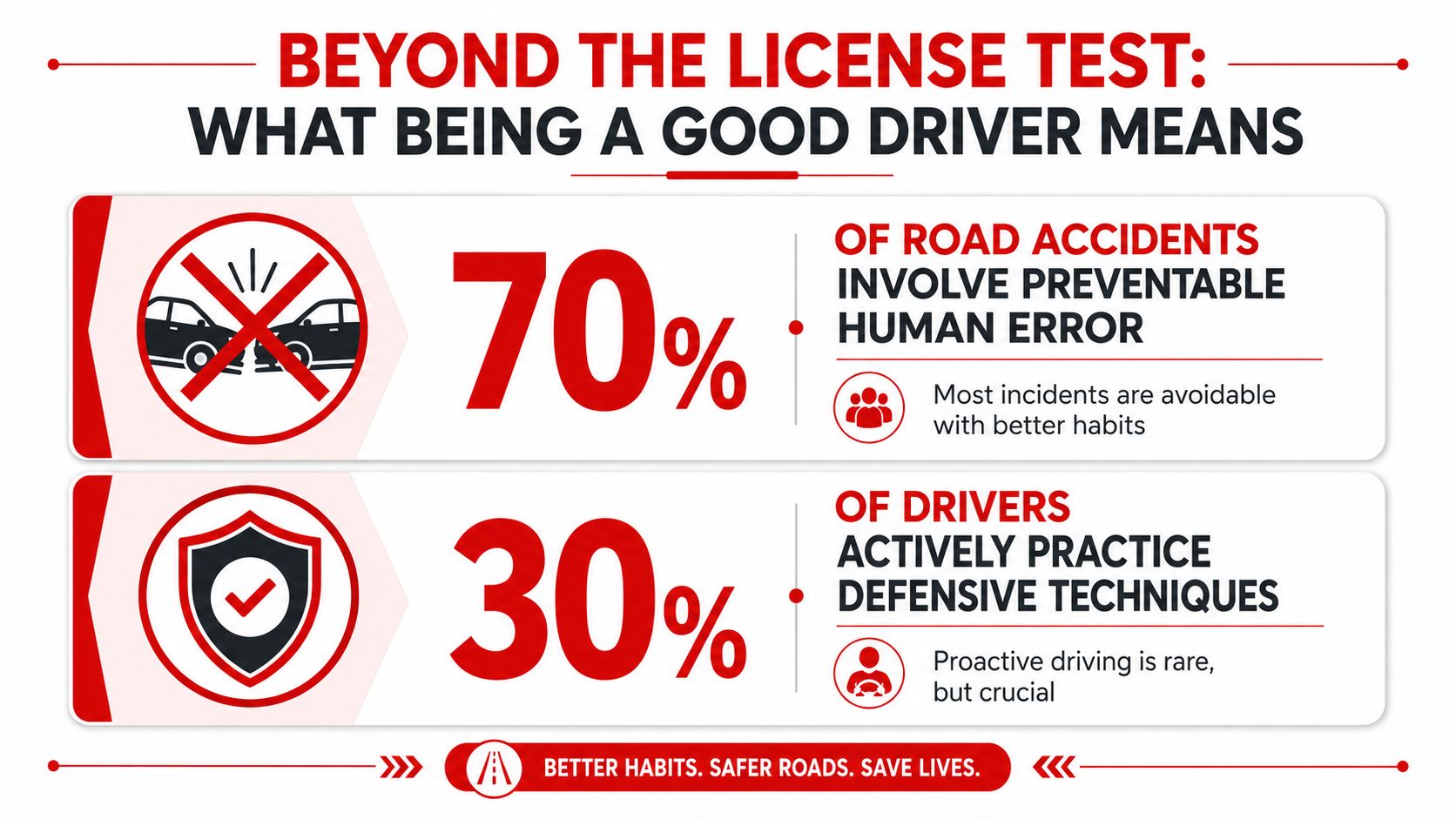
That distinction matters because driver error is a factor in approximately 77% of all traffic accidents, and for people ages 16 to 24, motor vehicle crashes account for 48.5% of deaths. Among fatal crashes involving male drivers ages 15 to 20, speeding was a contributing factor in 35% of cases. Those facts point to a fundamental lesson behind how to be a good driver: the biggest safety system in the car is still the person behind the wheel.
A good driver doesn't just steer, brake, and accelerate. A good driver manages space, attention, speed, and judgment. That's what keeps a normal trip from turning into a crisis.
Beyond the License Test What Being a Good Driver Means
It is commonly thought that good driving means obeying signs, staying in your lane, and avoiding obvious mistakes. That's only the surface layer. Real driving skill shows up when traffic compresses, someone cuts across your path, your phone tries to reroute you, or you arrive frustrated and distracted before the engine is even warm.
How to be a good driver starts with accepting that crashes are usually not random. Human choices drive most outcomes. The strongest statistic on that point is that driver error is involved in about 77% of traffic accidents. For younger drivers, the stakes are even higher. Motor vehicle crashes are the leading cause of death for ages 16 to 24, accounting for 48.5% of fatalities, and speeding remains a major factor in deadly crashes involving young drivers, including 35% of fatal crashes involving young male drivers. Families working on early habit-building can also review teen driving rules that reduce preventable risk.
Risk management matters more than test-day perfection
The license exam checks whether you know the rules and can perform basic maneuvers. Road safety depends on something else. It depends on whether you notice early warning signs, leave yourself enough margin, and refuse to let impatience make decisions for you.
A seasoned driver usually looks ordinary from the outside. The ride feels smooth. Nothing dramatic happens. That's the point.
Practical rule: Good driving is quiet driving. Fewer surprises, fewer abrupt inputs, fewer situations that need heroics.
The three parts of real driving skill
A useful way to think about it is to split driving into three connected disciplines:
- Car control: You need smooth steering, braking, and throttle use so the vehicle stays balanced.
- Defensive planning: You need space, scanning habits, and a constant backup plan.
- Mindset: You need restraint, especially when you're rushed, angry, tired, or tempted to multitask.
Most weak drivers don't fail because they never learned to turn a wheel. They fail because they make small, bad decisions repeatedly until traffic punishes one of them.
Mastering the Fundamentals of Car Control
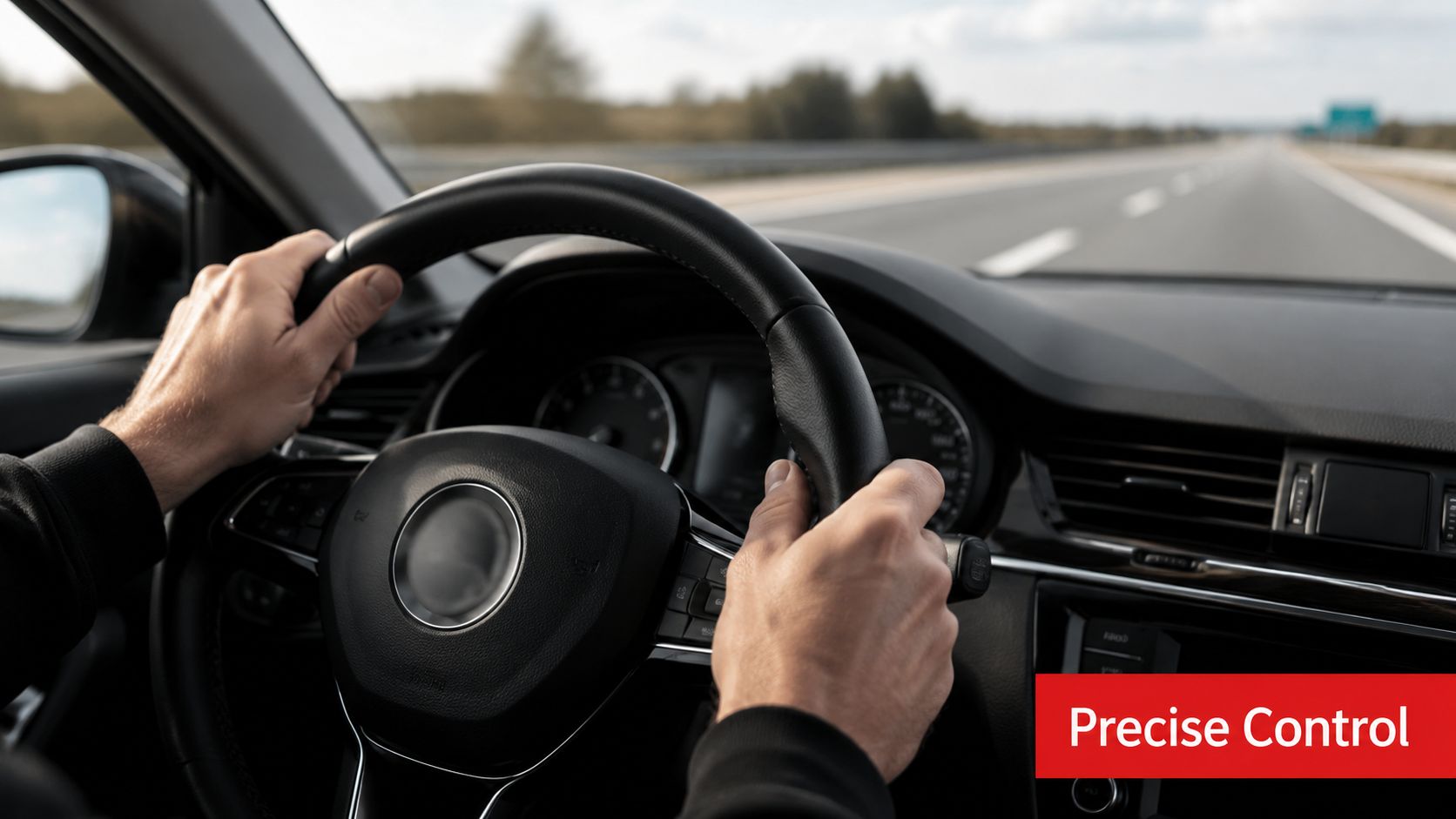
Car control isn't about flashy technique. It's about keeping the car settled so you always have grip available when you need it. Smooth drivers are safer because smooth inputs preserve traction, buy time, and make the vehicle more predictable.
Smoothness is a safety skill
Abrupt throttle, late braking, and jerky steering all do the same thing. They ask the tires to do too much at once. On dry pavement you may get away with it. In rain, cold, gravel, or traffic, that habit catches up with you.
A well-controlled car usually follows this rhythm:
- Accelerate progressively: Squeeze into the throttle instead of stabbing at it.
- Brake early and release smoothly: Hard braking should be reserved for genuine emergencies.
- Steer once, not three times: Set the car into the lane or turn with one clean input, then make only small corrections.
That approach improves comfort, but comfort isn't the main goal. The main goal is keeping reserve grip in the tires.
Look farther ahead than feels natural
The rougher a driver is with the controls, the more often the problem is visual, not mechanical. They're staring too close to the front of the car. That creates late reactions, then rushed braking and steering.
Train your eyes to work in layers:
| Visual task | What to watch for | Why it helps |
|---|---|---|
| Far ahead | Brake lights, lane closures, stale green lights | Gives you time to ease off before the problem arrives |
| Mid-range | Merging vehicles, turning traffic, crosswalk movement | Helps you judge whether to brake, coast, or change position |
| Near field | Lane markings, potholes, curb position | Keeps placement clean without tunnel vision |
A driver who sees farther drives smoother because the brain has time to choose instead of panic.
For slippery conditions, winter driving habits that reduce loss of control become even more important. The car can only respond to the traction the road gives you.
Steering and balance under load
There's no need to overcomplicate steering technique. What matters is control and consistency. Use the method that lets you keep stable hand placement and avoid tangling your arms. For everyday road driving, the goal is simple: turn enough, unwind smoothly, and avoid adding sudden throttle or brake pressure while the car is heavily loaded in a corner.
If the car feels rushed in the middle of a turn, the mistake usually happened before the turn.
That's why experienced drivers do most of their speed adjustment in a straight line. Enter at a speed you can manage calmly, then let the car track through without needing corrections.
A short demonstration helps make that visible:
Stop coasting through decisions
Many drivers coast when they should be choosing. Coasting isn't always wrong, but it becomes a problem when it replaces judgment. If you're approaching a tightening gap, a yellow light, or a slowing queue, decide early whether you're maintaining speed, easing off, or braking.
That habit does two things. It keeps the car balanced, and it makes your actions easier for other drivers to read.
The Defensive Driver's Proactive Playbook
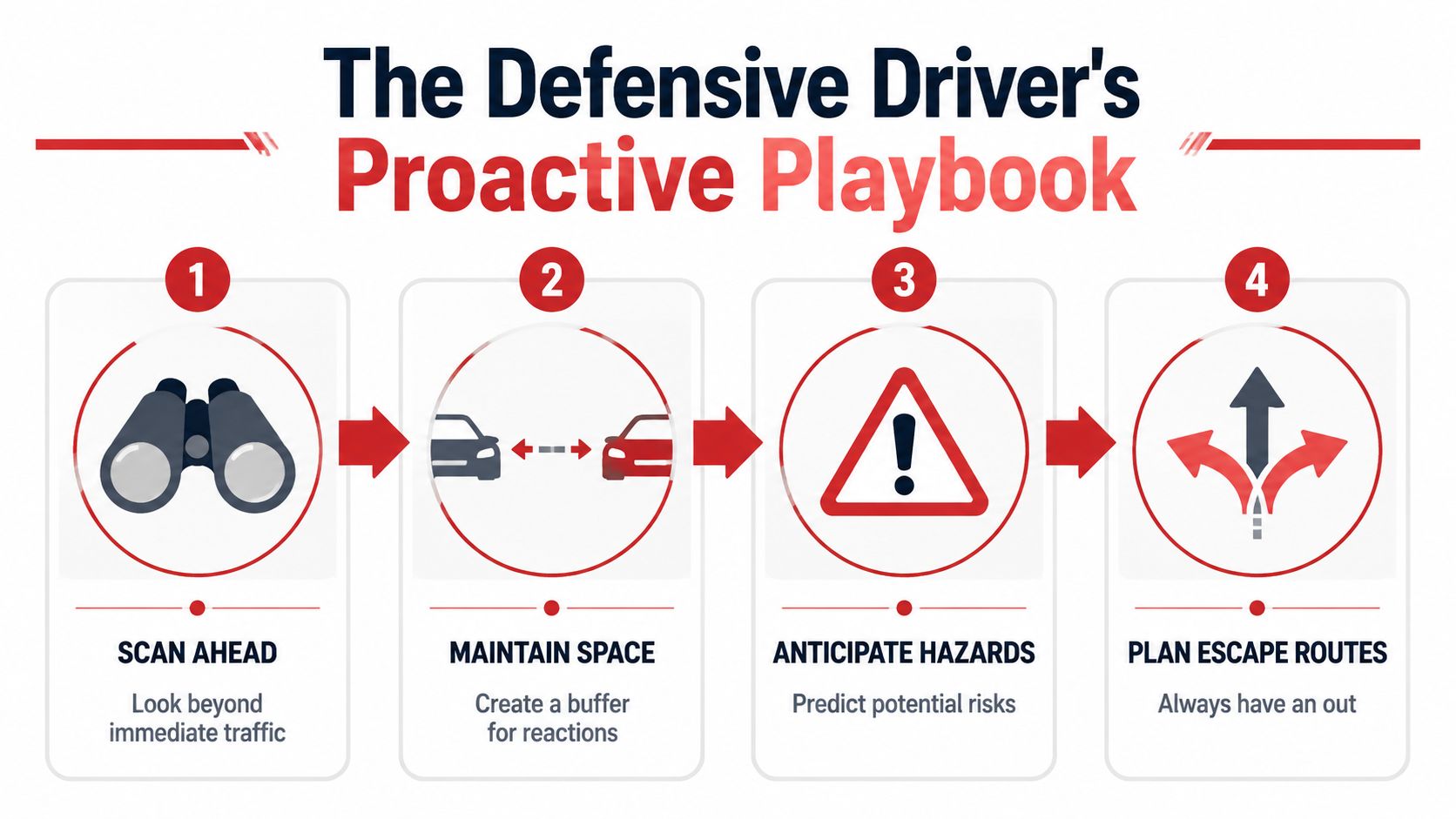
The best defensive drivers don't spend the day reacting. They spend the day preventing. Their main tool isn't fast reflexes. It's time. They create time by managing space.
The most practical place to start is the following gap. A core defensive method is to maintain at least a 3-second following gap in normal conditions. The method is simple: pick a fixed roadside object, start counting when the vehicle ahead passes it, and make sure you finish the count before your vehicle reaches that same point, as described in this superior driving techniques guide.
Space is what gives you options
Drivers who follow too closely usually tell themselves they're staying engaged. In practice, they're borrowing reaction time from their future self. When the lead vehicle brakes hard, there's no reserve left.
Use this simple spacing model:
- Normal traffic: Keep at least the 3-second gap.
- Bad weather or low visibility: Increase the gap. Don't treat the minimum as a target.
- Stopped traffic: Leave enough room to see the rear tires of the vehicle ahead. That gives you a small escape window if traffic stacks up behind you.
This is one reason how defensive driving helps new drivers is such a useful topic. New drivers often focus on lane position and signaling but underestimate how much risk can be reduced before a hazard develops.
Scan in layers, not in snapshots
A weak scanner checks only what's immediately in front of the hood. A strong scanner reads the whole environment. That means looking ahead for compression, checking mirrors before you need them, and noticing where conflict points are forming.
A practical version of this is the old search, evaluate, execute pattern:
- Search for brake lights, drifting cars, turning wheels at side streets, pedestrians near the curb, and open doors in parked cars.
- Evaluate which problem could become your problem soonest.
- Execute a low-drama response, such as easing off, changing lane position, or preparing a lane change early.
Good defensive driving looks patient from the outside because the driver solved the problem before anyone noticed it.
Always keep an out
An “out” is your escape option if another road user makes a bad move. Sometimes that's an open shoulder. Sometimes it's the empty half of your lane. Sometimes it's the extra following distance that lets you brake in a straight line instead of swerving.
Parking lots are where many drivers stop thinking defensively because speeds are low. That's a mistake. Tight sightlines, backing vehicles, carts, and people walking unpredictably make them messy risk zones. Parking lot safety habits reward the same mindset as highway driving: slow down, scan early, and don't assume others see you.
Cultivating the Unwavering Mindset of a Safe Driver
The most important safety feature in any car is judgment. Not horsepower. Not all-wheel drive. Not a screen full of alerts. Judgment decides whether the driver is fit to drive, calm enough to drive, and disciplined enough to ignore every distraction competing for attention.
Alcohol makes that point brutally clear. At a BAC of 0.08, a driver is 4 times more likely to crash than a sober driver. In the United States, alcohol-impaired driving caused an average of 32 deaths per day in 2024, which means one person was killed every 44 minutes. Those aren't abstract public-safety numbers. They describe repeated failures of self-assessment.
Zero tolerance is the only reliable rule
Many drivers still think the main question is whether they “feel okay.” That's the wrong test. Impairment affects judgment early, and one of the first things it damages is the ability to judge your own condition accurately.
That's why the rule has to be simple:
- If you've been drinking, don't drive
- If you're using anything that dulls reaction or attention, don't drive
- If you're exhausted enough that your focus wanders, don't pretend coffee solved it
There's no skill level that cancels out an impaired brain.
Distraction and emotion work the same way
Not every dangerous mindset comes from substances. Anger narrows attention. Fatigue slows decision-making. Phone use turns a moving vehicle into a divided-attention experiment.
A lot of drivers imagine distraction as texting only. Real distraction is broader. It includes hunting for playlists, reading navigation too late, arguing with passengers, replaying a work call in your head, or rushing because you left ten minutes later than you should have.
The disciplined driver asks one question before moving: “Am I ready to give this trip my full attention?”
Patience is not passive
Safe drivers aren't timid. They're selective. They know when to wait for a cleaner gap, when to let an aggressive driver go, and when to abandon the urge to “teach someone a lesson.”
That mindset changes the whole drive. Instead of competing with traffic, you manage it. Instead of reacting emotionally, you make boring, effective choices. On public roads, boring is usually what competence looks like.
Handling High-Pressure Scenarios and Emergencies
The hardest part of driving isn't remembering what a sign means. It's making a clean decision when the environment gets noisy. Safety research consistently shows crashes are driven less by knowledge of rules than by poor moment-to-moment choices, attention, and speed management in situations like merging, navigating intersections, and recovering from mistakes, as discussed in this driving analysis video.
Merging into fast traffic
A poor merge usually starts too late. The driver reaches the end of the ramp still deciding, then either brakes sharply or forces their way into a bad gap.
A better merge has a sequence:
- Build speed on the ramp so your vehicle fits the flow.
- Look early, not just at the final moment.
- Choose a gap before the lane ends.
- Make one decisive move into that gap.
- If the gap collapses, adjust smoothly. Don't jerk the wheel.
The key judgment call is whether to brake or accelerate. If the gap is opening ahead, add speed progressively. If a vehicle is sitting in your blind area, easing off slightly may be safer than trying to squeeze ahead.
Four-way stops and tight parking
At a four-way stop, confusion causes more trouble than lack of courtesy. Drivers wave each other through, hesitate, then move together. The fix is simple. Stop fully, identify order, and act predictably. If another driver is erratic, don't race them for the principle of being right. Let them go.
Reversing into a tight spot also exposes judgment under pressure. Drivers get flustered because they feel watched. Slow down more than your ego wants to. Set the car up early, use your mirrors, turn your head when needed, and don't keep cranking in more steering after the setup is already wrong. If the angle is poor, pull forward and reset.
What to do when the car itself goes wrong
Emergencies reward drivers who avoid sudden inputs.
| Situation | First response | What to avoid |
|---|---|---|
| Tire blowout at speed | Hold the wheel firmly and stabilize the car | Slamming on the brakes immediately |
| Brake failure | Pump the brake pedal if appropriate, reduce speed, and steer to a safe area | Waiting too long to act |
| Skid on a slippery surface | Look where you want to go and steer to regain alignment | Overcorrecting or staring at the hazard |
If the car has been broken into, tampered with, or left vulnerable after an incident, practical next steps matter as much as the driving response. This guide on what to do after a car break-in is useful because pressure doesn't end when the vehicle stops moving.
Under stress, the best drivers simplify. Eyes up. Hands steady. One correction at a time.
Using Modern Tech to Reinforce Good Driving Habits
Drivers now manage more screens, alerts, and automation than any previous generation. The risk is not the technology itself. The risk is handing over judgment to systems that can assist but cannot read the full traffic picture, the weather, or another driver's bad decision.
Good drivers set the rules before the engine starts. Route entered. Audio chosen. Phone out of reach. Driver-assist settings checked. That reduces decision load once the car is moving, which matters because touchscreen taps, voice prompts, and lane-centering feedback all pull attention in small pieces. Small pieces still add up.
Use assistance systems to reduce workload, not responsibility
Adaptive cruise control, lane-keeping support, blind-spot alerts, and parking cameras can help a disciplined driver stay ahead of the car. They also create a common failure pattern. The driver relaxes the scan, trusts the warning to catch everything, and reacts late when conditions change outside the system's limits.
That is why I teach drivers to ask one question any time a feature is active: what am I still responsible for right now? Usually the answer is most of the job. Gap judgment, surface grip, closing speed, and escape space still belong to the person in the seat.
A simple routine works well:
- Set navigation before moving: Miss the turn if you have to. Do not fix the route while rolling.
- Silence unnecessary notifications: Fewer prompts mean fewer glances away from the road.
- Keep assist features familiar: Learn what each alert sounds like and when it tends to intervene.
- Maintain a live visual scan: Mirrors, far distance, and adjacent lanes still need regular checks even with sensors on.
Objective feedback improves judgment faster than memory
Many drivers judge themselves by intention. Safe drivers judge themselves by patterns. If a trip includes repeated hard braking, sharp acceleration, or late lane changes, the issue is usually planning and attention, not bad luck.
Tools that record trip behavior help because they replace guesswork with evidence. CARLOCK can monitor events such as harsh braking, rapid acceleration, aggressive cornering, vehicle movement, and tampering alerts. That makes it useful for parents coaching a new driver, owners checking how a shared car is used, and fleet managers reviewing habits that increase wear and crash risk.

The value is not surveillance for its own sake. The value is seeing the moment where judgment broke down. Hard braking after every freeway merge often points to poor lane selection. Repeated sharp cornering can signal speed carried too deep into turns. Those are coachable decisions.
Build a cockpit that supports faster, cleaner decisions
Technology only helps if the setup is easy to read and easy to manage. Screen brightness, seat position, mirror alignment, charging cable placement, and even eyewear affect how quickly a driver can process information. Drivers comparing options for clearer transitions between dashboard, mirrors, and distance vision may find Style Site Optical's progressive driving lens guide useful.
It also helps to know where modern safety systems work well and where they do not. This overview of smart car safety features and their limits is worth reviewing with a skeptical, practical mindset.
The goal is simple. Use technology to lower workload, sharpen feedback, and protect attention. Keep judgment in human hands.