

Driver’s Desk
GPS Car Tracker: A Complete Guide to Vehicle Security
The market for GPS tracking devices reached USD 4.2 billion in 2025 and is projected to reach USD 8.9 billion by 2031, with vehicle tracking as the dominant segment, according to Global Market Insights research on the GPS tracking device market. That matters because it changes how you should think about a GPS car tracker. This isn't a niche gadget for hobbyists anymore. It's part of mainstream vehicle security.
Most drivers still picture car protection as something passive. A steering wheel lock. A loud siren. A blinking LED on the dash. Those tools can still help, but they mostly react after someone has already targeted the vehicle. A GPS car tracker changes the model from passive defense to active awareness.
The easiest way to understand it is to compare it to a smartphone. Your phone uses satellite positioning to know where it is, but it needs a network connection to send that information to an app. A true vehicle tracker works the same way. One part figures out the car's location. Another part sends that information to you. That combination is what turns raw location data into a practical security system.
For car owners, that means more than a dot on a map. It means knowing if a vehicle moved without permission, if it was started unexpectedly, or if someone tried to disconnect the device. For parents, it means visibility into how a new driver is using the car. For small businesses, it means knowing where vehicles are and how they're being used. If you want a broader look at practical ownership benefits, CarLock's guide to the benefits of GPS car tracking is a useful starting point.
Introduction
A real GPS car tracker is built around two jobs. First, it determines where the vehicle is. Second, it sends that information to your phone or web dashboard. Old alarms make noise and hope someone notices. Modern tracking systems collect information and deliver it directly to the person responsible for the car.
That distinction matters when a car is parked in an apartment lot, left with a valet, loaned to a family member, or used by an employee after hours. If the vehicle moves, the owner can know quickly. If the device is tampered with, the owner can know quickly. If the car is stolen, there's a path to recovery that doesn't depend on someone hearing a siren.
A car alarm tries to scare a thief away. A tracker helps you know what happened, where it happened, and whether it's still happening.
Many buyers get confused because the market mixes very different products under similar language. Some devices are true security tools. Others are closer to convenience gadgets. The difference usually comes down to how location is determined, how data is transmitted, and whether the device can keep reporting independently.
That's why choosing a GPS car tracker isn't just about buying “something that tracks.” It's about choosing a system that can operate in real driving conditions, send alerts in time to matter, and keep working even when a vehicle is moving far from the owner.
The Core Technology How GPS and Cellular Work Together
A true GPS car tracker depends on a two-part system. The first part is satellite positioning. The second part is cellular communication. If you remove either piece, you lose the thing that makes real-time vehicle security possible.
How the tracker figures out location
A GPS car tracker uses trilateration from at least three satellites to determine the vehicle's position, and under open sky that position is typically accurate to 8 to 15 feet. It then sends location data, along with information like speed and engine status, through an integrated cellular module such as 4G LTE for near real-time monitoring, as explained in BrickHouse Security's overview of car tracking technology.
That sounds technical, but the basic idea is simple. Satellites broadcast timing and position signals. The tracker listens. By measuring signals from multiple satellites, it calculates where the car is on Earth.
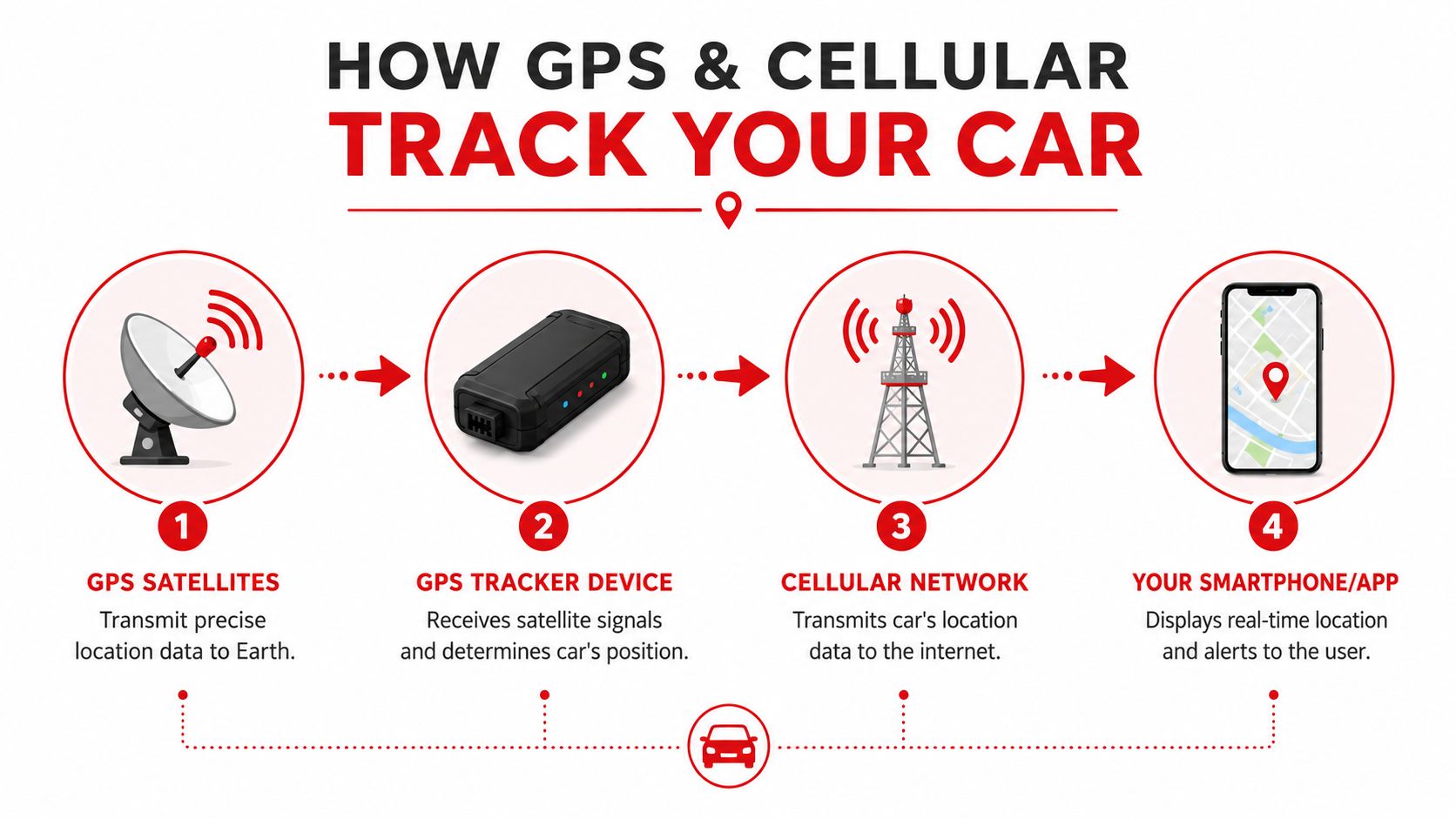
If you want a product-level explanation of that flow, this walkthrough of how GPS trackers work breaks down the same process in practical terms.
Why cellular matters just as much
GPS alone doesn't alert you. GPS only tells the device where the car is. To get that information to your phone, the tracker needs a communications path. That's where the cellular module comes in.
Think of it this way:
| Part | Job | Why it matters |
|---|---|---|
| GNSS receiver | Determines where the vehicle is | Gives the tracker its position |
| Cellular module | Sends that data to a server or app | Lets you see alerts and location remotely |
| Power source | Keeps both systems running | Allows continuous tracking |
Without cellular service, the tracker may know where the car is but can't report it to you in real time. That's the core difference between a real security tracker and a device that only stores information locally or relies on nearby phones.
Practical rule: If a device can't independently send its location, it isn't built for dependable theft recovery.
How this affects real security
This dual system creates practical outcomes that owners care about.
- Fast awareness: The tracker can report movement, engine activity, or route changes while they're happening.
- Independent operation: It doesn't need the thief's phone, your phone, or a stranger's phone nearby.
- Useful telemetry: Some systems also report vehicle-related events such as engine status or harsh driving behavior.
- Continuous coverage: When powered through the vehicle or a stable installed source, the device can keep working without needing constant manual charging.
Readers often assume “GPS” means the whole product. It doesn't. GPS is the positioning half. Cellular is the reporting half. Security depends on both.
Key Features That Go Beyond Location Dots on a Map
A good GPS car tracker does more than show you a moving icon. Its main value comes from alerts, context, and timing. A map tells you where the car is. A security system tells you what's wrong and when to act.
Real-time updates that matter
Modern trackers can provide location refreshes as fast as every 5 to 10 seconds, while also supporting tamper alerts when the device is unplugged. Those capabilities rely on cellular service, which is why subscription plans commonly fall in the $5 to $25 per month range, according to Car and Driver's testing roundup of GPS trackers.
That speed matters in ordinary situations, not just dramatic theft stories. If a car is being towed, moved from a parking spot, or started without permission, a delayed update can turn a manageable problem into a long chase.
A Bluetooth finder might eventually show a last known area. A proper tracker can keep feeding fresh data as the vehicle moves.
Feature by feature, problem by problem
A lot of buyers see a feature list and don't know which items are real security tools and which are fluff. Here's the practical view.
- Tamper alerts: If someone unplugs or disconnects the device, you know right away. That gives you a head start while the vehicle may still be nearby.
- Trip history: If an employee, family member, or mechanic says the car only went across town, trip logs can confirm the route.
- Movement alerts: These help when the car is parked for long periods, such as at an airport, condo lot, or street parking spot.
- Battery warnings: Useful when you're trying to distinguish a security issue from an electrical issue.
- Driving behavior data: Harsh braking, fast acceleration, and aggressive cornering can help parents coach new drivers or help businesses monitor vehicle use.
One example in this category is CarLock's vibration sensor explanation, which shows how movement and disturbance alerts can catch break-in attempts or towing before the car is gone.
What these features look like in real life
A parent lends the family car to a newly licensed teenager. The parent isn't trying to spy. They want to know whether the car left the expected area late at night and whether the driving was erratic. Trip history and driving-event alerts make that conversation concrete instead of emotional.
A contractor parks a work van outside a supply warehouse before sunrise. Someone tries to disconnect the tracking device before moving the van. A tamper alert arrives first, followed by movement data. That sequence changes the owner's response from “I think something happened” to “I know when it started.”
Here's a quick visual explainer of how these systems are commonly used:
The feature that buyers overlook most
Many people focus on the map because it's easy to picture. The more important feature is often the alert pipeline. If your phone gets notified the moment a device is unplugged or the vehicle moves unexpectedly, you have a chance to react before the situation gets worse.
A location trail helps after the fact. An immediate alert can help while the event is still unfolding.
That's the difference between tracking as information and tracking as security.
Real-World Use Cases From Anti-Theft to Fleet Management
The easiest way to judge a GPS car tracker is to stop thinking about features and start thinking about situations. When a problem happens, what does the device provide for the owner?
Stolen vehicle recovery
A parked car disappears from a garage. The owner doesn't need a louder alarm. The owner needs information that law enforcement can use.
Vehicle tracking systems are used for stolen vehicle recovery, providing real-time location data to police and, in some systems, even enabling remote engine immobilization. That directly addresses the weakness of traditional alarms, which are often ignored or disabled, as described in Wikipedia's overview of vehicle tracking systems.
That's why recovery tools and deterrent tools aren't the same thing. A steering wheel lock may slow someone down. A siren may attract attention. A live tracker can tell responders where to look.
A parent coaching a new driver
A teenager says they're going to school, then to practice, then home. Most of the time that's exactly what happens. Sometimes it isn't.
A GPS tracker can help in ways that have nothing to do with theft. If a vehicle leaves a usual route, shows abrupt driving behavior, or appears somewhere unexpected late at night, the parent has useful facts. The better use of that information isn't punishment. It's coaching. Did the teen brake too hard because traffic was chaotic, or because they were distracted? Did they take a detour, or hand the car to someone else?
That kind of oversight is more like a driving safety tool than a spy gadget when it's used transparently.
Small fleet visibility
A small business with two delivery vans doesn't need enterprise software jargon. It needs answers to ordinary questions.
- Where is the vehicle right now?
- Did the driver reach the customer location?
- Why did today's route take longer than yesterday's?
- Is one van being driven more aggressively than the other?
For business owners in that position, this guide to fleet vehicle tracking gives a practical view of how location data, trip history, and alerts can support daily operations.
Dedicated trackers versus Bluetooth tags in the real world
Many buyers commonly make an incorrect comparison. A Bluetooth tag and a GPS car tracker may both appear to “show where something is,” but they solve different problems.
A Bluetooth finder is like a baby monitor. It helps in a limited, close-range context and depends heavily on surrounding conditions. A dedicated vehicle tracker is closer to a professional security camera system. It's designed for independent operation, ongoing reporting, and use in situations where stakes are higher.
| Scenario | Dedicated GPS car tracker | Bluetooth item finder |
|---|---|---|
| Car stolen and moving across town | Built for ongoing remote tracking | May only show delayed or indirect updates |
| Vehicle parked in a quiet area | Can still alert through its own connection | Depends on outside devices being nearby |
| Business vehicle oversight | Supports operational visibility | Not designed for vehicle management |
| Teen driving feedback | Can provide route and event context | Not built for driving analysis |
If your goal is to find keys between couch cushions, a Bluetooth tag makes sense. If your goal is to secure a vehicle that can move miles away in minutes, the comparison ends quickly.
The Critical Difference True GPS Trackers vs Bluetooth Item Finders
A lot of confusion comes from marketing language. Many products get called “trackers,” but they don't all track the same way, and they definitely don't offer the same kind of protection.
According to SafeHome's GPS industry outlook, approximately 170 million Americans own a location-tracking device. That broad adoption includes many Bluetooth-based products, but those devices are distinctly different from a dedicated GPS car tracker because they rely on nearby device networks instead of their own cellular link.
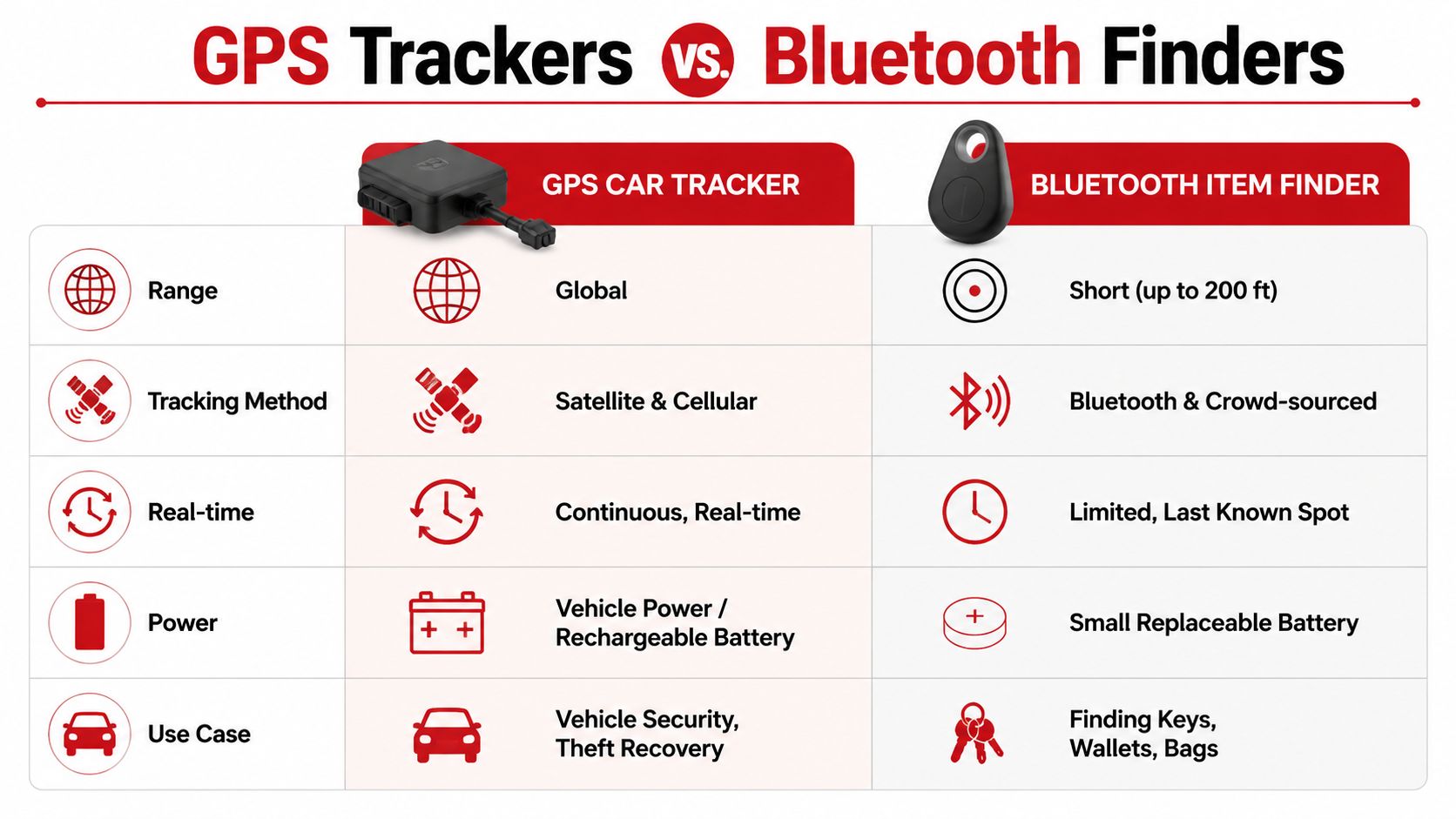
The difference starts with independence
A Bluetooth item finder is built for lost-property recovery. Keys. Wallets. Bags. Things you misplace. It doesn't independently report its position across long distances. It depends on short-range communication and, in many ecosystems, nearby phones participating in a larger network.
A GPS car tracker is built for a moving asset. It determines its own location and sends that information over a cellular connection. That independence is the whole game.
If a stolen car ends up in a quiet industrial area or on a back road, the tracker doesn't need strangers walking by with compatible phones. It can keep reporting on its own.
A side-by-side security test
Here's the cleanest way to evaluate the difference:
- Range: A real vehicle tracker works across broad geographic areas because it uses satellite positioning and cellular transmission. A Bluetooth finder is short-range by design.
- Refresh behavior: Security trackers can update repeatedly while the car is moving. Bluetooth products usually give a last known or opportunistic location.
- Power design: Vehicle trackers are often hardwired, plugged into OBD-II, or built for longer-term operation. Item finders are optimized for tiny batteries and lightweight carry use.
- Security use case: One is meant for theft recovery and monitoring. The other is meant for finding misplaced belongings.
If the product depends on someone else's phone being nearby, it's not a dependable primary security tool for a vehicle.
Why subscriptions exist
People often say they want a “no monthly fee” option. That's understandable. But in tracking, cost usually follows capability.
A dedicated GPS car tracker uses cellular data transmission, cloud infrastructure, and app-based alert delivery. Those aren't decorative extras. They're the mechanism that turns location hardware into a live security service. If you remove that service layer, you usually remove real-time alerts, independent reporting, and remote visibility.
That's also why comparing a Bluetooth tag to a cellular tracker on sticker price alone is misleading. The products do different jobs.
Privacy and legality fit into this distinction too
Bluetooth finders have generated public concern because they can be misused for stalking or covert monitoring. Dedicated vehicle trackers can also be misused if someone installs them without consent. The legal and ethical line is straightforward in principle. Tracking your own vehicle for security is one thing. Tracking another person without proper ownership, authority, or consent is another.
A proper buying decision should include both capability and legitimacy. You want a tool that's strong enough to secure the vehicle and clear enough in its use that you're not stepping into a privacy problem.
Understanding Legal Rules Privacy and Cost
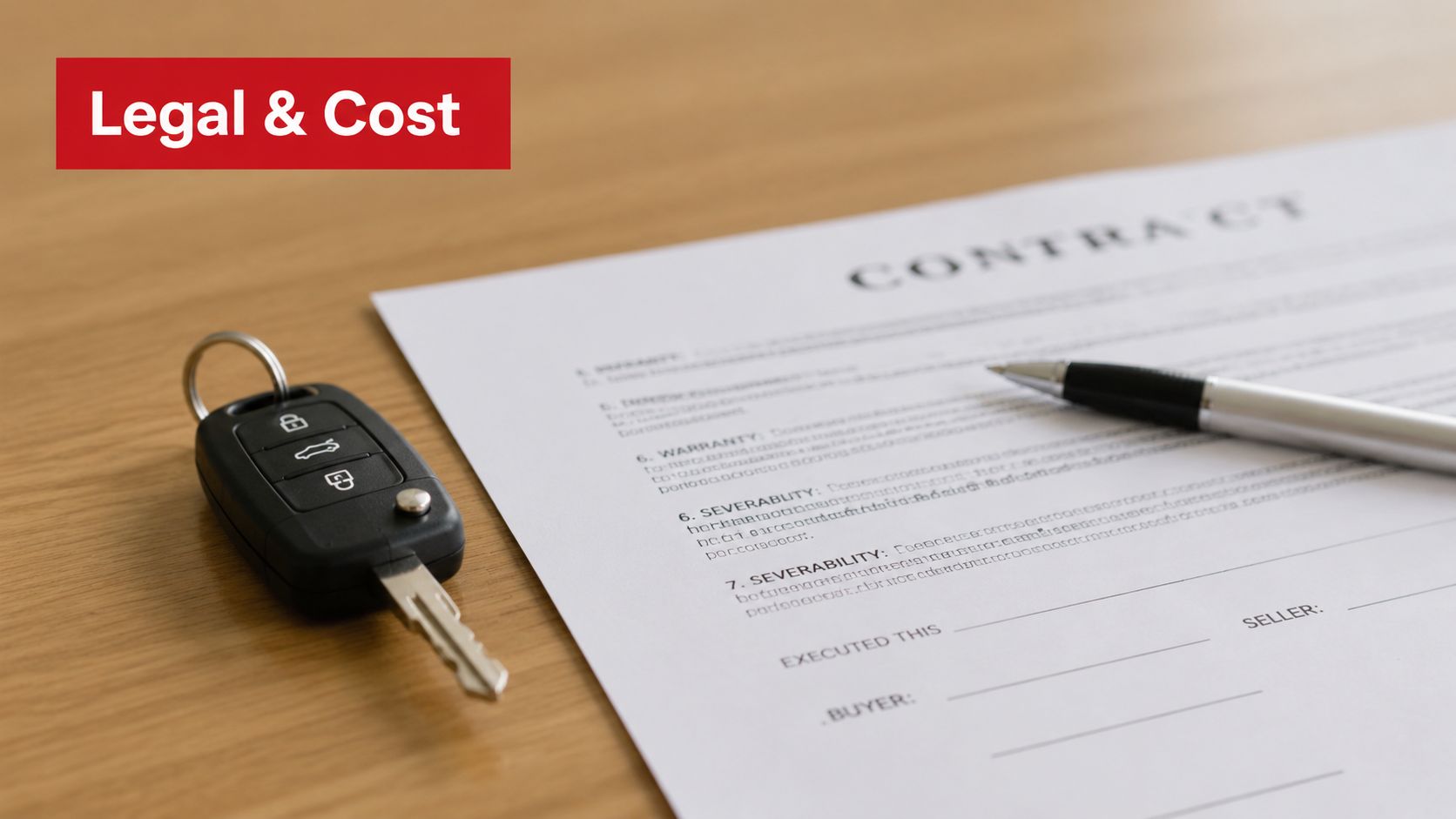
Legal questions about a GPS car tracker are usually really questions about permission, disclosure, and control. The device itself is only part of the story. The bigger issue is who owns the car, who drives it, and who has agreed to the tracking.
Can you legally put a tracker on a car
If you own the vehicle and use the tracker to protect that vehicle, you are on the strongest legal footing. Trouble starts when someone uses a tracker to monitor another adult without clear authority or consent. A tracker can protect property, but it can also become a surveillance tool if used carelessly.
The practical rule is simple. Ownership and disclosure matter.
Parents and employers often fall into gray areas that feel obvious until you look closer. Tracking a family car used by a teen is different from secretly tracking an adult partner. Tracking a company-owned vehicle during work hours is different from tracking an employee's personal car after hours. State laws can change the details, so specific advice should come from a qualified attorney in the relevant jurisdiction.
If ownership is unclear, or the driver has not been informed, pause before installing anything.
What about hidden trackers from dealerships or lenders
This concern is real, but it is often misunderstood. Some dealers and lenders use starter interrupt devices or GPS units in financed vehicles, especially in higher-risk lending arrangements. The issue is usually disclosure, not a secret industry-wide plot.
The Federal Trade Commission has taken action against businesses for failing to be clear about vehicle financing and related practices, which is a useful reminder to read the paperwork closely and ask direct questions before signing. Buyers should pay close attention to contract language about telematics, repossession technology, payment assurance devices, or vehicle location services. You can also review the FTC's consumer guidance and enforcement materials on auto sales and financing at consumer information from the Federal Trade Commission on buying and financing a car.
A few checks can prevent surprises later:
- Inspect the OBD-II port: Look under the driver-side dashboard for any plug-in device you did not approve.
- Read the finance agreement carefully: Search for terms like telematics, GPS, starter interrupt, repossession device, or monitoring.
- Ask for written disclosure: Find out who controls the device, what data it sends, and whether removal is allowed after the loan terms change.
- Keep records: Photograph any device you find and save copies of the sales and finance documents.
That distinction matters. A lender-installed unit tied to a contract is one issue. A hidden Bluetooth tag slipped into a car by a stalker is a very different problem, and it should not be confused with a legitimate cellular GPS security system that you knowingly buy for your own vehicle.
Why the monthly cost isn't just a fee
A subscription pays for the parts of the system that keep working after the hardware is installed. GPS tells the device where the car is. Cellular service carries that information to the cloud. The app then turns that data into alerts, trip history, and account access. It works like paying for both the alarm siren and the phone line that calls you when the alarm goes off.
That is why a low upfront price can be misleading. Some products store information locally, update infrequently, or depend on nearby phones instead of their own cellular connection. In a theft case, those limits are not minor details. They determine whether you get an alert in time to act.
For a clearer explanation of what recurring service covers, see CarLock's breakdown of GPS tracking cost and service components.
What should buyers ask before signing up
A good purchase decision starts with operational questions, not marketing claims.
| Question | Why it matters |
|---|---|
| How does the device send its location? | Shows whether it uses independent GPS and cellular reporting or depends on nearby phones |
| What happens if power is cut or the device is unplugged? | Tells you whether tamper alerts or backup power are available |
| Who can access the data in the app? | Clarifies account control and privacy |
| Is the driver informed and has consent been documented when needed? | Helps avoid legal disputes and family or workplace conflict |
| Where is the device installed? | Affects signal quality, visibility, and ease of inspection |
One factual product example is CARLOCK, which is a real-time GPS and cellular vehicle security system that reports suspicious movement, tampering, battery issues, and trip history to a smartphone app. That puts it in the dedicated vehicle-security category, not the Bluetooth item-finder category.
Your GPS Car Tracker Questions Answered
Car owners usually ask the same practical questions before buying a tracker. The concern is rarely the map itself. It is whether the device will create problems, miss a theft, or collect more information than expected.
Those are reasonable questions, especially because many buyers have seen Bluetooth tags and true GPS trackers discussed as if they were the same tool. They are not. A dedicated vehicle tracker uses the car's power, GPS satellites, and a cellular connection to report vehicle activity. A Bluetooth finder is built for misplaced keys, bags, or wallets and depends on nearby phones.
Can a GPS tracker drain my car battery
A properly installed hardwired or OBD-II tracker usually draws very little power and should not interfere with normal vehicle operation, according to Dawarich's explanation of hidden GPS tracker myths.
The easier way to understand it is to compare it with a digital clock in the dashboard. It uses a small, steady amount of electricity. Portable battery-powered trackers create a different issue. They rely on their own battery, so they can stop reporting if the battery runs down and no one notices.
That is why power source matters as much as the tracking feature list.
Can a tracker record conversations inside my car
Usually, no. A standard GPS car tracker is built to report location, movement, speed, trip history, and vehicle-related alerts. That is very different from an audio surveillance device.
The confusion often starts because people hear the word “tracking” and assume “spying.” In practice, a vehicle tracker works more like a security log than a hidden microphone. It can tell you the car moved at 2 a.m. or that the battery was disconnected. It does not mean the device is listening to the cabin.
Will installing one void a car warranty
Warranty questions usually come back to one issue. Installation quality.
A plug-in OBD-II model is often the simplest option because it does not alter factory wiring and can be removed easily. A hardwired unit can also be a good fit, especially if you want a more discreet setup, but it should be installed correctly and matched to the vehicle. Problems tend to come from poor wiring, damaged components, or careless installation work, not from the basic fact that a tracker is present.
If you want the least friction, choose a device designed for your vehicle type and follow the manufacturer's installation guidance.
Can thieves block the signal
They can try. Some theft crews use jammers or remove power quickly.
That does not make a tracker pointless. It changes what you should expect from it. A good system can still send tamper alerts, movement alerts, or last-known-location data before the signal is interrupted. That early warning can matter because it tells you the theft started, not hours later when the parking space is already empty.
Vehicle security works like layers on a front door. A lock, a camera, and a motion light each solve a different part of the problem. A tracker is the layer that helps with visibility and recovery.
What happens in an underground garage or poor coverage area
GPS and cellular signals can weaken in underground garages, concrete parking structures, tunnels, and some dense city blocks. That usually causes delayed updates rather than total failure.
A simple way to picture it is this. GPS needs a view of the sky, and cellular needs a path to the network. If one path is blocked, reports may pause. Once the car returns to better conditions, the device can resume sending data.
That behavior is normal for radio-based systems. It is not the same as a Bluetooth finder being out of range. With Bluetooth, the tag may have no direct way to report at all unless a compatible phone comes near it.
Do I need a tracker if I already have an alarm
An alarm and a tracker solve different problems.
An alarm is built to make noise and discourage access. A tracker is built to document movement, send alerts, and help you find the vehicle after it leaves the spot where you parked it. If your main concern is theft recovery, family driving oversight, or knowing when a work vehicle is used after hours, a tracker adds visibility an alarm does not provide.
Many owners use both for that reason.
If you want a dedicated vehicle security system rather than a general-purpose item finder, CARLOCK offers real-time GPS and cellular tracking, suspicious activity alerts, tamper detection, battery warnings, and trip history in a smartphone app. It is built for car owners who want live visibility into theft risks, family vehicle use, or small fleet activity.