

Driver’s Desk
GPS Tracker Vehicle: Your Complete Security Guide
Vehicle tracking is projected to represent a large share of the GPS tracking device market by 2025, and that shift reflects a practical change in how owners protect their cars. A gps tracker vehicle system is no longer treated like a specialty add-on. For many drivers, it has become part of a layered security plan built around one simple goal. Find the vehicle quickly if someone moves it.
That matters because theft rarely happens the way owners expect. A siren may draw attention, a steering wheel lock may slow someone down, and careful parking may reduce risk, but none of those tools answers the question that starts the moment your car is gone. Where is it now?
A vehicle tracker fills that gap. It works like a live trail instead of a one-time warning. Instead of only making noise at the scene, it can show location, movement, and alerts that help you respond before a temporary incident turns into a permanent loss. If you want context on the limits of audible deterrents, this guide to an alarm system for a car explains where alarms help and where they stop helping.
Reliability is the overlooked part.
Many owners focus on app screenshots and feature lists, then miss the failure points that decide whether the tracker works during an actual theft. Battery-powered units can struggle in cold climates because low temperatures reduce battery performance, much like a phone that dies faster on a freezing day. Trackers that depend on nearby phones have a different weakness. If no compatible device is close enough, your "tracker" becomes a blind spot.
That is why power source, installation method, and network connection matter as much as GPS itself. A professionally installed, hardwired system usually gives steadier protection because it draws power from the vehicle and is harder for a thief to disable quickly. For owners who care about real anti-theft performance, those details matter more than flashy specs.
Why Your Vehicle Needs More Than a Car Alarm
Vehicle tracking is no longer a niche add-on. Analysts project that vehicle tracking will make up a large share of the GPS tracking device market in 2025, reflecting how owners now expect more than a siren after a break-in.
That shift makes sense. A car alarm can create noise at the scene, but theft rarely ends at the moment a door opens. The main problem starts once the vehicle moves. If your car is being towed out of a parking lot at 2 a.m., a loud alert may buy a few seconds. It does not answer the question you care about most. Where did the vehicle go?
What alarms still do well
Traditional alarms still serve a purpose. They can interrupt a hurried thief, draw attention, and make an easy target less attractive.
But an alarm works like a smoke detector. It warns you that something is wrong. It does not tell you where the problem went after the first alert.
That gap matters because modern theft is often quiet, fast, and organized.
Where alarms fall short in real theft situations
A basic alarm leaves out the details owners need after the first few moments:
- No live location: Once the vehicle is moved, the alarm cannot show its current position.
- No event history: You may not know whether the car was opened, started, towed, or moved without ignition.
- No recovery support: Police and owners need location data, not just proof that a siren sounded.
- Too many false alarms: Repeated nuisance alerts train neighbors and passersby to ignore the noise.
If you want more background on the limits of audible deterrents, this guide to an alarm system for a car explains where alarms help and where they stop helping.
Practical rule: If a security device cannot tell you where the vehicle is after it moves, it only solves the first part of the theft problem.
What actually improves anti-theft protection
A gps tracker vehicle system adds visibility after the initial alert. Instead of only sounding off, it records movement, sends location updates, and gives you a timeline of what happened. That changes the owner's role from guessing to acting.
The overlooked part is reliability under stress. Many shoppers focus on map screenshots and app features, then miss the failure points that matter during an actual theft. Battery-powered trackers can lose performance in freezing weather, much like a phone battery draining faster on a cold morning. If the battery weakens when the car is stolen, the tracker may go silent at the exact moment you need it most.
Hardwired systems solve that problem more effectively because they draw power from the vehicle itself and are usually harder to find and disable quickly. For owners in cold climates, or anyone serious about recovery instead of just alerts, that difference is not minor. It is often the line between a device that looks good in a demo and one that keeps reporting when conditions get rough.
How a GPS Tracker for Vehicles Really Works
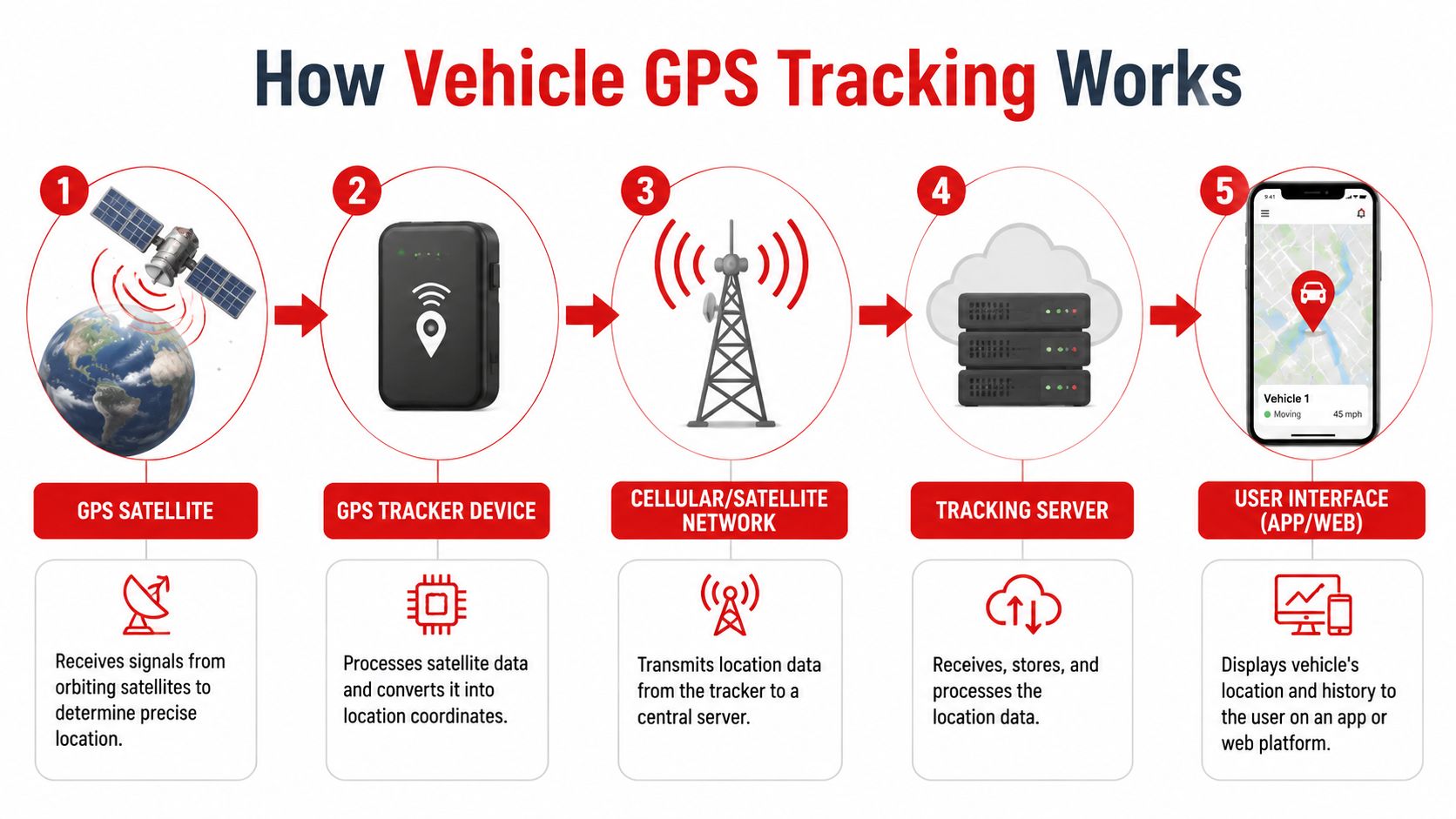
A vehicle tracker has two jobs. First, it figures out where the car is. Second, it sends that information to you. The GPS functions as the device knowing its own address. The cellular connection then serves as the phone call that tells you that address.
Without GPS, the device can't determine location precisely. Without cellular or another communication path, it can't report that location in real time.
How the tracker finds the car
The tracker listens for signals from satellites and calculates its position. In normal language, the device compares timing from multiple satellites to work out where it sits on the map. That's why open parking lots usually produce better tracking than dense downtown blocks or garages.
Real-time GPS vehicle trackers typically achieve location accuracy of 8 to 15 feet in open-sky conditions, and modern units that use multi-constellation GNSS receivers such as GPS, GLONASS, and Galileo lock positions 2 to 3 times faster and maintain steadier tracking, according to Car and Driver's GPS tracker testing overview.
That "multi-constellation" phrase sounds technical, but the idea is simple. A receiver that can hear more satellite systems has more chances to get a clean fix. In a theft scenario, that can mean fewer gaps and less drifting on the map.
How the alert reaches your phone
Once the tracker calculates location, it sends that data through a network to a server, and then your app displays it. So the full chain looks like this:
- Satellites send signals
- The tracker calculates coordinates
- The network carries the data
- A server processes and stores it
- Your app shows the result
That process is described clearly in this guide on how GPS trackers work.
A tracker isn't one technology. It's a chain. If any link in that chain is weak, your security is weak.
Why owners get confused
Many people assume "GPS tracker" means any small device with a map in an app. That's not accurate. Some products determine location well but report poorly. Others report only when another device is nearby. Some have weak power setups, so they go quiet at the worst time.
When you shop for a gps tracker vehicle system, don't focus only on whether it can show a dot on a map. Ask whether it can keep that dot updating when the vehicle is moving, hidden, parked, or stolen.
GPS Security Systems vs Bluetooth Item Finders
Many buyers make the wrong purchase. A GPS + cellular vehicle tracker is designed to monitor a moving car independently. A Bluetooth item finder is designed to help locate personal items through short-range connections and nearby device networks.
Those are different jobs.
If your keys slip behind a couch, a Bluetooth tag is useful. If your SUV is taken to an industrial lot, underground garage, or remote area, a Bluetooth finder may not give you what you need from an anti-theft tool.
The practical difference
A dedicated vehicle security system actively reports the car's location and can trigger alerts tied to vehicle events. A Bluetooth finder is usually waiting to be noticed by another device nearby.
Here's the side-by-side view.
| Feature | GPS + Cellular Tracker (e.g., CarLock) | Bluetooth Item Finder (e.g., AirTag) |
|---|---|---|
| Location method | Uses GPS/GNSS to determine vehicle position | Uses Bluetooth proximity and nearby device networks |
| How data reaches you | Sends location through cellular connectivity to an app | Relies on nearby compatible devices detecting the tag |
| Anti-theft suitability | Built for vehicle monitoring and recovery | Built for finding personal items |
| Alerts | Can support movement, tamper, engine, or geofence alerts | Typically centered on item presence or last detected location |
| Performance in isolated areas | Better suited to remote or low-traffic areas | Weaker if no nearby devices pass the tag |
| Power approach | Often OBD-II or hardwired for continuous use | Usually small internal battery |
| Vehicle integration | Designed around car use and security events | Not designed as a dedicated automotive security system |
Where Bluetooth finders fall short
A stolen vehicle can move quickly through environments that are bad for casual item-finding tools. Remote roads, enclosed structures, and low-device areas all reduce the chance that a Bluetooth-dependent tracker will update in a way that's useful.
That's why purpose matters. A product built for wallets and luggage isn't automatically a good fit for anti-theft recovery.
For readers comparing product categories, this CarLock Tag 3.0 setup and usage guide helps illustrate the difference between tag-style tracking and dedicated vehicle security systems.
A simple buying rule
Ask one question: If the vehicle is stolen and no helpful phones are nearby, will this device still report its location to me?
If the answer is uncertain, it isn't your primary theft-recovery tool.
Essential Features of a Modern Vehicle Tracker
A map pin alone doesn't make a strong security system. The value comes from how quickly the system updates, what events it notices, and how clearly it tells you something is wrong.
Real-time tracking matters more than stored logs
For theft protection, you want an active system, not one that internally stores data for later. Real-time GPS tracking systems provide continuous monitoring with updates as frequent as every 5 to 10 seconds, while passive systems only record data at intervals and store it locally until downloaded, according to Geoforce's explanation of real-time vs passive GPS tracking.
That difference is huge in real life.
If someone tows your car at 2:14 a.m., a passive device may create a useful record after the fact. A real-time device can notify you while the event is still happening.
Alerts that actually help
A strong gps tracker vehicle setup should warn you about events, not just wait for you to open the app and look around.
Useful alert types include:
- Unauthorized movement: Your parked car starts rolling or changes location unexpectedly.
- Engine start alert: Someone turns the vehicle on outside your normal pattern.
- Tow or vibration alert: You get a warning when the vehicle is lifted, bumped, or shaken.
- Tamper or disconnect alert: The system notices if someone unplugs or interferes with the device.
- Geofence alert: The car leaves or enters a defined area, such as your driveway or a company yard.
The best alerts don't flood you with noise. They answer one question fast: "Do I need to act right now?"
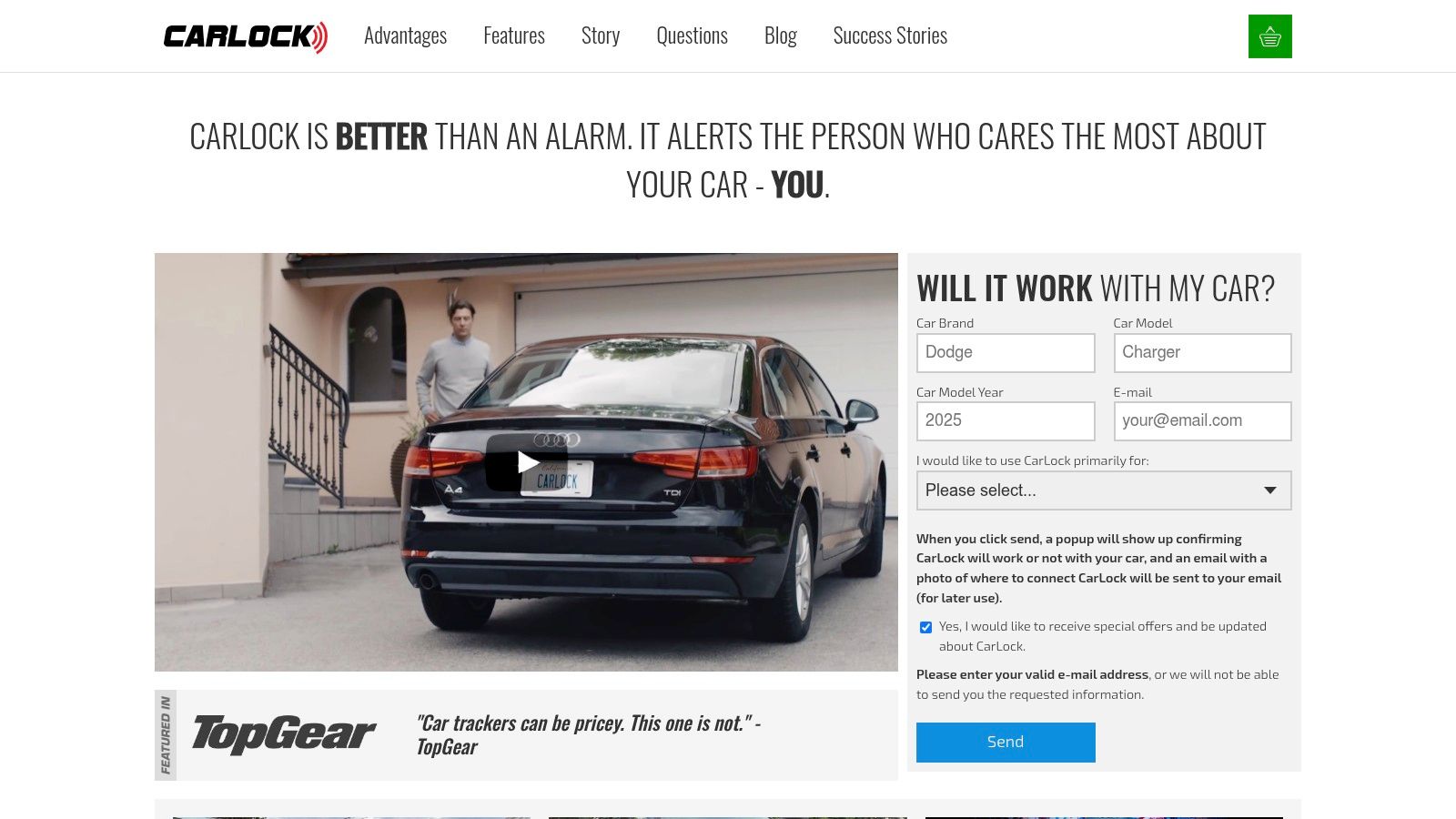
One example in this category is CARLOCK, which monitors vehicle movement, engine starts, unusual vibration or towing activity, disconnection attempts, and battery-related issues through a phone app. That's the kind of event-driven design you should look for in any serious vehicle security system.
Features that help beyond theft recovery
Some owners buy a tracker after a break-in scare. Then they discover it helps with everyday use too.
Trip history
Trip history shows where the car has been. That's useful if you're checking whether a valet took a detour, confirming where a family member parked, or reviewing use of a business vehicle.
Driving behavior alerts
Harsh acceleration, hard braking, and aggressive cornering can reveal risky driving habits. Parents often care about this for teen drivers. Small fleet owners care because unsafe driving increases wear, fuel burn, and exposure to claims.
A short product walkthrough helps make these features more concrete:
Clear app design
This one gets overlooked. During a stressful event, a cluttered app slows you down. You want to open the app and instantly see location, recent alerts, and the last known movement.
The best feature list on paper won't help much if the app hides the basics when you're trying to figure out whether your car is being stolen or towed.
Installation Power and Connectivity Options
Most buyers focus on features first and installation second. For security, that order should often be reversed. Power and connectivity decide whether the tracker keeps working when conditions get rough.
The three common installation types
You'll usually see three formats.
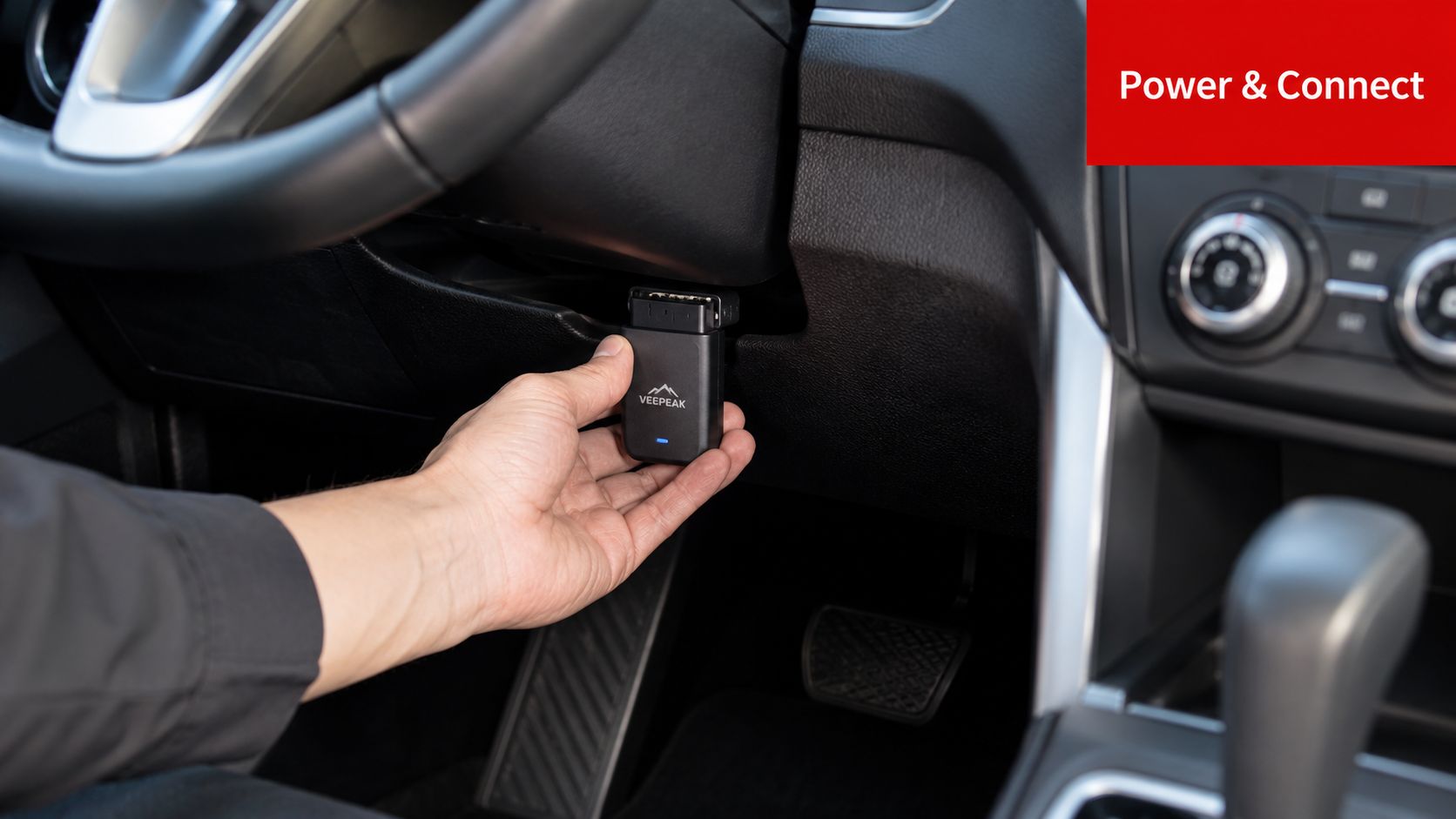
OBD-II plug-in
This is the easiest to install. You plug the device into the vehicle's OBD-II port, usually under the dashboard. It draws power from the car, which means you don't have to remember to charge it.
Hardwired tracker
A hardwired unit is connected directly into the vehicle's electrical system. It takes more effort to install, but it can offer a cleaner, more concealed setup and continuous power.
Battery-powered magnetic tracker
This is the "easy" option many guides push. You charge it, attach it somewhere, and start tracking. On paper, that sounds convenient. In theft recovery, convenience can become a weakness.
Why battery-powered units can fail in winter
This is one of the least discussed problems in consumer tracker advice. Battery-powered GPS trackers lose 40 to 60% of signal strength and battery life when exposed to temperatures below -20°C (-4°F). By contrast, hardwired and OBD-II-connected trackers maintain continuous power and real-time reporting regardless of temperature, according to the cited cold-weather tracker data summarized with USA Today's related vehicle cold-weather reference. The same verified data also notes that 34% of stolen vehicles in cold climates are recovered in gridlock due to failed tracker signals.
That matters if you live where winter is real, not theoretical. A magnetic battery unit may look fine during installation in a warm garage. Then the car disappears on a freezing night, and the device stops reporting reliably.
Cold-weather takeaway: A tracker you must recharge is also a tracker that can die. Theft doesn't wait for better weather.
For a breakdown of these setups, this article on car tracking installation options including plug-and-play, hardwired, and battery-powered units is worth reading.
Why subscriptions exist
People often ask why vehicle trackers have monthly fees. The answer is practical. A real-time tracker needs network connectivity and cloud services to send alerts, process location data, and store trip history. Without that service layer, many "live" features stop being live.
A no-subscription promise can sound attractive. But if the device can't maintain independent communication, you're usually trading away the thing that makes anti-theft tracking useful in the first place.
Use Cases Legality and Privacy Considerations
Vehicle trackers are used by very different people for very different reasons. A parent wants peace of mind. A business owner wants accountability. An individual owner wants theft protection. The legal and privacy questions change depending on who owns the vehicle and who drives it.
Personal and family use
Tracking your own vehicle for theft recovery is the simplest case. You're protecting your property and watching for unauthorized movement, towing, or tampering.
Family situations need more care. If a parent uses a tracker on a car driven by a teenager, the security purpose may be obvious, but the healthiest approach is still transparency. Explain what the device monitors, what alerts matter, and when you'll check it.
Business and fleet use
For companies, trackers can help with route oversight, unauthorized use, and proof that a vehicle was where it was supposed to be. They can also help identify tampering or disconnection attempts.
For company-owned vehicles, employers are typically legally permitted to install GPS tracking devices without employee consent, according to SafetyCulture's overview of vehicle tracking devices. Even so, smart operators don't treat legality as the only standard. They create a written policy and tell employees what is being monitored and why.
A related concern is the flip side of the issue. Sometimes the question isn't "Can I track my car?" but "Is someone else tracking it?" This guide on how to know if your car is being tracked is a helpful complement.
Privacy practices that build trust
Use simple ground rules:
- State the purpose clearly: Theft prevention, driver safety, or fleet oversight.
- Limit access: Only the people who need location data should see it.
- Avoid secret monitoring in family settings: Legal isn't always the same as wise.
- Review alerts, not every movement: Constant surveillance creates tension and usually isn't necessary.
Good tracking policy is boring on purpose. People should know the rules before the app ever sends an alert.
Checklist for Choosing Your GPS Tracker
By the time you're comparing products, the main question isn't "Which one has the longest feature list?" It's "Which one will still work when my vehicle is moved without permission?"
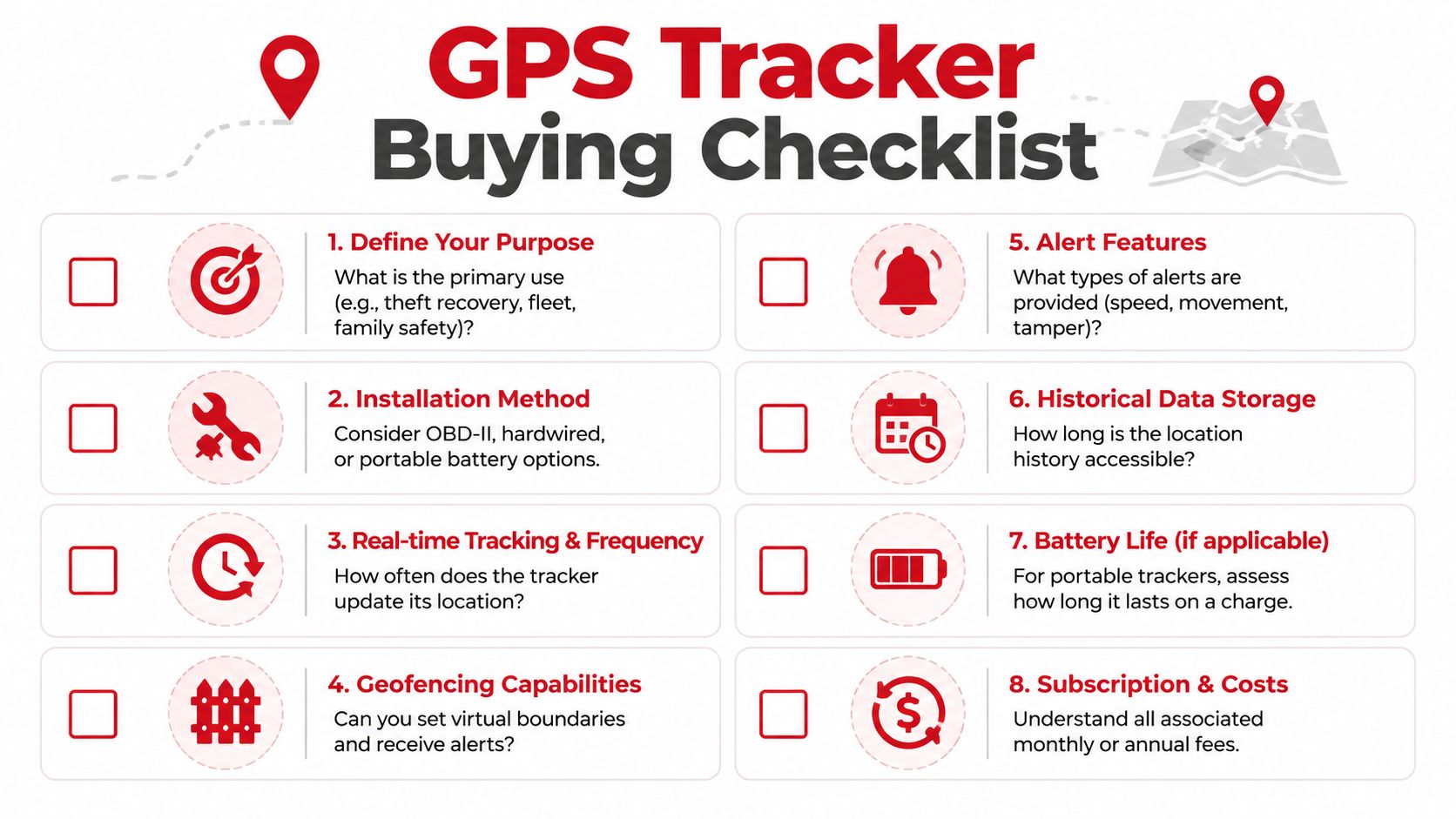
Use this checklist before you buy.
The short list that matters
- Pick the right technology: Choose a true GPS-based vehicle security system, not a Bluetooth item finder if theft recovery is your goal.
- Check the power source: OBD-II and hardwired options usually make more sense for continuous vehicle security than rechargeable battery units.
- Confirm real-time reporting: Make sure the device supports live updates and immediate alerts, not just stored trip logs.
- Look for tamper awareness: A security tracker should warn you if it's unplugged, disconnected, or otherwise interfered with.
- Review the alert types: Movement, engine start, towing, geofence, and battery-related alerts all serve different purposes.
- Test the app experience: The map, alert history, and trip log should be easy to read under stress.
- Understand the subscription: Ask what the recurring fee covers, especially network connectivity and cloud-based alerts.
- Match the device to your climate and use case: A winter theft-recovery setup has different needs than a fair-weather weekend car.
A final rule for making the decision
Buy for the failure scenario, not the demo. In a product listing, almost every tracker looks capable. The actual test is what happens when the vehicle is stolen at night, parked in a difficult location, or exposed to severe cold.
A dependable gps tracker vehicle system should keep power, keep reporting, and keep telling you what changed. That's what turns a tracking device into actual security.
If you want a vehicle security system built around real-time GPS, cellular connectivity, instant smartphone alerts, trip history, and tamper notifications, CARLOCK is one option to evaluate. It's designed for continuous vehicle monitoring rather than casual item finding, which makes it relevant for theft protection, teen driver oversight, and small fleet visibility.