

Driver’s Desk
Finding the Best Car Tracker System: A Data-Driven Guide
Finding the best car tracker system requires a balance between robust, real-time security and user-friendly features. Leading systems, such as CarLock, achieve this by offering simple OBD-II installation, a proactive alert system, and detailed driver monitoring, all managed from a smartphone application. These systems are far more than just a location marker on a map; they are comprehensive security solutions that provide genuine peace of mind, backed by verifiable performance data.
Your Guide to Modern Vehicle Tracking
A modern car tracker is no longer a simple homing beacon. It has evolved into an intelligent co-pilot and a vigilant security guard, consolidated into a single compact device. This evolution is driven by significant market demand for enhanced vehicle safety and connectivity. The global vehicle tracking market was valued at $27.56 billion in 2024 and is projected to reach $78.63 billion by 2032, according to market analysis. This substantial growth reflects a direct response to rising vehicle theft rates—with the FBI reporting over 1 million vehicle thefts in 2022, a 10.9% increase from 2021—and the operational needs of expanding commercial fleets.
What Modern Trackers Actually Do
At its core, the best car tracker system establishes a persistent data link to your vehicle, regardless of its location. This is accomplished using a combination of the Global Positioning System (GPS) for precise location data and a cellular connection to transmit that data to your device. This constant link is the foundation for a suite of powerful features that deliver both security and practical insights.
A truly effective system provides actionable intelligence, answering critical questions in real-time:
-
Is my vehicle being tampered with at this moment?
-
Has my vehicle exited a predefined geographic area (geofence)?
-
What is the current health of my vehicle's battery?
-
Has the engine been started without authorization?
By translating raw data into clear, immediate alerts, a car tracker transforms from a reactive recovery tool into a proactive security system. This empowers you to act before a potential theft is complete, not just after.
Different Trackers for Different Needs
Understanding the primary types of trackers is the first step toward making an informed choice. Each is engineered for a specific use case, balancing ease of installation with the level of security offered. A detailed analysis of various car tracking solutions can provide further context, but let's begin with a direct comparison.
The table below outlines the three most common tracker types. This provides a clear overview of their core differences, enabling you to determine the optimal fit for your vehicle and security requirements.
Quick Comparison of Car Tracker Types
| Tracker Type | Power Source | Installation | Best For |
|---|---|---|---|
| OBD-II Tracker | Vehicle's OBD-II port | Plug-and-play (seconds) | Everyday users, ease of use, and vehicle diagnostics. |
| Hardwired Tracker | Vehicle's battery | Professional installation | Covert anti-theft, constant power, and fleet management. |
| Battery-Powered | Internal rechargeable battery | Magnetic or adhesive mount | Asset tracking, portability, and temporary use. |
As the data suggests, an OBD-II tracker is the optimal choice for most drivers seeking a simple, effective, and data-rich solution. For applications requiring maximum covertness and a permanent power source, such as high-value asset protection or fleet management, a hardwired unit is the superior option. Battery-powered trackers provide unmatched flexibility but necessitate regular battery maintenance.
What Makes a Great Car Tracker? The Must-Have Features
What truly differentiates a basic location device from the best car tracker system? The distinction lies in a set of non-negotiable features that convert a passive device into an active guardian for your vehicle, delivering genuine security through proactive alerts.
These are not merely ancillary functions; they are the industry standard. As technology advances, features like real-time location tracking and geofencing have become baseline expectations. The focus has shifted from simple post-theft recovery to comprehensive, real-time monitoring and prevention.
Let's dissect the essential capabilities that define a top-tier car tracker and demonstrate why each is a critical component of your vehicle's first line of defense.
Real-Time GPS Tracking and Refresh Rates
The fundamental function of a tracker is to report your vehicle's location. However, the term "real-time" is contingent on the device's refresh rate—the frequency at which it updates its position. This metric is of paramount importance during a theft event.
Consider a scenario where a vehicle is stolen. A tracker updating its location every few minutes provides a delayed, fragmented trail, significantly hampering law enforcement's ability to intercept. In contrast, a system that refreshes every few seconds delivers a live, continuous track, enabling a much faster and more effective response.
Key Takeaway: A high refresh rate and pinpoint GPS accuracy are not just for convenience; they are vital for successful vehicle recovery. In an emergency, every second and every meter of precision counts.
Geofencing for Virtual Boundaries
Geofencing is one of the most powerful proactive security tools available. It allows users to define virtual perimeters around specific geographic locations, such as a home, office, or school.
This functions as an invisible boundary for your vehicle. The moment your vehicle crosses this predefined line, either entering or exiting, an instant notification is sent to your smartphone. This is a critical feature in several key scenarios:
-
Theft Prevention: Receive an immediate alert if your car is moved from your driveway overnight.
-
Monitoring Young Drivers: Confirm when a teen driver arrives safely at their destination.
-
Unauthorized Use: Ensure a valet or mechanic is not using your vehicle for unauthorized purposes.
This feature elevates the system from passive tracking to active monitoring of your vehicle's authorized locations, giving you control even from a distance.
Critical Security Notifications
While location data is important, the most urgent alerts are those that signal an immediate threat. The best car trackers monitor the vehicle's state and instantly notify you of suspicious activity—often before a thief has even started the engine. You can review a full suite of these advanced GPS tracking device features and how they create layers of protection.
These notifications function as a digital alarm system, delivered directly to your phone. Here are the most critical alerts to look for:
-
Vibration and Disturbance Detection: A sensitive accelerometer can detect unusual vibrations, such as someone bumping the car, attempting to break a window, or jacking it up to steal wheels. This provides an alert before significant damage occurs.
-
Unauthorized Engine Start: This is a crucial alert. If the engine starts and the system is armed, you are notified immediately, providing an opportunity to contact authorities while the thief is still in close proximity.
-
Device Tampering Alerts: Should a thief locate and attempt to unplug the tracker, a premium system will send a "device disconnected" notification. This alert is a final line of defense, indicating active interference with your security system.
Together, these features create a comprehensive security network that provides a complete picture of your vehicle's safety, empowering you to protect your investment proactively.
Advanced Capabilities Beyond Location Tracking
While real-time location is the core function of any tracker, the best car tracker system today provides far more. These advanced features transform a simple anti-theft device into a comprehensive vehicle management platform, offering a deeper, more useful understanding of your car’s safety, health, and usage patterns.
Basic GPS provides a limited, external view of your vehicle's status. Advanced features, in contrast, are analogous to having a full suite of sensors monitoring every critical system, providing a complete and actionable diagnostic picture.
Monitoring Driving Habits for Safety and Savings
A powerful advanced feature is driver behavior monitoring. Modern trackers are equipped with sophisticated accelerometers—the same technology that orients your smartphone screen—to detect aggressive or unsafe driving maneuvers.
This data provides objective, actionable insights into on-road activity. The system can instantly flag and log events such as:
-
Harsh Braking: Frequent hard stops can indicate tailgating or inattentive driving and lead to premature wear on brake pads and rotors.
-
Rapid Acceleration: Aggressive acceleration significantly increases fuel consumption and places stress on the engine and transmission.
-
Aggressive Cornering: High-speed cornering is not only dangerous but also causes uneven and accelerated tire wear.
This data is aggregated into a simple driver safety score. For families with new drivers, this is an invaluable coaching tool. For any driver, it is a direct method for reducing fuel costs and mitigating mechanical wear.
By translating raw movement data into a clear safety score, a premium tracker helps you improve driving habits, boost safety, and extend the lifespan of your vehicle's critical components.
Unlocking Vehicle Health Diagnostics
Beyond how a car is driven, some of the best trackers report on its internal condition. OBD-II trackers, in particular, connect directly to the vehicle's onboard computer, effectively turning your smartphone into a diagnostic tool.
This functionality demystifies the "check engine" light and helps you proactively address issues. For example, the system can alert you if your car battery's voltage drops to a critical level, preventing a no-start situation. You can learn more about these benefits in our guide on how trackers monitor your vehicle’s overall health and diagnostics.
When the check engine light does illuminate, the tracker can read the specific Diagnostic Trouble Code (DTC). Instead of a vague warning, you receive an exact error code, providing a clear indication of the problem's nature and severity before consulting a mechanic.
The Future of Smart Vehicle Management
This technology is continually advancing. The integration of AI and machine learning is enabling predictive maintenance alerts and optimized, fuel-efficient routing. Concurrently, devices are becoming smaller and more power-efficient, enhancing their covert nature and minimizing battery drain. You can discover more insights about these advancements in GPS tracker technology on DataInsightsMarket.com.
These advanced features elevate a car tracker from a reactive security device to a proactive vehicle ownership partner. It is no longer just about recovering a stolen vehicle; it's about preventing problems, promoting safer driving, and achieving tangible cost savings over the life of your vehicle.
Comparing Tracker Types: Hardwired vs. OBD-II vs. Battery
When selecting the best car tracker system, the first major decision concerns the hardware. This choice dictates installation method, power source, and the type of data you can access. The market is primarily segmented into three choices: hardwired, OBD-II, and battery-powered trackers.
Each is engineered for a different application, offering a unique balance of stealth, simplicity, and power reliability. Making the correct choice is critical to ensure the technology aligns with your security needs and daily usage patterns. Let's examine their comparative strengths and weaknesses.
The Covert Guardian: Hardwired Trackers
For applications demanding discreet, permanent security, hardwired trackers are the superior choice. These devices are wired directly into the vehicle's electrical system and concealed, typically behind the dashboard or within the engine bay. This professional, hidden installation makes them extremely difficult for a thief to detect and disable.
Drawing power directly from the car's battery ensures constant, uninterrupted protection, making this type the standard for high-security anti-theft applications and professional fleet management. The primary trade-off is the requirement for professional installation, which adds to the initial cost and time.
The Plug-and-Play Solution: OBD-II Trackers
For the majority of drivers, OBD-II trackers represent the optimal balance of powerful features and effortless installation. These trackers plug directly into a vehicle's On-Board Diagnostics (OBD-II) port—the same port used by mechanics for engine diagnostics. The installation process is completed in under a minute without any tools.
This direct connection to the vehicle's computer is a significant advantage. It not only powers the device but also allows it to access valuable vehicle health data, such as battery voltage. While more visible than a hardwired unit, the combination of simplicity and rich data makes it the preferred choice for personal vehicle security. The user experience can be further enhanced with features like the CarLock Tag feature, which works seamlessly with the OBD-II system to prevent false alarms.
The Flexible Nomad: Battery-Powered Trackers
For maximum flexibility, battery-powered trackers are unrivaled. Operating on their own internal power, they can be placed almost anywhere—in a vehicle, on a construction trailer, or inside a valuable equipment case. Installation is typically accomplished in seconds using strong magnets or adhesive.
While portability is their key feature, it comes with a significant constraint: battery life. These devices require regular recharging, with battery duration ranging from days to weeks depending on usage and reporting frequency. This makes them less suitable for continuous 24/7 vehicle security but ideal for tracking assets that lack an independent power source.
The choice between tracker types is a strategic one. It's a balance between covert security (hardwired), user-friendly data access (OBD-II), and ultimate portability (battery-powered). Your primary goal—whether it's theft recovery, daily monitoring, or asset tracking—will guide you to the right hardware.
This decision tree helps visualize how different features align with various security priorities, from theft prevention to driver behavior analysis.
As the chart illustrates, if anti-theft is the top priority, features like tamper alerts are essential. If the focus is on vehicle usage, driver behavior insights become more valuable.
To further clarify the choice, the table below provides a detailed, feature-by-feature comparison of the three hardware types.
In-Depth Comparison of Car Tracker Hardware
Choosing the right hardware requires understanding the trade-offs between installation, power, and data capabilities. This table offers a side-by-side analysis of key differentiators to help you select the optimal solution for your needs.
| Feature | Hardwired Tracker | OBD-II Tracker | Battery-Powered Tracker |
|---|---|---|---|
| Installation | Professional installation required; hidden from view. | Plug-and-play; installs in seconds into the OBD-II port. | Magnetic or adhesive; can be placed anywhere. |
| Power Source | Draws power directly from the vehicle's battery. | Powered by the vehicle's OBD-II port. | Internal rechargeable battery. |
| Stealth | Very High – Can be completely hidden. | Moderate – Located at the OBD-II port. | High – Can be hidden anywhere, but larger. |
| Vehicle Data | Limited to location and basic power status. | Access to rich diagnostics like battery health and DTCs. | No access to vehicle data; location only. |
| Best For | Covert anti-theft, fleet management, permanent installs. | Everyday drivers, ease of use, vehicle health monitoring. | Asset tracking, temporary use, rental vehicles. |
Ultimately, the best car tracker is the one that aligns precisely with your specific requirements—whether that means maximum stealth, ultimate convenience, or the flexibility to track any asset, anywhere.
What About Installation and Ownership Costs?
When researching car trackers, the initial device price is only one component of the total investment. To accurately assess the cost, one must consider the total cost of ownership, which includes installation and the recurring subscription fee required for operation. These are not hidden fees but essential components of a real-time tracking service.
Getting the Tracker Installed
The initial cost consideration is installation, which varies significantly between tracker types.
For plug-and-play OBD-II trackers, the process is straightforward. The user locates the vehicle's OBD-II port (typically under the steering column), plugs in the device, and setup is complete. This process takes less than a minute, requires no tools, and incurs no installation cost. It is the definitive do-it-yourself solution.
Hardwired systems, by contrast, require a more involved process. They are designed for direct integration with the vehicle's electrical system and covert placement, necessitating professional installation. This should be performed by a qualified auto electrician to ensure safe, reliable, and discreet integration.
The cost for professional installation typically ranges from $75 to $200. While this represents an additional upfront expense, it results in a tamper-resistant, fully concealed security system that is highly unlikely to be discovered or disabled by a thief.
Why You Need a Subscription Plan
The most significant ongoing cost is the subscription fee. Nearly all real-time GPS trackers require a monthly or annual service plan. This fee is not an arbitrary charge; it is essential for the system's functionality.
The subscription covers several critical services:
-
Cellular Data: Each tracker contains a SIM card that uses a cellular network to transmit location and sensor data from the vehicle to cloud servers and ultimately to your smartphone app.
-
Cloud Storage: All trip histories, alert notifications, and driver behavior reports are securely stored in the cloud for on-demand access.
-
App Maintenance & Support: A portion of the fee funds ongoing mobile app development, feature enhancements, and customer support services.
A subscription fee is the lifeblood of a real-time tracking system. It ensures the device stays connected, the software stays up-to-date, and your data is always accessible, providing continuous and reliable protection for your vehicle.
While upfront and ongoing costs are key, it's also worth knowing about bigger industry trends like data privacy and security vulnerabilities. To get a broader view, you can learn more about the challenges in the car tracker market on MarketReportAnalytics.com. By budgeting for both the hardware and the subscription, you ensure your vehicle has uninterrupted protection without unforeseen expenses.
How CarLock Delivers Real-World Vehicle Security
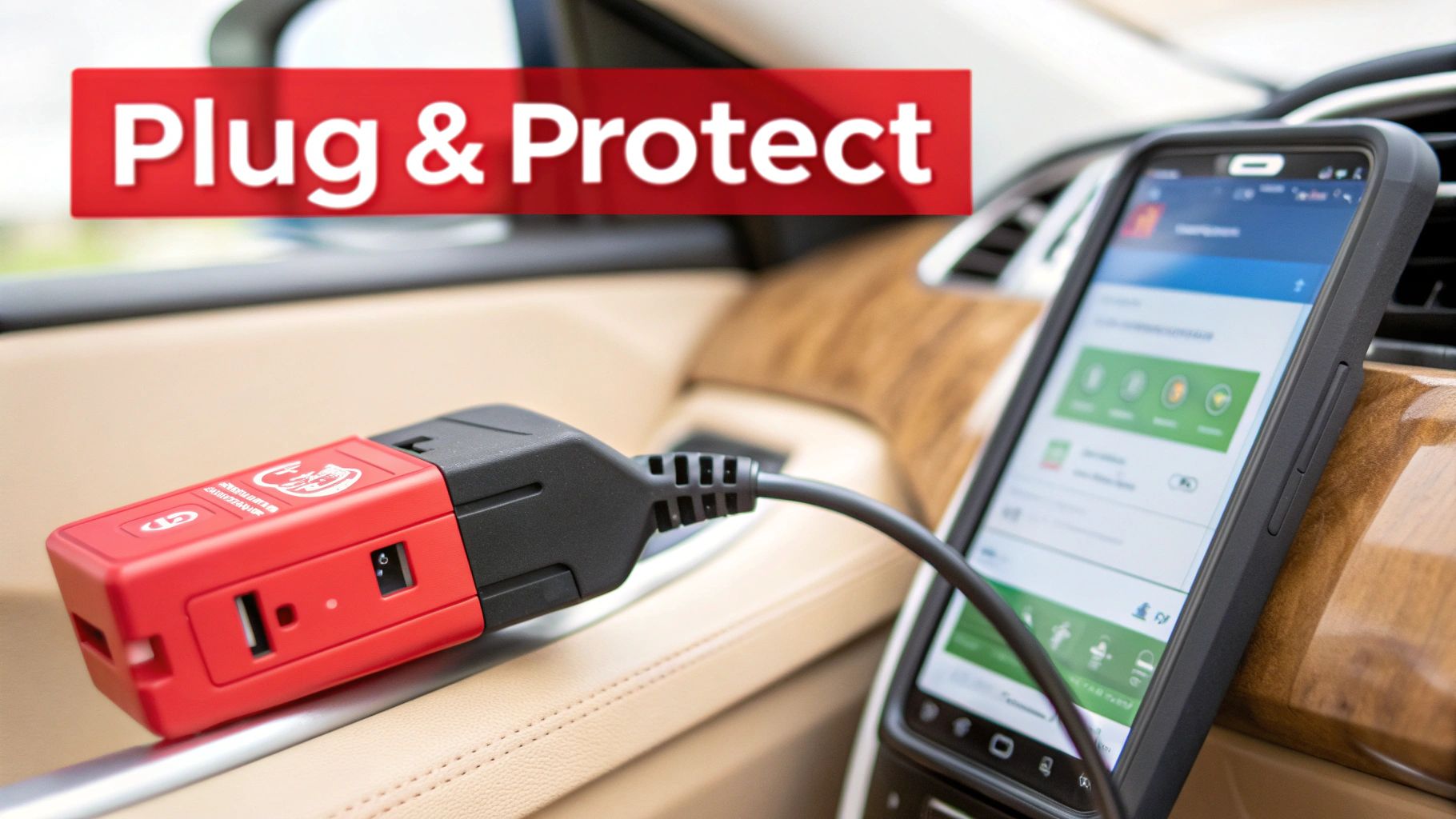
Understanding the features of a car tracker is one thing; seeing how they integrate to protect a vehicle in real-world scenarios is another. CarLock is engineered not just for tracking, but for creating a comprehensive security perimeter around your vehicle. It integrates all the essential features previously discussed into a single, seamless, and user-friendly system.
At its core, CarLock is built on the principle that security must be immediate and effective. The plug-and-play OBD-II device allows for deployment in under 60 seconds. No tools, wiring, or technical expertise is required. From the moment it is plugged in, the vehicle is protected, making it one of the most powerful yet accessible solutions on the market.
This design eliminates the cost and complexity of professional installation, putting advanced security within reach of any car owner and delivering immediate peace of mind.
An Aggressive, Multi-Layered Alert System
CarLock's primary advantage lies in its proactive and aggressive alert system, designed to provide warnings at the first indication of a threat. The system monitors for subtle signs of unauthorized activity that precede a theft.
Using a highly sensitive accelerometer, the system detects suspicious vibrations. This means an instant alert is sent to your phone if the device detects activity such as:
-
An attempt to break a window or pry open a door.
-
The vehicle being jacked up for wheel or catalytic converter theft.
-
Unauthorized towing.
This vibration detection serves as the first line of defense, often providing the critical seconds needed to prevent theft or damage. When combined with alerts for unauthorized engine starts or device disconnection, the system creates a multi-layered shield that monitors the vehicle's status comprehensively.
CarLock turns your smartphone into a virtual watchdog. It doesn't just log events after the fact; it actively monitors your car and sends immediate, actionable alerts for any suspicious activity. Your phone becomes the ultimate anti-theft remote.
Intuitive Monitoring Through a User-Friendly App
All of this powerful technology is managed through an intuitive mobile application that provides a clean, simple overview of your vehicle’s status. The app serves as a command center, putting essential functions at your fingertips without overwhelming you with complex data.
From the app, users can check the vehicle's real-time location, review detailed trip histories, and monitor driver safety scores. These scores are calculated from metrics like harsh braking and rapid acceleration, offering valuable data for coaching new drivers or improving fuel efficiency. For a more detailed look at the available functions, review our complete guide to advanced car security features.
By blending a simple OBD-II installation with a powerful alert system and an easy-to-use application, CarLock delivers a complete security solution. It exemplifies how the best car tracker system should operate—providing not just tracking, but genuine, proactive security that puts you in control. It's security engineered for the real world, where every second counts.
Your Car Tracker Questions, Answered
Implementing a vehicle security system can raise several questions. To ensure you can select a car tracker with full confidence, we have compiled answers to the most common inquiries from drivers.
Will a Car Tracker Kill My Battery?
This is a valid and frequent concern. Modern trackers are engineered specifically to prevent battery drain. A quality system, particularly an OBD-II tracker like CarLock, is designed for minimal power consumption.
When the vehicle is parked, the tracker enters a low-power "sleep" mode, often drawing less current than the vehicle's onboard clock. It only draws more significant power when the engine is running or when it needs to transmit an urgent security alert. Furthermore, advanced systems will notify you if your vehicle's battery voltage drops to a critically low level, thereby helping to protect your battery.
Do I Really Need a Subscription for a GPS Tracker?
Yes, virtually all real-time GPS trackers require a subscription to function correctly. This is best understood as a cellular data plan for your vehicle. The tracker contains a SIM card that requires a connection to a cellular network to transmit its location data to the cloud and, subsequently, to your smartphone app.
A subscription is what keeps a real-time tracking system alive. It's not just an extra fee; it covers the cellular data plan, cloud storage for your driving history, ongoing app updates, and customer support. Be very cautious of trackers advertised with "no subscription fees"—they often lack true real-time tracking or have other hidden costs down the line.
Are Car GPS Trackers Even Legal?
Yes, it is completely legal. For your own personal vehicle, you are 100% within your legal rights to install and use a GPS tracking device. It is your property, and you have the right to secure it.
Legality becomes more complex only when a device is installed on a vehicle you do not own without the owner's explicit consent. For businesses tracking a fleet of company-owned vehicles, it is a standard and legal practice. The best practice for employers is to maintain transparency and inform staff that vehicles are monitored for safety and logistical purposes. For protecting your own vehicle, there are no legal concerns.
Ready to secure your vehicle with a system that’s simple, powerful, and reliable? CarLock provides instant plug-and-play installation, an aggressive alert system, and a user-friendly app to give you complete peace of mind. Learn more and get your CarLock device today.