

Driver’s Desk
Anti Theft Car Alarm Systems: A Data-Driven Guide to Protecting Your Vehicle
When you think of a car alarm, you probably picture a blaring siren that everyone ignores. For a long time, that was the best we had. But today’s anti-theft systems are a whole different ballgame—they've transformed from simple noisemakers into smart, connected guardians for your vehicle.
The best systems out there now fuse traditional alarms with real-time GPS tracking and instant smartphone alerts. This is a huge leap forward. It’s the difference between hearing a siren from a distance and getting a notification on your phone the second someone even touches your car. It’s about proactive protection, not just reacting after the damage is done.
Beyond the Siren: Understanding Modern Car Security
We've all felt that jolt of panic when you can't spot your car where you parked it. For decades, the only defense was a shrieking siren meant to scare off a thief and get attention. The problem is, in our noisy world, most people just tune them out. With a vehicle stolen approximately every 39 seconds in the United States, it's clear that old-school alarms just don't cut it anymore.
The good news? Car security has evolved. Modern anti theft car alarm systems have fundamentally changed how we protect our vehicles. Instead of just making a racket, these intelligent systems are designed to keep you informed and in control, wherever you are.
The New Standard in Vehicle Protection
The modern approach to security is all about silent, smart monitoring. The goal isn't just to scare a thief away with sound; it's to give you actionable information the moment a threat is detected.
What does that actually look like?
- Real-Time Alerts: You get an instant notification sent straight to your smartphone if your car is bumped, moved, or the engine is started without you.
- Precise GPS Tracking: You can pull up a map and see your car's exact location, which is critical for rapid recovery.
- Proactive Monitoring: The system can even learn your driving patterns and flag unusual activity, like sudden braking or a trip you didn't schedule. You can see how this modern approach to car security offers a completely new level of detail.
It’s a total shift in mindset. You're no longer just hoping a loud noise will scare someone off. You are the first line of defense because you're the first to know something's wrong.
Of course, active alarms aren't the only piece of the puzzle. Simple, passive measures still play a big role in a solid security strategy. For instance, the benefits of automotive window tint go beyond looks—tint can hide valuables from view and make your car a less tempting target. As vehicle theft continues to be a problem, understanding these modern tools and strategies isn't just for car buffs; it's essential for anyone who wants real peace of mind.
How a Car Alarm System Detects Threats
Think of a modern car alarm as your vehicle’s own personal security guard. At its heart is a central control unit—the "brain"—which is connected to a network of sensors cleverly placed around the car. This brain is always on duty, listening for any sign of trouble.
When a sensor picks up on a potential threat, like a window shattering or a door being pried open, it shoots a signal to the control unit. The unit immediately springs into action, triggering anything from a classic blaring siren to a discreet, real-time notification sent straight to your phone. This instant, intelligent response is what makes a real security system so much more than just a noisemaker.
The leap from loud, often-ignored sirens to smart, connected alerts has completely changed the game for vehicle protection. This infographic perfectly illustrates that simple but powerful shift.
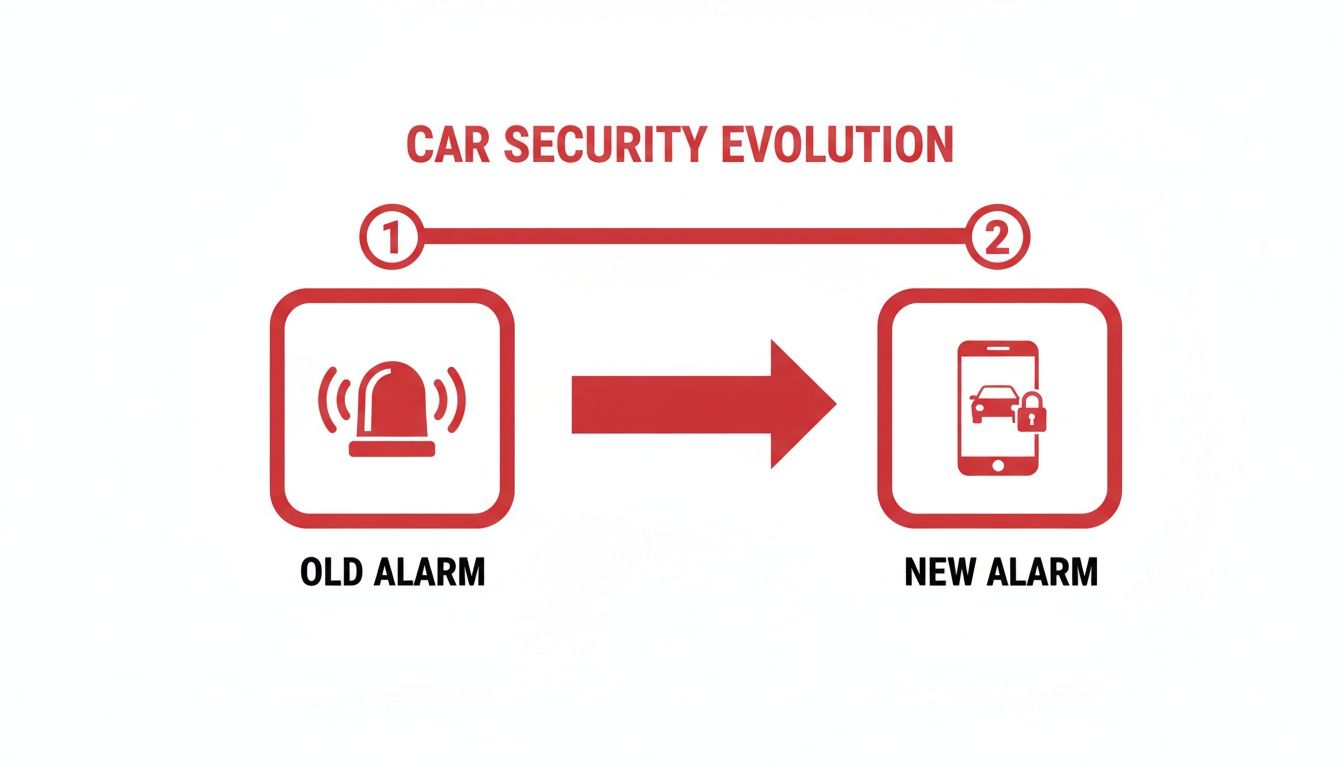
As you can see, the technology has moved from a loud, public broadcast that people often tune out to a proactive, personal alert that puts you in control.
The Key Sensors That Stand Guard
Any anti theft car alarm system is only as good as its sensors. Think of them as the system's eyes and ears. Each type is designed to spot a specific kind of threat, and together they weave a tight security net around your vehicle.
Here’s a breakdown of the most common sensors and what they do:
- Door and Trunk Sensors: These are your first line of defense. They work like simple tripwires and sound the alarm the moment a door, hood, or trunk is opened while the system is armed.
- Shock and Vibration Sensors: These little guys feel for physical impacts. They're tuned to react to the jolt of a window breaking or even another car bumping into yours. The more advanced ones can even pick up on the subtle vibrations from a tow truck trying to lift your vehicle.
- Motion Sensors: Using microwave or ultrasonic waves, these sensors create an invisible field inside your car. If a thief breaks a window without setting off the shock sensor, the second they move inside the cabin, this sensor will catch them.
- Glass Breakage Sensors: These are essentially tiny microphones calibrated to hear the very specific high-frequency sound of shattering glass. This helps avoid false alarms from a passing motorcycle while ensuring an instant response to a break-in.
- Tilt or Inclination Sensors: Absolutely essential for fighting modern theft tactics. These sensors detect if your car’s angle changes. If someone tries to jack it up to steal your catalytic converter or wheels, or tow it away altogether, this sensor knows and sounds the alarm.
From Detection to Action
So, what happens when a sensor is tripped? The control unit has to decide how to respond. A basic factory-installed alarm might just honk the horn and flash the lights. But a modern system gives you a far more powerful and useful response.
Instead of just making a racket in the parking lot, the system’s brain can send a silent alert. This signal travels over a cellular network directly to an app on your phone, giving you an immediate heads-up with specifics like "Vibration Detected" or "Engine Started."
This approach is just smarter. A blaring siren is easily ignored; people are so used to false alarms they just walk on by. A direct notification to your phone, on the other hand, empowers you to act immediately, whether that’s running to the window to check or calling the police with real-time information.
This smooth, rapid flow from detection to notification is the signature of today’s best anti theft car alarm systems, effectively turning your smartphone into a dedicated security hub for your vehicle.
Comparing the Different Types of Car Security
When you're looking for an anti theft car alarm system, it's easy to get lost in the options. But really, it all boils down to three main types of systems. Getting a handle on how each one works is the best way to figure out what you truly need to protect your car and get some peace of mind.
The need for solid car security is bigger than ever. We're talking about a global market that's now worth USD 15.7 billion, and that number is climbing fast. Why? Because car theft is a massive problem, costing vehicle owners an estimated $7.4 billion in 2020 in the U.S. alone.
While old-school alarms still make up over 28.8% of the market, the whole industry is set to grow by 8.1% annually through 2034. The real driver behind that growth? Smart trackers. They’re changing the game.
Factory-Installed Alarms
Most new cars come with a basic alarm right from the factory. Think of it as the default security setting—it's designed to scare off casual thieves by making a lot of noise and flashing the lights.
It’s convenient, no doubt. The alarm is built right into your car’s system and works with your regular key fob. But that's also its weakness. These systems are pretty basic, usually just relying on sensors on the doors, trunk, and hood. Experienced thieves know their limitations and, frankly, most people have learned to ignore car alarms going off in a crowded parking lot.
Aftermarket Alarm Systems
If you want to step up your security, an aftermarket alarm is the next logical move. You buy these systems separately and get them installed, which opens up a world of customization and more advanced features.
With an aftermarket system, you can add things like:
- Shock Sensors: These detect the jolt of a window being smashed.
- Tilt Sensors: Get an alert if someone tries to tow or jack up your car.
- Two-Way Pagers: Your key fob doesn't just arm the system; it buzzes to tell you when the alarm is triggered, even if you're too far away to hear it.
These systems are a definite upgrade and a much better deterrent. The only catch is they can be tricky to install (you'll probably want a pro to do it) and they're still only as good as your ability to respond when the alarm goes off. To see how these features compare, this guide to car security systems offers a great breakdown.
GPS Tracking Systems: The Modern Solution
This is where car security gets really smart. Instead of just making a racket, GPS tracking systems are all about silent, intelligent monitoring that can help you get your car back. They represent the most significant leap forward for anti theft car alarm systems.
A GPS tracker doesn't just scream for help. It tells you exactly where your car is, right now. This completely changes the game, putting you in control and giving you the power to work with police for a quick recovery.
Systems like CarLock push this even further. They pack in a bunch of different sensors and send instant, specific alerts straight to your phone. You'll know if your car is vibrating strangely, if the engine starts without you, or even if the device itself is unplugged. Your phone basically becomes a 24/7 command center for your car's security.
To give you a clearer picture, let's break down how these three system types stack up against each other.
Comparison of Vehicle Security System Types
| Feature | Factory Alarm System | Aftermarket Alarm System | GPS Tracking System (e.g., CarLock) |
|---|---|---|---|
| Primary Function | Noise-based deterrence | Advanced deterrence & remote alerts | Real-time tracking & recovery |
| Alert Type | Local siren & flashing lights | Local siren, flashing lights, pager alert | Silent smartphone notifications |
| Key Advantage | No extra cost, integrated with vehicle | Customizable, better sensors | Pinpoint location tracking, recovery aid |
| Common Weakness | Predictable, easily disabled, "siren fatigue" | Professional installation needed, limited range | Requires a subscription, reliant on cell service |
| Best For | Basic, built-in protection | Users wanting a louder, more sensitive alarm | Proactive monitoring & theft recovery |
As you can see, each system has its place. But for those who want the most comprehensive and proactive protection, a GPS tracker is in a league of its own.
You can learn more about how CarLock’s car tracking capabilities offer this advanced layer of protection, working either as a powerful standalone solution or as a smart upgrade to your existing alarm system.
What to Look For in a Modern Security System
A blaring siren might scare off an amateur, but it's not what defines a truly effective security system anymore. The real game-changer is having a system that silently feeds you real-time intelligence, turning you from a passive victim into an informed first responder. It's about getting the right information, right now.
Think about it this way: an old-school alarm just screams that something is wrong. A modern system, however, sends a notification to your phone telling you exactly what's wrong, where your car is, and when it happened. That’s the kind of information that makes a difference.
Real-Time GPS Tracking and Location History
This is the absolute bedrock of modern vehicle security. Real-time GPS tracking is your single best tool for getting your car back if the worst happens. Instead of just filing a police report and hoping for the best, you can literally open an app and show officers exactly where your vehicle is on a map.
GPS tracking completely changes the narrative from theft prevention to theft recovery. Knowing your car's exact location dramatically increases the odds that police will find it quickly and safely.
Location history is another powerful tool. It keeps a running log of where your car has been, which is incredibly useful for business owners tracking fleet vehicles or for parents who want to make sure their teenager is sticking to approved routes.
Vibration Detection and Engine-Start Alerts
A lot of trouble starts long before a car is actually driven away. Thieves might bump the car to see if an alarm goes off, try to jack it up to steal the catalytic converter, or smash a window. This is where a system’s sensors prove their worth.
- Vibration Detection: This sensor picks up on unusual impacts and movements. Someone bumps your car in a tight parking garage? You get an instant alert on your phone and can go check for damage right away.
- Unauthorized Engine Start: This is one of the most vital alerts you can get. If the engine fires up and you're not the one who started it, the system notifies you immediately. This gives you a crucial head start to call the police before the thief is even out of the neighborhood.
These early warnings are your front line of defense. To get a better feel for how these alerts function in the real world, you can check out the full list of CarLock's device features that offer this kind of detailed monitoring.
Geofencing and Driving Behavior Monitoring
Today’s systems aren’t just about theft; they’re also about giving you a window into how your car is being used when you’re not in it. This is where features like geofencing and driving analysis come into play.
Geofencing is a cool feature that lets you draw virtual perimeters on a map. You could set up a "safe zone" around your home, office, or your kid's school. If the car leaves or enters that zone, you get a notification. For parents of new drivers, this is an incredible source of peace of mind.
On top of that, harsh driving alerts keep an eye on how the vehicle is being handled. The system can flag and notify you about:
- Sudden, aggressive acceleration
- Hard braking
- Sharp, fast cornering
This is perfect for coaching a teen on better driving habits or for a fleet manager trying to promote a culture of safety. By bringing all these features together, a modern anti-theft car alarm system gives you a complete, 360-degree view of your vehicle’s security and use, putting you back in the driver's seat.
Finding the Right Car Alarm for Your Lifestyle
A car alarm isn't a one-size-fits-all gadget. What gives a parent peace of mind is totally different from what a business owner needs to manage a fleet of vans. The real secret is matching the technology to your life, transforming a simple security device into a personalized guardian for your vehicle.
And let's be honest, that kind of smart security has never been more important. Over 1 million vehicles were stolen in the U.S. in 2022, a 7% increase from the previous year. It's no wonder that over 40% of commercial fleets now use tracked alarms. But it's not just for businesses; these systems can deter up to 70% of theft attempts and boost the recovery rate to 85% within the first 24 hours. You can get a deeper dive into the car security system market growth on Data Insights Reports.
Let's break down a few common scenarios to see which features make the most sense for you.
For the Concerned Parent
When you hand the keys to a new teen driver, your worries go way beyond theft. It’s all about their safety and making sure they’re building good habits. Here, an advanced GPS tracker becomes less of a theft-recovery tool and more of a co-pilot for responsible driving.
Look for features that help you guide them:
- Speed Alerts: Get a ping on your phone if the car goes over a speed limit you've set. It’s a perfect, low-drama way to start a conversation about staying safe.
- Geofencing: This lets you draw virtual perimeters around places like school, home, or a friend's house. You’ll know when they arrive or leave these "safe zones."
- Harsh Driving Notifications: The system can flag aggressive moves like flooring the accelerator, slamming on the brakes, or taking corners too fast. It gives you the chance to coach them into becoming a smoother, safer driver.
For the Classic Car Owner
Owning a high-value classic or a collectible car comes with a unique brand of anxiety. These cars are often irreplaceable heirlooms, making them a magnet for professional thieves. For you, the priority is catching the slightest hint of trouble, and doing it discreetly.
With a pristine classic car, the best system is one that offers robust protection without messing with the vehicle's original condition. You want a non-invasive installation and alerts sensitive enough to pick up on the most subtle threats.
The must-have features for this owner include:
- Sensitive Vibration Alerts: You need to know instantly if the car is bumped, jostled, or even just leaned on. This kind of alert can tip you off long before a thief ever gets a door open.
- Discreet Plug-and-Play Installation: An OBD-port device is perfect. There’s no cutting wires, no drilling holes—just simple protection that preserves the car’s integrity.
- Low Battery Notifications: Classics often sit for long periods. An alert that tells you the car's battery is getting low is an absolute lifesaver.
For the Resident in a High-Theft Area
If you live somewhere with a reputation for car crime, your entire focus shifts to immediate response and quick recovery. Let's face it, loud sirens are often just background noise in these neighborhoods. Your most powerful weapon is a silent, instant notification sent straight to your phone.
The goal is to know a threat is happening the second it starts, giving you a critical head start to call the police. You can read reviews from CarLock users who've been in this exact situation and got their cars back. For this scenario, nothing beats unauthorized engine start notifications and real-time GPS tracking to get your vehicle back fast.
Getting Started: Installation and Upkeep
You’ve picked out the perfect anti-theft car alarm system. Now what? For many people, the thought of a complicated installation is enough to cause a headache. With traditional aftermarket alarms, you're usually looking at a trip to a professional installer. That means booking an appointment, paying for labor, and leaving your car at the shop for hours while someone splices into your vehicle's wiring.
Thankfully, modern systems have tossed that old playbook out the window.
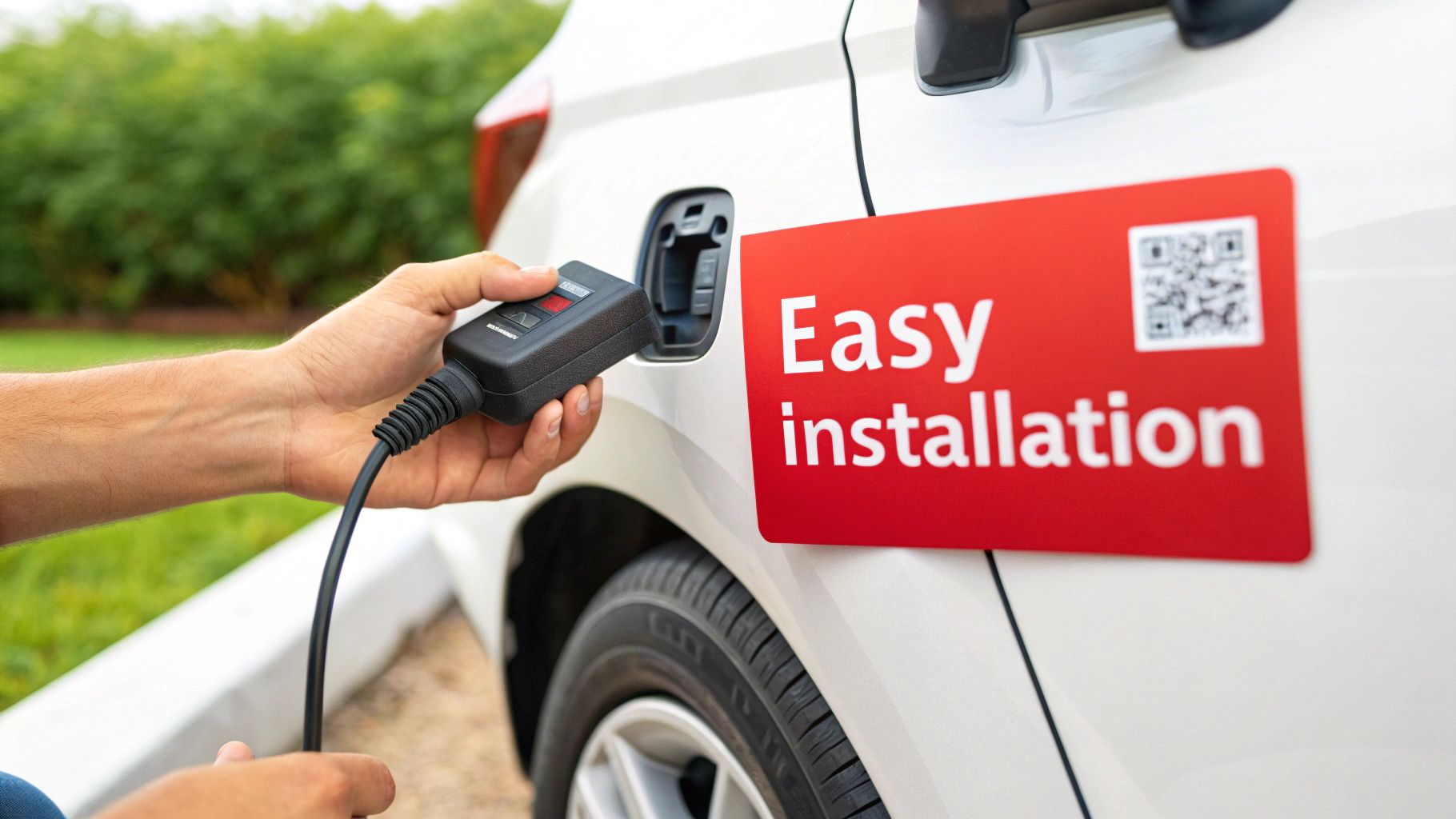
Solutions like CarLock are designed for real people, not expert mechanics. They use a simple plug-and-play setup, which means you can literally install it yourself in about 30 seconds. All you have to do is find your car's OBD (On-Board Diagnostics) port—it's almost always under the dashboard near the steering wheel—and plug the device in. No tools, no wiring, no fuss.
Keeping Your System Running Smoothly
Once your system is plugged in and active, keeping it in good shape is a breeze. Forget about the periodic check-ups and recalibrations that older alarms sometimes needed. Modern GPS-based trackers are pretty much self-sufficient.
Your main job is just to make sure the device can talk to the network and the satellites. Here’s all you need to do:
- Check for a Clear Signal: The tracker needs a relatively clear line of sight to the sky to pick up GPS signals. The OBD port location works great for this, but try to avoid stuffing metal objects in the area that could block it.
- Update Your App: Your phone is the control center for the whole system. Keeping the app updated means you always have the latest features, security fixes, and performance boosts.
- Keep Your Subscription Active: Real-time tracking relies on a cellular connection to send alerts, which usually requires a small monthly subscription. Just make sure it’s current, and you’ll have seamless, round-the-clock protection.
The Payoff: Financial and Legal Perks
Putting a quality security system in your car isn't just about peace of mind—it's a genuinely smart financial move that comes with some serious legal muscle. Insurance companies love seeing proactive security measures and often give a little something back to owners who install certified anti-theft devices.
Insurance Savings: It's common for insurers to offer premium discounts from 10% to 25% for cars with active GPS tracking. Why? Because these devices make recovering a stolen vehicle much more likely, which saves the insurance company from a massive payout.
This financial benefit is a big reason why car alarms make up over 28.8% of the global revenue in the entire vehicle anti-theft market. Whether you're managing a fleet of work vans or just protecting your daily driver, the insurance savings can often cover the cost of the system itself. You can dig deeper into the trends driving the vehicle anti-theft market on grandviewresearch.com.
And if the worst does happen, the data from your GPS tracker becomes your best friend. The detailed location history provides solid, admissible evidence for law enforcement and your insurance company. It cuts through the red tape and makes a stressful situation much easier to handle.
Common Questions About Anti-Theft Car Alarms
Even with a good grasp of the tech, you probably still have a few questions rolling around in your head. That's completely normal. Choosing the right anti-theft car alarm system is a big decision, so let's clear up some of the most common concerns to help you feel confident about protecting your car.
Will a GPS Tracker Drain My Car Battery?
This is easily one of the most frequent questions we hear, and it’s a smart one to ask. Nobody wants to find their car with a dead battery.
Thankfully, modern GPS trackers like CarLock are designed to be incredibly power-efficient. When your car is parked, the device goes into a power-saving "sleep mode," sipping just enough energy to stay vigilant. It only wakes up and uses more power when it detects a potential threat, like a vibration or someone trying to start the engine.
If you drive your car daily, you'll never even notice the tiny amount of power it uses. As an extra safeguard, many systems will even send you a "low battery" alert if your car's main battery voltage starts to drop, giving you a heads-up before it ever becomes an issue.
Do Anti-Theft Systems Really Lower Insurance Premiums?
Yes, they often do! Insurance companies love anything that reduces their risk, and a good anti-theft system does just that. By making your car harder to steal and easier to recover, you're a less risky client.
Insurers often pass those savings on to you with discounts ranging anywhere from 5% to over 25%.
The exact discount depends on the type of system you have. A basic factory immobilizer might get you a small break, but an active GPS tracker that offers real-time location data for quick recovery will usually land you in the top tier of savings. Your best bet is to call your insurance agent and ask them directly what discounts they offer for specific anti-theft devices.
At their core, these systems serve different purposes. An immobilizer is passive; it just stops the engine from starting without the right key. An alarm is active; it's designed to detect a break-in and make a lot of noise or send an alert to your phone. A GPS tracker is your recovery expert.
If a thief gets past the first two layers, the tracker gives police the live location data they need to get your car back fast. To dig deeper into these differences, check out these answers to common GPS tracker questions.
Ready to upgrade your vehicle’s security with a system that puts you in control? CarLock offers real-time tracking, instant alerts, and the peace of mind you deserve. Protect your car today at https://www.carlock.co.