

Driver’s Desk
A Complete Guide to Car Security Anti Theft Systems in 2026
When it comes to protecting your car, the best defense is a layered one. Think of effective car security anti theft not as a single product, but as a complete strategy. It's about combining visible deterrents, smart electronics, and real-time tracking to build a fortress around your vehicle. This multi-faceted approach is, without a doubt, the smartest way to guard one of your most valuable assets.
The Realities of Modern Car Theft
To grasp why a robust security plan is non-negotiable, you must accept an uncomfortable truth: your vehicle is a prime target for thieves. Car theft is a crime that always feels distant—until it happens in your own driveway.
The statistics from the National Insurance Crime Bureau (NICB) paint a stark picture. In 2022, over one million vehicles were stolen in the United States, a 7% increase from the previous year. Even more alarmingly, this translates to a vehicle being stolen approximately every 32 seconds, contributing to over $8 billion in losses. This isn't just an abstract number; it directly impacts your wallet through rising insurance premiums as companies struggle to cover billions in annual claims.
A Problem That Varies by Location and Vehicle
Car theft is not a random act. Risk is heavily concentrated in certain metropolitan areas and on specific vehicle types. States like California and Texas consistently report the highest number of thefts, with urban centers serving as hotspots for opportunistic criminals.
It's also true that not all cars are targeted equally. Thieves tend to focus on:
- Popular Models: Everyday vehicles like full-size pickup trucks and common sedans are goldmines for their parts, which can be stripped and sold quickly on the black market. The Chevrolet Silverado 1500, for instance, has been a perennial favorite target.
- Older Vehicles: Cars manufactured before modern anti-theft technology (like transponder chip keys and engine immobilizers) became standard are often much easier to steal with traditional methods.
- High-Value and Luxury Cars: These are frequently snatched by organized crime rings, destined for illegal export to overseas markets where they fetch a premium price.
The real cost of car theft goes way beyond a vehicle's sticker price. Even when theft rates fluctuate, the total value of stolen vehicles keeps climbing. This adds up to billions in annual losses and ultimately drives up insurance costs for every car owner.
The Financial and Personal Cost of Theft
Losing your vehicle is far more than just an inconvenience; it's a major financial blow and a deeply personal violation. The most obvious cost is losing your car if it isn't recovered, but the other expenses pile up fast—insurance deductibles, rental car fees, and the administrative nightmare of filing police reports and claims.
This is precisely why a proactive approach to car security anti theft is so essential. Simply relying on a factory-installed alarm is often insufficient to deter a motivated thief. Our guide on what makes a complete car security system can provide a clearer understanding of what layered protection entails.
By understanding the real-world, data-backed risks, you can start making smarter decisions to protect your investment and, just as importantly, your peace of mind.
How Thieves Target and Steal Your Vehicle
To stop a thief, you first have to think like one. Long gone are the days of a single, one-size-fits-all method for stealing a car. Today’s criminals employ a diverse toolkit, from surprisingly simple brute-force attacks to sophisticated digital exploits that feel like something out of a spy movie. Understanding how they operate is the first step to building a rock-solid car security anti theft strategy.
Forget the idea of a master thief randomly picking a car on the street. Most car theft is a crime of opportunity. An unlocked door, a window cracked open, or valuables left in plain sight are practically an open invitation. But even if you’ve got the basics covered, a determined thief has plenty of ways to get around your car’s factory-installed defenses.
Old-School Tactics Still Work
Even with all the new technology in cars, the classic methods haven't gone away. Why? Because on older or less secure vehicles, they're still incredibly fast and effective. These are the physical techniques aimed at bypassing mechanical locks and basic alarms.
Some of these tried-and-true methods include:
- Forced Entry: The smash-and-grab is the oldest trick in the book. A broken window or a slim jim slid down the door panel is often the quickest way inside. From there, they can either attempt to start the car or steal any valuables left behind.
- Hot-Wiring: This is the classic movie scene where a thief rips open the steering column and manipulates the wiring. While modern electronic immobilizers have made this nearly impossible on newer cars, it’s still a real threat for vehicles built before the early 2000s.
- Key Cloning: This takes more skill. A thief with the right hardware can capture and copy the signal from your physical key, essentially creating a perfect digital twin that your car's security system will accept without question.
The Rise of Digital and Tech-Based Theft
As our cars have become rolling computers, thieves have evolved into hackers. They've developed clever digital attacks that turn the very technology designed to protect your car against you.
A thief no longer needs a crowbar to steal your car; sometimes, all they need is a laptop or a signal amplifier. Modern theft often involves exploiting the very conveniences, like keyless entry, that drivers have come to love.
Relay Attacks are one of the most widespread high-tech threats today. The process is shockingly simple: one thief stands near your home with a signal-boosting device, capturing the faint signal your key fob constantly emits. That signal is then relayed to an accomplice next to your car, tricking your car's computer into thinking the key is present. The doors unlock, the push-to-start button works, and they're gone in seconds.
Even more frightening is CAN Bus Injection. Think of your car’s Controller Area Network (CAN bus) as its central nervous system—it manages everything from the windows and locks to the engine itself. Thieves have discovered how to tap into this system, often by removing a headlight to access the wiring. Once connected, they can send fraudulent commands directly to the car's computer, instructing it to unlock the doors and start the engine.
The New Wave of Low-Tech Hacks
Ironically, some of the most recent theft trends exploit high-tech cars with surprisingly simple tools. This has made certain models huge targets for thieves, as recent data from the National Insurance Crime Bureau (NICB) shows.
A massive surge in thefts of specific Hyundai and Kia models, for instance, wasn't the result of a sophisticated digital hack. Instead, thieves discovered a vulnerability in models that lacked a standard engine immobilizer and figured out they could bypass the ignition system with nothing more than a common USB cable. This simple exploit caused a dramatic spike in thefts for those vehicles.
Top 5 Most Stolen Vehicles in the US (2022 Data)
The following table, based on the NICB's 2022 "Hot Wheels" report, summarizes the most frequently stolen vehicles. These numbers often reflect a combination of a vehicle's popularity and specific vulnerabilities that thieves have learned to exploit.
| Rank | Vehicle Model | Number of Thefts |
|---|---|---|
| 1 | Chevrolet Pickup (Full Size) | 49,903 |
| 2 | Ford Pickup (Full Size) | 48,175 |
| 3 | Honda Civic | 27,113 |
| 4 | Honda Accord | 27,089 |
| 5 | Hyundai Sonata | 22,464 |
Seeing models like the Hyundai Sonata and Honda Civic on the list highlights how a combination of popularity and known vulnerabilities can make a car a prime target. You can find more details in the full report on the most stolen vehicles to see where your car stands.
Knowing the enemy's tactics—from jimmying a door to hijacking the car's computer—makes it clear that a single factory alarm just isn't enough anymore. The only truly effective car security anti theft plan is a layered one, with multiple defenses designed to counter each of these threats.
Building a Layered Security Strategy for Your Car
If you want to truly protect your car, don't rely on just one gadget. Professional thieves are masters at bypassing a single security device. The real secret is to think in layers. The best defense is a smart framework that forces a criminal to waste time, make a ton of noise, and dramatically increase their chances of getting caught.
This idea is what security professionals call a "layered defense," and it's a core principle in protecting anything valuable. Think of it like defending a castle. You wouldn't just count on a strong front gate, would you? Of course not. You’d have a moat, high walls, vigilant guards, and a fortified keep inside. Each layer has a job, and together, they make the castle a nightmare to attack.
To see why this is so vital, just look at the different ways thieves operate. They have a whole playbook of tricks.
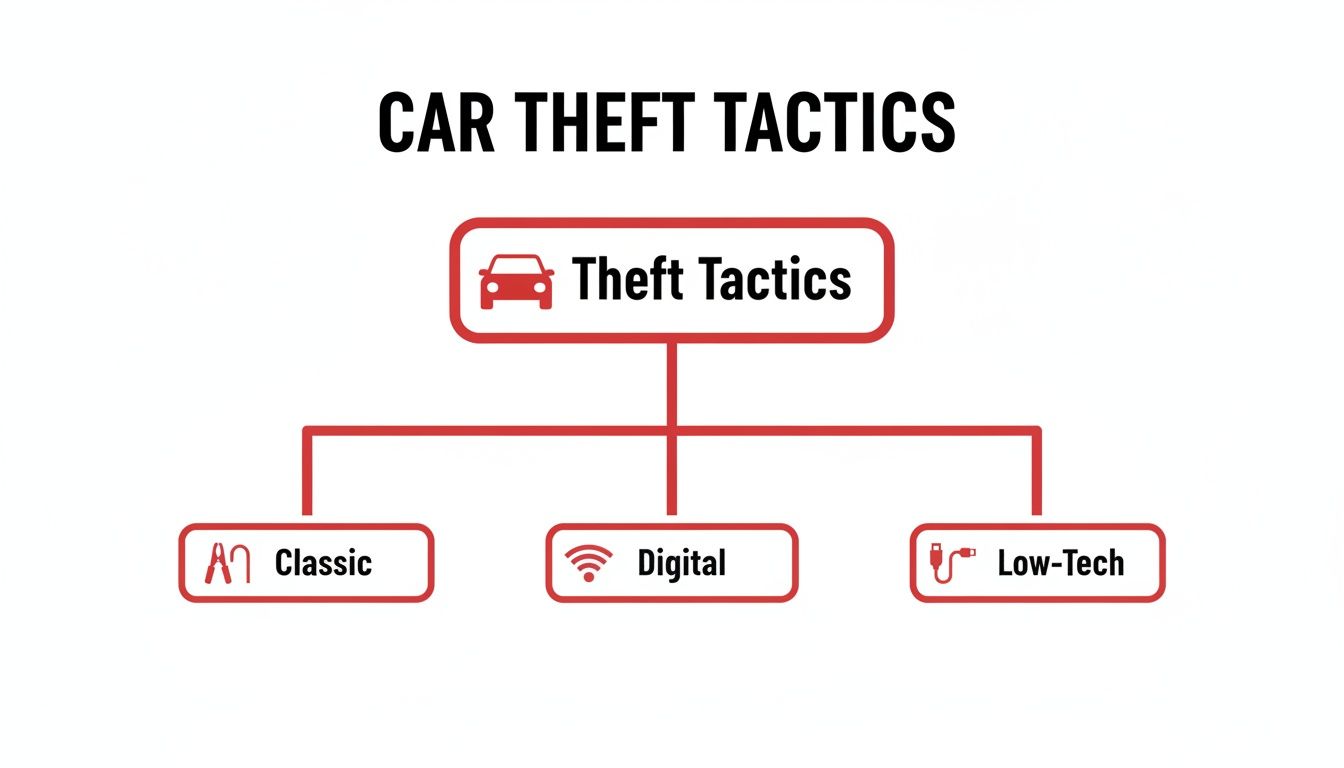
As you can see, their tactics range from old-school brute force to slick digital hacks and even simple, opportunistic moves. The only way to counter such a diverse threat is with an equally diverse, multi-layered security plan.
Layer 1: Visual Deterrents
Your first line of defense is psychological. It’s all about making your car look like more trouble than it's worth. A thief casing a parking lot for an easy target will almost always skip the car that’s visibly protected and move on to the next.
Common visual deterrents include:
- Steering Wheel Locks: These large, brightly colored metal bars are impossible to ignore. They signal that stealing the car will require noisy power tools and significant time.
- Blinking LED Lights: A tiny flashing light on the dash—whether from a real alarm or a dummy unit—plants a seed of doubt. Is there an active system? Most thieves won't stick around to find out.
- Security Decals: Simple stickers announcing the vehicle is protected by an alarm or GPS tracking can be surprisingly effective. It’s a low-cost way to make a criminal think twice.
Will these stop a determined professional? Probably not. But they are fantastic at warding off the opportunistic crooks who are responsible for a huge number of vehicle thefts.
Layer 2: Audible Alarms
So, what if a thief ignores the visual warnings and tries to get in anyway? That's when your second layer kicks in: the alarm. The goal here is brutally simple—create chaos and draw a ton of unwanted attention.
A piercing car alarm is a thief’s worst enemy. It destroys their cover of silence, makes people look, and shrinks their window of opportunity from minutes to seconds.
Most factory alarms only activate when a door or trunk is forced open. However, superior aftermarket systems, which you can learn about in our guide to choosing a modern car alarm, add more triggers. They can detect the sound of breaking glass, motion inside the car, or even the vehicle being tilted—as it would be if someone tried to tow it or steal its wheels.
Layer 3: Immobilizing Devices
Let's say a thief is bold enough to break in and tough out the siren. Your third layer is what stops them dead in their tracks. Immobilizers are devices that prevent the engine from starting or the car from being driven, even if the thief has defeated the locks and the ignition.
Some of the most effective immobilizers are:
- Kill Switches: This is a hidden switch that cuts power to a vital system, like the fuel pump or starter. If the thief doesn't know where it is and how to flip it, the engine will not start.
- Steering Column Locks: A mechanical lock that physically stops the steering wheel from turning, making it incredibly difficult to steer or tow away.
- Electronic Immobilizers: These are standard on almost all modern cars. They require a key with a specific transponder chip to be present for the engine to start. No chip, no start.
Layer 4: Tracking and Recovery
This is your final, critical safety net. If a determined thief manages to get past every other defense and actually drive off, a tracking system is your best—and often only—shot at ever seeing your car again.
GPS trackers provide real-time location data, allowing you and law enforcement to pinpoint exactly where your vehicle is. This technology flips the script on car theft, turning what used to be a near-certain loss into a high-probability recovery. The best systems even send you an instant alert if your car moves without your permission, giving you a crucial head start.
By weaving these four layers together, you create a comprehensive car security anti theft strategy. You're no longer relying on a single point of failure; you've built a system that makes your vehicle a frustrating, risky, and difficult target for any criminal.
Why Real-Time GPS Tracking Is a Game Changer
Visual deterrents, alarms, and immobilizers are all about stopping a thief in their tracks. But what happens if a truly determined criminal manages to bypass them all? That’s where the most powerful layer of modern vehicle protection comes into play: real-time GPS tracking. It completely changes the dynamic, shifting the strategy from passive prevention to active, real-time recovery.
Think about a traditional car alarm. It blares away, but in most cities, it’s just background noise that gets ignored. This is passive security. It makes a scene and hopes someone notices. A modern tracking system, on the other hand, is proactive. It empowers you by turning your smartphone into a virtual watchdog for your car.
From Passive Alarms to Proactive Alerts
The real breakthrough is the immediate, actionable information you receive. Instead of a loud horn that everyone tunes out, a real-time system sends a specific alert straight to your phone. This is the cornerstone of an effective car security anti theft response, giving you the power to take action the second something is wrong.
Systems like CarLock exemplify this proactive philosophy. They don’t just wait for a door to be pried open. Instead, they use a suite of sensors to detect the subtle signs of a theft in progress:
- Vibration Detection: The system can pick up on faint vibrations, such as those from power tools, a window being smashed, or even the car being jacked up to steal the wheels. You get an alert before a thief even sets foot inside.
- Unauthorized Engine Start: If the engine starts but your phone isn't nearby, you'll receive an immediate notification. This is a critical alert that can stop a theft dead in its tracks.
- Vehicle Movement: If your car is being towed or hauled away on a flatbed without the engine running, you’ll know about it instantly. This is essential for catching thieves who try to avoid starting the car altogether.
This constant stream of real-time data completely transforms your ability to protect your vehicle. You’re no longer a helpless bystander; you become the first line of defense. To see all the features in action, you can explore the details of our advanced car tracking technology.
A Real-World Recovery Scenario
The true value of this technology becomes clear when you see how it plays out in the real world. Imagine this: You park your car for the night and head inside. Hours later, your phone buzzes—a "Vibration Detected" alert from your CarLock app. A moment later, a second alert pops up: "Vehicle Started."
You know immediately a theft is happening. You call the police, but instead of just reporting a stolen car, you can give them its exact location, moving in real-time on a map. Officers can track the vehicle's path, leading to a quick interception and recovery, often within minutes.
A real-time GPS tracker is your ultimate safety net. It provides the critical location data and immediate alerts needed for swift police intervention, turning a potential total loss into a successful recovery.
This isn't a fantasy scenario. The ability to provide live tracking data dramatically boosts the chances of getting your car back, and fast. While recent data shows motor vehicle thefts may have fallen by 17% in early 2024, staying vigilant is still crucial as overall numbers remain historically high. You can learn more about how these trends are impacting car owners on KBB.com.
In a layered security plan, a GPS tracker is your final and most important piece. It answers the critical question: "What if everything else fails?" By giving you a direct, live link to your vehicle, it ensures you always have a way to fight back.
Smart Habits That Outsmart Thieves
All the gadgets and alarms in the world can't replace good old-fashioned common sense. The truth is, some of the most powerful car security anti theft strategies are habits, not hardware. They don’t cost a dime, but they can make all the difference.
Think of it this way: thieves are looking for an easy score. They're opportunists. By making a few small tweaks to your daily routine, you can make your vehicle look like too much trouble, encouraging them to simply move on to an easier target. These aren't just random tips; they're tactical moves that make every other security layer you have even stronger.
Make Your Location a Deterrent
Your first line of defense is decided the moment you put your car in park. Thieves love darkness and hate an audience, so where you leave your car can either work for you or against you.
Whenever possible, always park in well-lit, high-traffic areas. A thief is going to feel far more exposed under a bright streetlight or in a garage with security cameras than they would on a deserted side street. In fact, a study of convicted car thieves found that nearly 25% admitted to backing off a potential target if they felt the risk of being seen was too high.
Think of your parking spot as the first layer of your vehicle’s defense. A well-chosen location is a passive guard that works for you around the clock, creating an environment where thieves feel exposed and vulnerable.
Employ Simple Physical Barriers
Don't forget the simple, built-in mechanics of your car. A couple of old-school tricks can throw a real wrench in a thief's plans, especially if they’re trying to tow your vehicle away.
When parking on a hill, turn your steering wheel all the way toward the curb. If someone tries to tow your car, the front tires will immediately jam into the curb, making noise and stopping them in their tracks. Even on a flat street, turning the wheels to a full lock engages the steering column lock. It’s one more physical barrier they have to break before they can get anywhere.
Defend Against Digital Threats
The convenience of keyless entry has opened the door for high-tech thieves. Using a method called a relay attack, they can capture the signal from your key fob—even from inside your house—and use it to unlock and start your car.
Luckily, the fix for this high-tech problem is surprisingly low-tech.
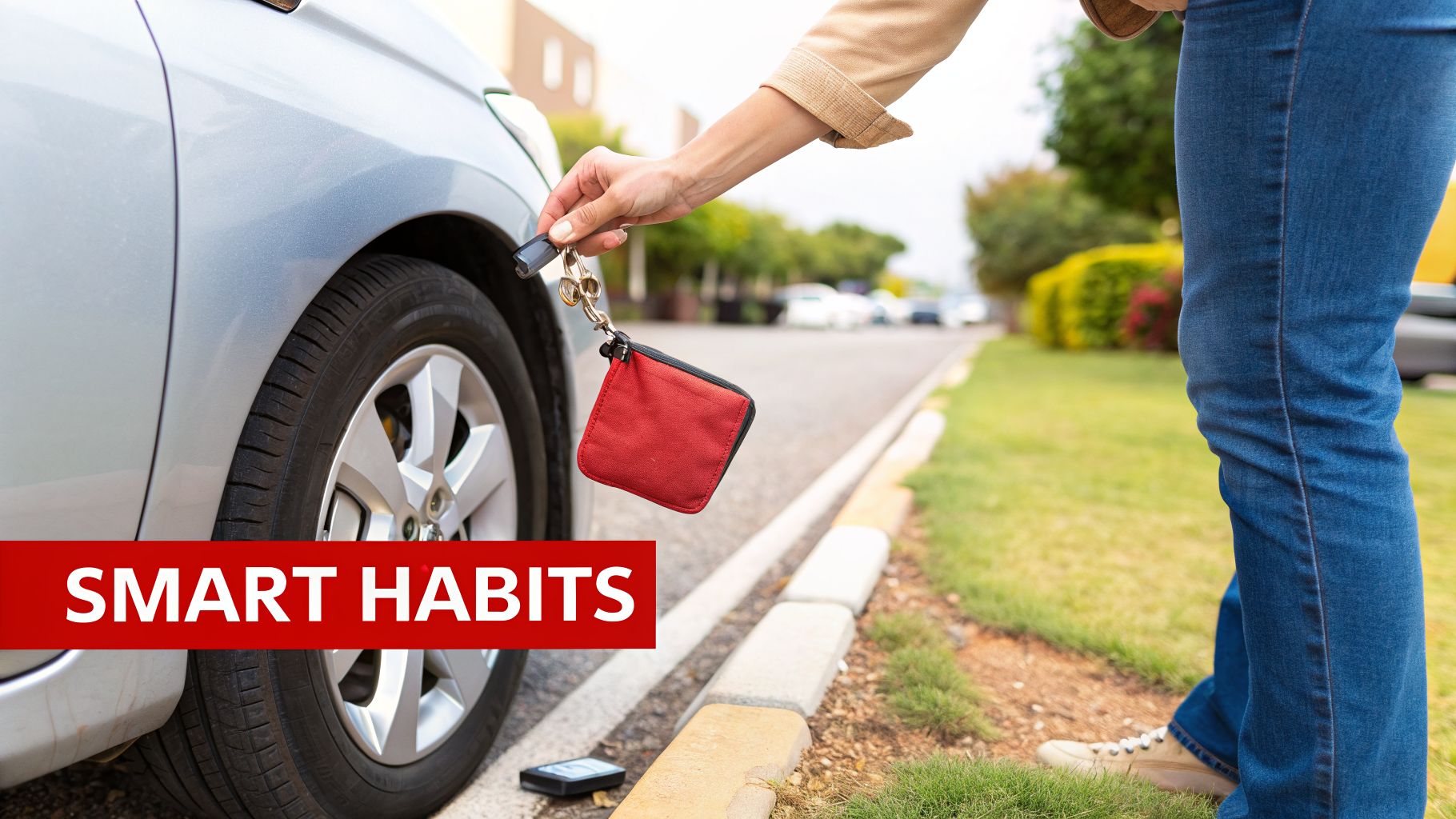
- Use a Faraday Pouch: This is non-negotiable for keyless fobs. When you're at home, store your keys in a signal-blocking pouch or box. These create an electromagnetic shield (a Faraday cage) around the fob, so thieves can't sniff out its signal.
- Keep Keys Away From Doors: It sounds obvious, but don't leave your keys on a hook or in a bowl right by the front door. The farther your keys are from the exterior of your house, the harder it is for a relay device to pick up the signal.
When you combine these habits with your other security devices, you create a powerful defense. You're not just making your car physically harder to steal; you're sending a clear psychological message to any would-be thief that this car is not worth the hassle.
Navigating Insurance Claims and Recovery
Let’s talk about a silver lining. Investing in a solid car security anti theft system does more than just stop thieves—it can also save you money and headaches if the worst should happen. Insurance companies recognize the value of these devices; many offer discounts on comprehensive coverage if your vehicle is equipped with an approved anti-theft system. That means your security setup can start paying for itself from day one.
These premium reductions can apply to everything from passive immobilizers to advanced, real-time GPS trackers. Simply provide proof of installation to your insurer, and you could see your comprehensive premiums drop. It's a true win-win: your car is safer, and you keep more of your hard-earned money.
What to Do If Your Car Is Stolen
That gut-wrenching moment you realize your car is gone is something no one wants to experience. But keeping a cool head and acting fast can make all the difference in getting it back.
If your car disappears, here’s your immediate action plan:
- Confirm It Was Stolen: Before panicking, take a breath. Is it possible it was towed? A quick call to your local police non-emergency line or a nearby impound lot can clarify this.
- File a Police Report: Once you confirm the theft, report it to the police immediately. You’ll need to provide the make, model, year, color, and license plate number. The single most important piece of information is your Vehicle Identification Number (VIN). Keep a photo of your VIN (on your dashboard or doorjamb) on your phone for easy access.
- Provide Tracking Data: This is where a GPS tracker becomes invaluable. If you have one, share its live location data with the police dispatch right away. This information is an absolute game-changer, giving officers a direct path to intercepting your vehicle. To see how this works in practice, take a look at the features of a modern car locator system.
- Contact Your Insurance Company: As soon as you have a police report number, get on the phone with your insurer to begin the claims process.
The Role of Insurance and Swift Recovery
The financial impact of car theft is staggering. According to recent data, national vehicle theft recovery rates are worryingly low, with some reports showing less than half of all stolen vehicles are ever returned to their owners. For example, some Canadian hot spots like Ontario and Quebec see recovery rates stuck around 50%. You can discover more insights about these car theft trends and their impact on San.com.
This is precisely where your insurance policy steps in. Before you need to file a claim, it’s vital to understand your policy, especially what comprehensive auto insurance covers. This is the part of your policy that handles non-collision events, including theft.
A GPS tracker transforms an insurance claim from a potential total loss into a recovery mission. Providing law enforcement with live tracking data not only drastically speeds up the recovery but also simplifies your claim and gets you back on the road faster.
Without a tracker, the process is usually a painful waiting game. If your vehicle isn't found within a set timeframe (often 15-30 days), your insurer will likely declare it a total loss. They'll pay out its actual cash value, minus your deductible, and you're left shopping for a new car.
With a GPS tracker, you have a very real chance of getting your actual vehicle back, often with minimal damage. This saves you from the financial hit, the stress of replacement, and the loss of a car you know and trust.
Frequently Asked Questions About Car Security
Even after digging into car security anti theft systems, a few questions always seem to pop up. It's completely normal. Let's tackle some of the most common ones we hear from drivers who are serious about protecting their cars.
Is a Factory-Installed Car Alarm Enough?
In short, no. While a factory alarm is better than nothing, think of it as just the first, most basic step. We've all heard them go off in a parking lot and seen everyone just ignore them. Thieves know this, too.
Professionals can often bypass a standard factory alarm in seconds. That's why a truly effective security plan is layered. You want to combine that basic alarm with tougher defenses like an engine immobilizer and, crucially, a real-time GPS tracker to create a setup that will actually stop a determined criminal.
Are Kill Switches Legal to Install?
Yes, installing a kill switch is perfectly legal in all 50 states. It's a common question, but you can rest easy on this one.
A kill switch is considered an aftermarket security device. It doesn't interfere with your vehicle's essential safety systems like airbags or brakes. It simply interrupts a single circuit—like the one to the fuel pump or starter—to prevent the engine from running. Because it's purely for security, there are no legal issues with adding one to your car.
Why Do I Need to Pay a Subscription for a GPS Tracker?
This is all about the "real-time" part of the equation. For a GPS tracker to be truly effective, it needs to be able to communicate with you right now. That requires a connection to a cellular network. The subscription fee simply covers the cost of that cellular data plan.
Without a subscription, a GPS tracker is like a phone with no service. It might be able to record its location, but it has no way to send that critical information to you when you need it most—during a theft.
Think of that small fee as the power source for your peace of mind. It’s what keeps the device constantly connected, ready to instantly alert you to vibrations, an unauthorized engine start, or if the car is moved without your key. This live link is what turns a tracker from a passive gadget into a powerful recovery tool.
We have a whole page dedicated to these kinds of inquiries. You can find more answers to your GPS car tracker questions on our dedicated page.
For the ultimate peace of mind, a proactive security system that puts you in control is essential. CarLock provides instant alerts and real-time tracking, acting as your vehicle’s 24/7 digital guard. Secure your car today by visiting https://www.carlock.co.