

Driver’s Desk
Your Expert Guide to a Real Time GPS Tracking Device in 2026
At its core, a real-time GPS tracking device is a compact electronic unit that determines its precise location using signals from the Global Positioning System (GPS) satellite network. It then transmits this location data over a cellular network to a secure server, allowing you to monitor your vehicle's position and status live via a smartphone app. This provides an up-to-the-minute, actionable overview of your car's security, making it one of the most powerful anti-theft tools available today.
Beyond the Car Alarm: Why You Need a Real-Time Tracker
Let’s be honest: when was the last time you saw someone rush to a window because a car alarm was blaring? A 2017 study found that less than 1% of people who hear a car alarm actually report it to the police. We've all learned to tune them out. In a world where car thieves employ increasingly sophisticated techniques, a shrieking siren is little more than a noisy relic. A traditional alarm simply isn't enough to protect your car anymore.
This is where a real-time GPS tracking device completely changes the game. It’s less like a car alarm and more like a dedicated security guard for your vehicle, one that communicates with you directly, 24/7. Instead of just making noise and hoping a passerby does something, you get an instant alert on your phone the second a potential threat is detected.
Why Active Alerts Are a Game-Changer
Modern car theft is fast and often quiet. Relying on outdated technology is a gamble most of us can't afford to take. A real-time GPS tracker flips the script from reactive noise to proactive protection.
It’s about getting ahead of the threat with:
- Instant Alerts: You get a notification the moment the device feels a vibration (like a window break), when the engine is started without authorization, or if the car is moved while parked.
- Live Location Tracking: If the worst happens and your car is stolen, you can see its exact location on a map in real time. This is absolutely crucial for police recovery, with data showing that vehicles with GPS trackers have a recovery rate of over 90%.
- True Peace of Mind: Whether your car is parked down the street, in a massive airport garage, or outside a hotel in another city, you know exactly what’s happening with it.
A modern security system shouldn't just scream for help after a break-in; it should tell you a threat is emerging the instant it begins. That immediate communication is what makes a tracker a serious anti-theft tool.
More Than Just Anti-Theft
But these devices aren't just one-trick ponies. The same technology that protects your car from thieves can offer a ton of other practical benefits.
Parents with new teenage drivers can get a clear picture of their driving habits, helping to encourage safer behavior on the road. For small business owners, tracking a fleet of vehicles can help optimize routes, monitor employee use, and keep tabs on valuable assets, often leading to significant reductions in fuel and maintenance costs.
This kind of advanced technology is no longer out of reach. Solutions like CarLock package the power of a real-time GPS tracking device into a simple, user-friendly app, putting total control right in your pocket. While classic alarms might still serve a purpose, you can see how they stack up against today’s systems in our article on the evolution of the car alarm.
Now, let's dive into how this all works.
How a Real-Time GPS Tracking Device Actually Works
It’s easy to think of a real-time GPS tracking device as a bit of black-box magic, but what’s happening under the hood is a beautifully coordinated dance between three key technological components. It's a simple, elegant process where hardware, connectivity, and software come together to put your vehicle’s location right at your fingertips.
Let's unpack how this technology gives you an immediate, live look at where your car is at any given moment.
Step 1: The Hardware Listens for Satellites
It all starts with the physical tracker. This small but powerful device is the heart of the whole system, containing a sensitive GPS receiver that works a lot like the one in your phone’s map app. Its sole job is to constantly listen for signals from a network of at least 31 navigation satellites orbiting high above the Earth.
To figure out its exact position, the tracker needs to lock onto signals from at least four of these satellites. By calculating the tiny difference in time it takes to receive each signal (a process called trilateration), the device can triangulate its own precise latitude and longitude with an accuracy often within a few meters.
Step 2: The Tracker Phones Home
Once the tracker knows where it is, it has to report back to you. This is where the "real-time" part really kicks in. The best way to think about a real-time GPS tracking device is as a tiny, specialized cell phone with just one mission: reporting its location and status.
Tucked inside every tracker is a SIM card, just like the one in your smartphone. This card allows the device to connect to a cellular network (like 4G or 5G) and send its location data over the internet to a secure cloud server. This data package also includes crucial information from its internal sensors, such as vibration alerts or if the engine was just started.
This cellular link is what separates a live security tool from a passive data logger. Without it, the device could only record where it's been, not alert you the second something happens. It’s the live connection that turns a simple tracker into a powerful anti-theft system.
This evolution from old-school, noisy alarms to smart, connected systems is a huge leap forward for vehicle security.
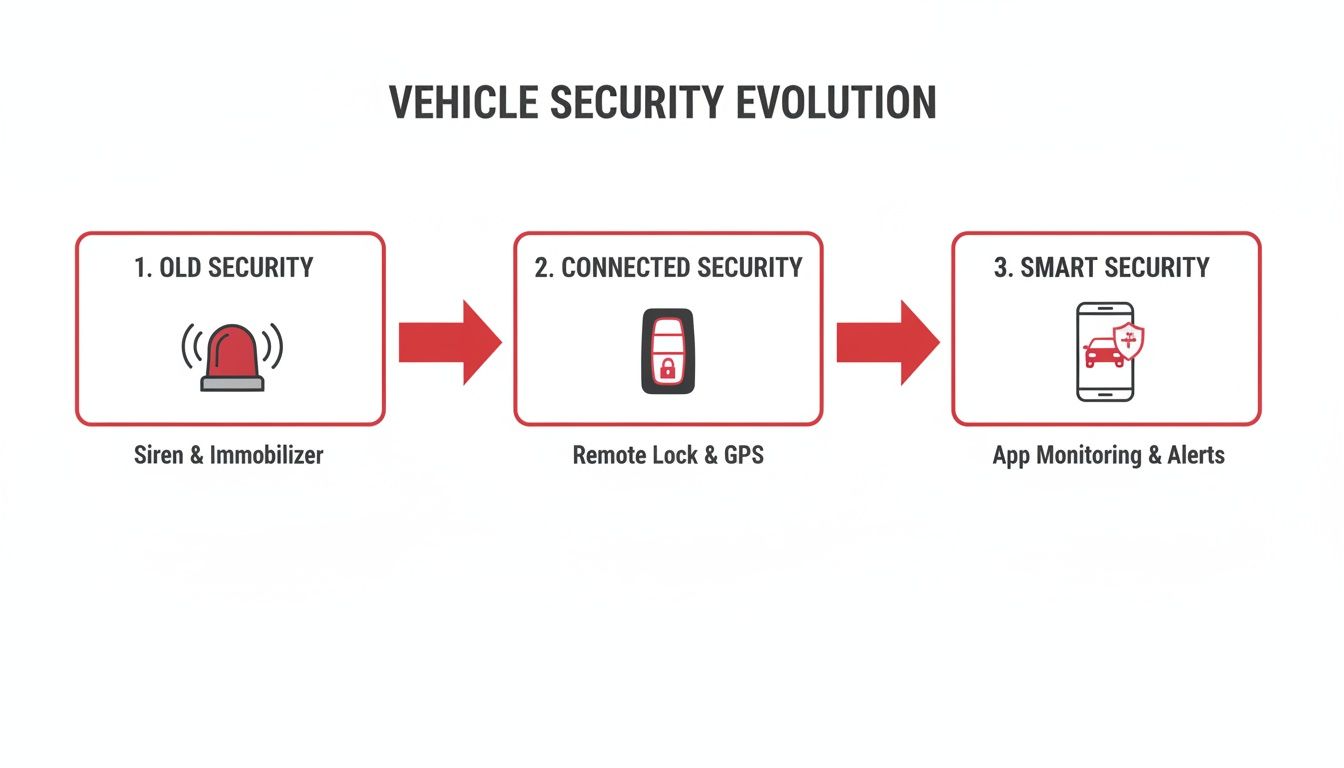
As you can see, we've moved from a system that just makes noise to one that gives you immediate, actionable information right on your phone.
Step 3: The Software Makes Sense of It All
The final piece of the puzzle is the software—this is your command center. All that data sent from your tracker is relayed almost instantly to a mobile app on your smartphone, like the CarLock app. This is where raw coordinates and sensor data get translated into something you can actually use.
The app takes that information and presents it as:
- A Live Map View: You can see your car’s exact location on a map in real time.
- Instant Push Notifications: Get immediate alerts if your car is moved, if vibrations are detected, if the engine starts, or if the device itself is disconnected.
- Detailed Trip Histories: Look back at previous drives, check speeds, and see where the vehicle has been.
This tight integration of hardware, a cellular network, and user-friendly software creates a complete security ecosystem. The technology is always getting smarter, too. Modern systems use advanced analytics to learn your driving habits and can even detect unusual behavior, as noted in recent market analysis like this GPS tracking device market report from IMARC Group.
Ultimately, it’s this simple three-step process that delivers genuine peace of mind. When you look at the device features available with CarLock, you can see exactly how this technology comes together to offer a complete, modern security solution for any vehicle.
Essential Features of a Modern GPS Tracking Device
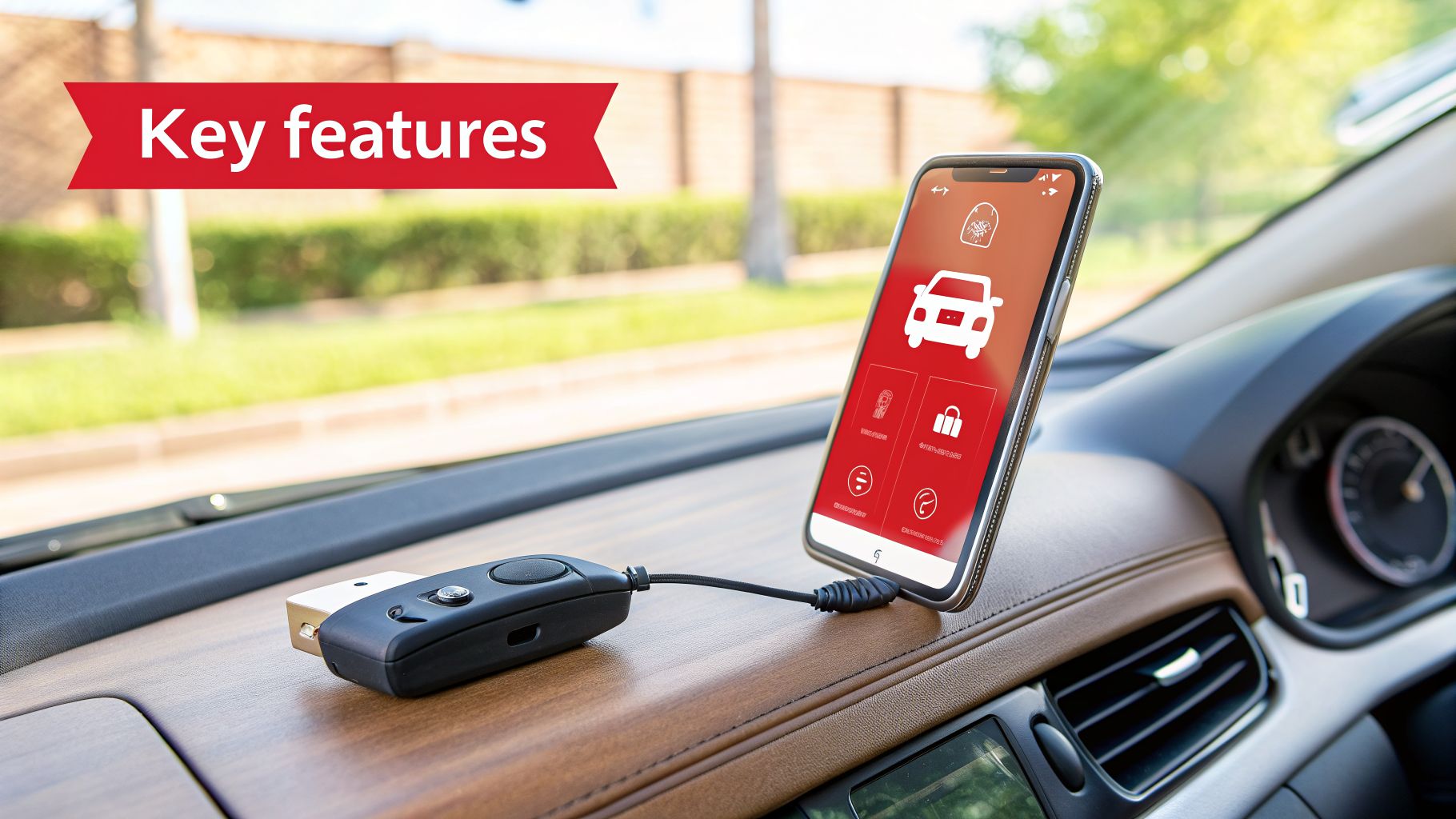
When you're in the market for a real-time GPS tracking device, it's easy to assume they all do the same thing. But the reality is, there's a world of difference between a simple tracker that just shows a dot on a map and a comprehensive system that actively protects your vehicle.
The best devices today have moved far beyond basic location pings. They’re smart, they’re proactive, and they give you information you can actually act on. Knowing what features to look for is what separates a gimmick from a genuine security partner.
Instant Alerts for Vibration and Tampering
Think of this as your car's digital alarm system—only smarter. A modern tracker’s first line of defense is its ability to feel a threat before your car even moves an inch. Sensitive internal accelerometers are tuned to detect the specific vibrations of a break-in, someone bumping your car in a parking lot, or even a thief trying to use tools or a jack.
Even if a tow truck tries to haul your vehicle away, you'll get an alert pushed straight to your phone. This feature effectively gives your entire car a nervous system, notifying you the second something is wrong. It's the difference between finding out your car was stolen hours ago and stopping the theft as it happens.
The core value of a real-time GPS tracking device lies in its proactive nature. Instead of discovering a theft or break-in hours later, you receive an alert at the very first sign of trouble, giving you a critical window to react.
Geofencing and Movement Monitoring
Geofencing is another game-changer. It’s a simple but powerful concept: you draw a virtual boundary on a map around any location you choose, like your home, your office, or your kid's school. The system then stands guard automatically.
The moment your car crosses one of these invisible lines—either entering or exiting the zone—you get an alert. You could set one to know if your vehicle leaves the work parking lot unexpectedly or if a teen driver goes somewhere they shouldn't. It's like having an automated watchdog working for you 24/7.
Paired with this is engine and movement monitoring. A quality tracker will ping you the instant the engine starts without your authorization. This is a crystal-clear signal that something is wrong and is one of the most critical anti-theft alerts you can have.
Driving Behavior Analysis
For anyone with a new driver in the family or a small business to run, a real-time GPS tracking device can double as an incredibly useful coaching and management tool. Many of the best systems today can analyze driving habits and give you straightforward, data-driven reports on safety and efficiency.
These trackers typically keep an eye on a few key metrics:
- Harsh Acceleration: Pinpoints aggressive, fuel-wasting starts from a stop.
- Hard Braking: Flags sudden stops that often point to tailgating or distracted driving.
- Sharp Cornering: Lets you know when turns are being taken too fast, a major safety risk and a sign of aggressive driving.
This isn't about playing "gotcha." It's about having objective data to start helpful conversations about being safer on the road. You can see exactly how this information is laid out by exploring the CarLock app features, which turn complex data into simple, useful insights.
Power Source Options and What They Mean for You
How a tracker gets its power is more important than you might think. It directly affects the ease of installation, operational reliability, and how covert it can be. There are three main approaches, and each has its own set of pros and cons.
Choosing the right power source is a crucial step. The table below breaks down what you need to know to find the perfect fit for your situation.
GPS Tracker Power Source Comparison
| Power Type | Installation | Power Reliability | Best For |
|---|---|---|---|
| OBD-II Plug-and-Play | Incredibly simple. Plugs directly into your car's OBD-II port in under 60 seconds. No tools required. | Excellent. It draws minimal power from the car battery and will even alert you if it's unplugged. | Most car owners who want a simple, reliable, and powerful anti-theft solution. |
| Hardwired | More complex. Needs to be wired directly into your vehicle's electrical system, often requiring professional installation. | The most reliable and permanent. It becomes a hidden part of your car's power system. | Fleet vehicles or anyone needing a completely covert installation where the tracker must be concealed. |
| Battery-Powered | Totally flexible. Can be placed almost anywhere in or on a vehicle with magnetic mounts. | Limited. Requires periodic recharging (from days to weeks), making it less ideal for constant security monitoring. | Tracking assets without a built-in power source (e.g., trailers, containers) or for temporary tracking needs. |
For most people, an OBD-II device like CarLock hits the sweet spot. It gives you the dead-simple installation of a plug-and-play unit but with the constant power and critical alerts (like the "device disconnected" notification) of a hardwired system. Getting this choice right ensures your real-time GPS tracking device is always on and ready to protect your vehicle.
Real-World Scenarios for GPS Vehicle Tracking
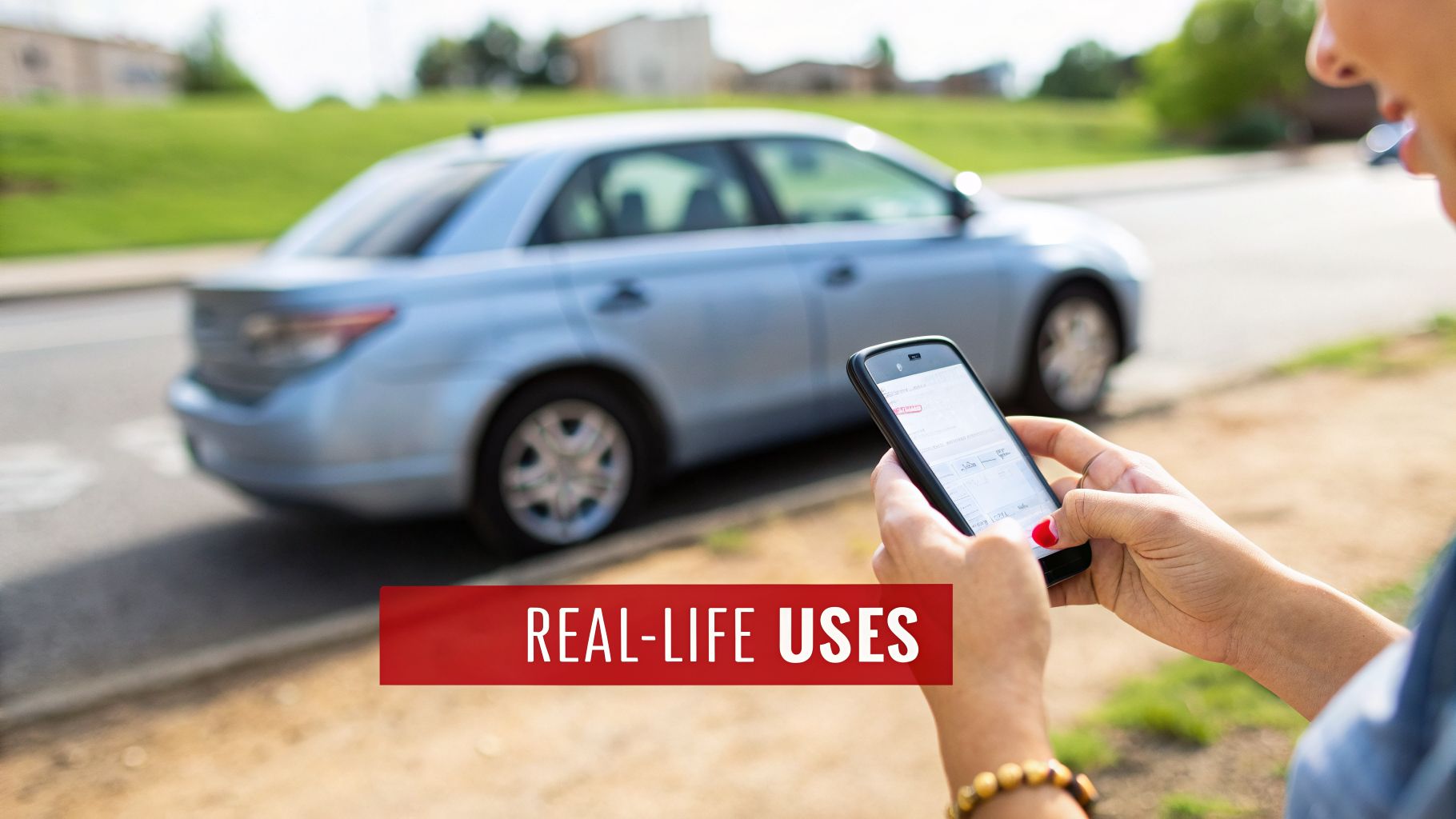
The high-tech features of a real-time GPS tracking device sound impressive on paper, but their real power is unlocked in the messy, unpredictable moments of everyday life. This isn't about collecting abstract data—it's about solving real problems and gaining priceless peace of mind.
So, let's move beyond the specs and see how these devices actually perform when it matters most, turning advanced tech into practical, real-world solutions.
The Anti-Theft Hero
Picture this: you're enjoying dinner with friends when your phone buzzes with a vibration alert from your CarLock app. Someone is trying to break into your car. Before they've even jimmied the lock, you're already in the know.
A moment later, a second alert pops up: "Engine Started." You pull up the app and watch in real-time as your car's icon starts moving down the street. But instead of panicking, you spring into action. You dial 911 and give the dispatcher the live tracking link. Now, the police can see your car’s exact location, speed, and direction of travel.
This is the game-changer. A real-time GPS tracking device transforms you from a helpless victim into an active part of the solution, giving law enforcement the actionable intelligence they need for a fast recovery.
With the live feed, officers intercept the car just a few miles away. Your vehicle is recovered with little to no damage, and the would-be thief is in custody. What could have been a total loss becomes a resolved incident, saving you a massive headache, a substantial insurance claim, and thousands of dollars.
The Teen Driver Guardian
Handing over the car keys to a new teenage driver is a nerve-wracking rite of passage for any parent. A real-time GPS tracking device acts as a silent co-pilot, helping you guide your new driver toward safer habits without hovering over their shoulder.
Modern solutions like those discussed in guides such as Life360 for Teen Driving Safety show just how valuable this technology can be. With a system like CarLock, parents can use data to build trust and encourage responsibility.
- Speed Alerts: Set a top speed you're comfortable with. If your teen goes over it, you'll get a notification. This creates a perfect, low-conflict opportunity to have a data-backed conversation about the risks of speeding.
- Geofencing: Draw virtual perimeters around key locations like home, school, or their after-school job. You’ll be alerted if they drive outside these approved zones, giving you a chance to check in and make sure everything is okay.
- Driving Behavior Reports: Get a weekly summary that flags things like hard braking or aggressive turns. This data helps you pinpoint specific skills they need to work on, making you a much more effective driving coach.
Ultimately, this approach shifts the dynamic from suspicion to mentorship. Your teen gets the freedom they want, and you get the reassurance you need.
The Small Business Optimizer
If you run a small business with even just a few vehicles on the road—for deliveries, service calls, or sales meetings—you know that efficiency is the name of the game. A real-time GPS tracking device quickly becomes a critical tool for streamlining your operations and protecting your bottom line.
Take a local plumbing company with three vans. By installing trackers, the owner can see every vehicle's location on a single map. Instantly, this opens up new possibilities. When an emergency call comes in, the dispatcher can see which plumber is closest and send them immediately, slashing response times and boosting customer satisfaction.
It’s no wonder vehicle tracking is so popular. The market for these devices is dominated by vehicle owners looking for better security and management. In fact, search volume analysis shows that interest in vehicle GPS trackers hit a normalized score of 95 in August 2026, easily outpacing other tracking categories. You can explore more about the trends in the GPS tracker market on accio.com.
On top of that, the business owner can use route history to verify that company vehicles aren't being used for personal errands, which helps keep fuel costs down and reduces liability. By reviewing past trips, they can even plan more efficient daily routes, cutting down on drive time and fitting more jobs into the day. To see how this works, check out our guide on how to use route history to your advantage.
Understanding the Legal and Privacy Rules
A real-time GPS tracking device offers incredible peace of mind, but it’s only natural to wonder about the rules. Is this all above board? The good news is that the legal side of things is usually quite straightforward.
At its core, the principle is simple: if you own the vehicle, you have the right to install a tracker on it. It’s your property. You are legally entitled to monitor its location for security, recovery, or any other personal reason. Where you need to be more thoughtful is when other people get behind the wheel.
Tracking Shared and Employee Vehicles
Things get a little more nuanced when a car you own is regularly driven by someone else, whether it's a family member or an employee. Even though the vehicle is yours, their expectation of privacy comes into play. This is where clear communication is not just good practice—it's essential.
When it comes to family, like a spouse or a new teen driver, an open conversation is the best path forward. Explaining that the tracker is a safety tool—there to help in an accident or to get the car back if stolen—builds trust. Frame it as a matter of shared security, not surveillance.
For business vehicles, the approach needs to be more formal. You absolutely must have a written company policy that clearly states company vehicles are equipped with GPS tracking. Employees need to be aware of this monitoring as a condition of using the vehicle. It's also a smart move to check your local state laws, as employee monitoring regulations can vary.
Legally tracking a vehicle you own is simple, but ethically, transparency is key. For family and employees, informing them of the device builds trust and ensures you are using the technology responsibly.
How Your Data Is Kept Safe
Just as important as the physical tracking is the privacy of your digital data. The information gathered by a real-time GPS tracking device—your daily routes, frequent stops, and live location—is incredibly sensitive. This is precisely why choosing a provider you can trust is non-negotiable.
A reputable company like CarLock understands the seriousness of protecting your information. Here’s a look at how your data is kept under lock and key:
- Robust Encryption: All data sent between the tracker, the cloud servers, and your smartphone app is fully encrypted using protocols like AES-256. This process scrambles the information, making it completely unreadable to anyone who might try to intercept it.
- Secure Servers: Your location history is stored on highly protected cloud servers with strict access controls, preventing any unauthorized person from viewing your private data.
- Strict Privacy Policies: Trustworthy companies are transparent about what data they collect and why. You can read more about our approach in the detailed guide on CarLock's commitment to user privacy.
Ultimately, a quality GPS security system doesn't just protect your car—it protects your personal information, too. That’s how you get true peace of mind.
Why CarLock Is a Smarter Choice for Car Security
When you’re looking at car security, it all boils down to a single question: does your system actually give you control? A traditional car alarm just makes noise, hoping someone nearby will pay attention. A modern real-time GPS tracker like CarLock, on the other hand, communicates. It becomes an active partner in protecting your car, reporting threats directly to you instead of just screaming into the night.
CarLock was built from the ground up to bring all the most important security features into one simple, powerful device. It turns your car into a connected vehicle that you can watch over from anywhere, right from your phone. It’s the difference between hearing a problem and seeing the solution in real time.
The Power of Simplicity and Speed
Let's be honest—one of the biggest reasons people stick with outdated security is because new tech can feel complicated. CarLock smashes that barrier with its signature OBD-II plug-and-play installation. There are no wires to splice or professional installers to call. You just plug the small device into your car’s standard diagnostic port, a process that genuinely takes less than a minute.
This incredible ease of use makes top-tier security accessible to anyone. From the moment it’s connected, CarLock is on duty, standing guard with a handful of alerts that truly matter:
- Vibration Detected: You get a notification the instant someone tries to break a window, jack up your car, or even just bumps into it.
- Engine Started: Know the second your engine turns on without you in the driver's seat. It's the earliest possible warning of a potential theft.
- Device Disconnected: Even if a thief finds the tracker and unplugs it, that act alone triggers an immediate alert to your phone.
- Vehicle Moved: If your car is towed or pushed without the engine running, you’ll be the first to know.
An Active System That Puts You in Charge
A passive alarm is a one-way street—it screams and hopes for the best. CarLock is an active, two-way communication system. It’s not just a tracker; it's a complete security ecosystem that links your car to your smartphone through a clean, intuitive app.
Think of CarLock as your car's personal security detail. It’s constantly on the lookout for trouble and reports straight to you, empowering you to take action instead of just making noise.
This proactive approach is more important than ever. With vehicle theft remaining a major headache for owners, the demand for better solutions is exploding. The global GPS tracking device market was valued at approximately USD 3.2 billion in 2026 and is projected to hit USD 8.2 billion by 2033. In the United States alone, the market is expected to grow from USD 2.26 billion in 2026 to USD 5.43 billion by 2033. This massive growth points to one thing: people are tired of ineffective alarms and are demanding real security. You can dig into the data yourself in this United States GPS tracking device market report.
Top-Tier Security Without the Top-Tier Price
Ultimately, CarLock’s biggest advantage is the incredible value it offers. It gives you a complete security suite—the hardware, the software, and the cellular connection—all for a low-cost subscription. This approach finally makes first-class vehicle protection affordable for everyone.
It proves you don't need to shell out thousands for a complex, professionally installed system to get genuine peace of mind. By focusing on the real-world needs of car owners with a proven, effective, and budget-friendly solution, CarLock stands out as the genuinely smarter choice for protecting your vehicle.
Frequently Asked Questions About GPS Trackers
It makes sense to have a few questions before you put a real time GPS tracking device in your car. We get it. Here are some straightforward answers to the questions we hear most often, showing just how simple and effective a system like CarLock can be.
Will a GPS Tracking Device Drain My Car Battery?
This is probably the number one concern we hear, and it's a valid one. However, a quality OBD-II tracker is designed for ultra-low power consumption. When your car is parked and turned off, the tracker enters a deep sleep mode, drawing a minimal amount of current—typically less than 2mA.
It only wakes up to send an update if it detects an event, like a vibration or the engine starting. Even better, a smart system like CarLock actively monitors your car's battery voltage. If it ever starts to get critically low for any reason, you'll receive an alert on your phone, so you’re never caught off guard by a dead battery.
How Hard Is It to Install a Real Time GPS Tracker?
The difficulty really depends on the type of tracker, but the OBD-II versions are made for a plug-and-play setup that takes less than a minute. Every car manufactured since 1996 has an On-Board Diagnostics (OBD-II) port, which is usually located under the dashboard near the steering column.
You just find the port and plug the device in. That’s it. No tools, no wiring, no special skills needed. From there, you just download the app, create your account, and activate the device. The whole process is designed to be finished in minutes.
Do I Need a Separate Data Plan for the Tracker?
No. You do not need to contact a mobile provider and sign up for another data plan or purchase a separate SIM card. Reputable tracking services like CarLock bundle all the necessary data connectivity into one simple subscription.
The device arrives with a multi-carrier SIM card already installed that can connect to various cell networks, ensuring you have the most reliable coverage possible. It's an all-in-one package that guarantees the tracker just works, right out of the box.
Can Thieves Just Unplug the GPS Tracker?
While it’s true that an OBD-II tracker can be physically unplugged, a well-designed system turns this potential weakness into another layer of security.
If the device is disconnected from your car's port while the system is armed, you will receive an immediate "Device Disconnected" alert on your phone. This tells you instantly that someone is tampering with your vehicle, giving you a critical heads-up to check on it. In this way, even an attempt to disable the tracker functions as an alarm.
Ready to secure your vehicle with the smartest, simplest solution on the market? Join thousands of other car owners who trust CarLock for 24/7 protection and peace of mind. Discover the CarLock advantage today!