

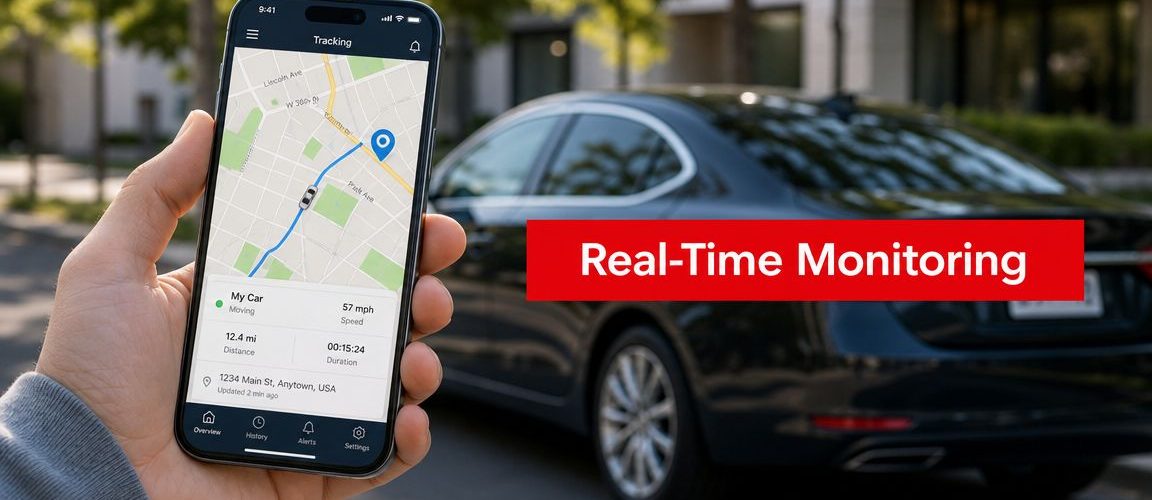
Driver’s Desk
Guide to Car Security: What Is Real Time Monitoring
You walk back to where you parked, reach for your keys, and stop. The space is empty.
At first you assume you forgot the row, the level, the side street. Then the questions start piling up. Was it towed? Did someone bump it and move it? Did someone take it? The worst part isn't only the loss of the car. It's the silence. You don't know what's happening, when it happened, or whether every passing minute makes recovery less likely.
That gap between an event and your awareness is exactly where real-time monitoring matters. For car security, it isn't a buzzword. It's the difference between finding out later and finding out while something is still happening. If you're comparing a live security system with a traditional siren, a periodic tracker, or even a Bluetooth item finder, the deciding factor is usually simple. How fast do you know, and how fast can you act?
The Moment of Panic Every Car Owner Dreads
A car owner usually doesn't start by asking, "What is real time monitoring?" They start with a more urgent question.
Where is my car?
That question can hit in a quiet driveway at dawn, outside a restaurant after dinner, or in a crowded parking garage when you're already late. You scan the area, press the key fob, listen for a chirp, and hear nothing. In that moment, old-school security feels thin. A steering wheel lock only matters if it stopped the thief. A siren only helps if someone noticed it. A basic alarm might have sounded, but if you weren't there, you still learned about the problem too late.
Many drivers first look for protection through a car alarm system for vehicle security. That's a sensible starting point. The problem is that noise alone doesn't answer the most important questions after an alert. What happened, when did it happen, and where is the vehicle now?
Why the panic feels so overwhelming
Part of the fear comes from uncertainty. If your car is gone, you don't know whether you're dealing with a misunderstanding or an emergency.
A modern security system changes that feeling by replacing guesswork with live information. Instead of checking on the car after the fact, you receive alerts as events happen. If the vehicle starts unexpectedly, moves without permission, or shows signs of tampering, the system can tell you right away.
The goal isn't only to record a problem. The goal is to close the gap between the event and your response.
A better question than where is my car
Once a driver understands that shift, the better question becomes this: Can my security system tell me about trouble while there's still time to do something?
That's the promise behind real-time monitoring. It gives you immediate awareness, which is often what creates peace of mind in the first place. You don't feel calm because risk disappeared. You feel calmer because you're no longer blind to what's happening.
What Real-Time Monitoring Actually Means
The simplest way to understand real-time monitoring is to compare it to sports.
Watching a live match tells you what's happening now. Reading the recap later tells you what already happened. Both contain information, but only one gives you a chance to react while the action is still unfolding.
That's the heart of what real time monitoring means in car security. A system collects data continuously, processes it with very little delay, and sends an alert while the event is still useful to you.
Low latency is the real point
According to Edge Delta's explanation of real-time monitoring and zero to low latency, real-time monitoring is defined by "zero to low latency" as its core operating standard. That same reference notes that some use cases need responses in milliseconds, while others can tolerate seconds. In security terms, the point is to act before a small incident, such as a tow, becomes a larger one, such as a theft.
That word latency is where many readers get stuck. It means delay.
If a car door is forced open at 2:00 and you learn about it at 2:10, the system gave you information. It did not give you real-time awareness in the way most owners require. If you learn about the same event almost immediately, your options change. You can check the app, call someone nearby, contact authorities, or verify whether a family member moved the vehicle.
Why real time isn't one fixed speed
Another common confusion is that people treat "real time" as a single technical standard. It isn't.
A useful explanation of how monitored security works helps show why timing matters in practical systems. In the same spirit, vehicle monitoring has to be judged by whether the alert arrives fast enough for the job it needs to do. A trip summary can arrive later. A theft alert can't.
Here's a simple way to understand it:
- Live alerting: Best for movement, tampering, engine starts, towing, and break-in risk.
- Periodic updates: Fine for reviewing past routes or general usage.
- Delayed finding: Better than nothing for lost property, but weak for active vehicle theft.
If you're evaluating a real-time car tracking system, don't just ask whether it "tracks." Ask whether it tells you what's happening while the event is still unfolding. That's the difference most buyers care about, even if they don't use the word latency.
The Technology Behind Real-Time Vehicle Tracking
A real-time vehicle security system depends on three layers working together at once. One layer finds the car. One layer notices suspicious activity. One layer gets that warning to you fast enough to matter.
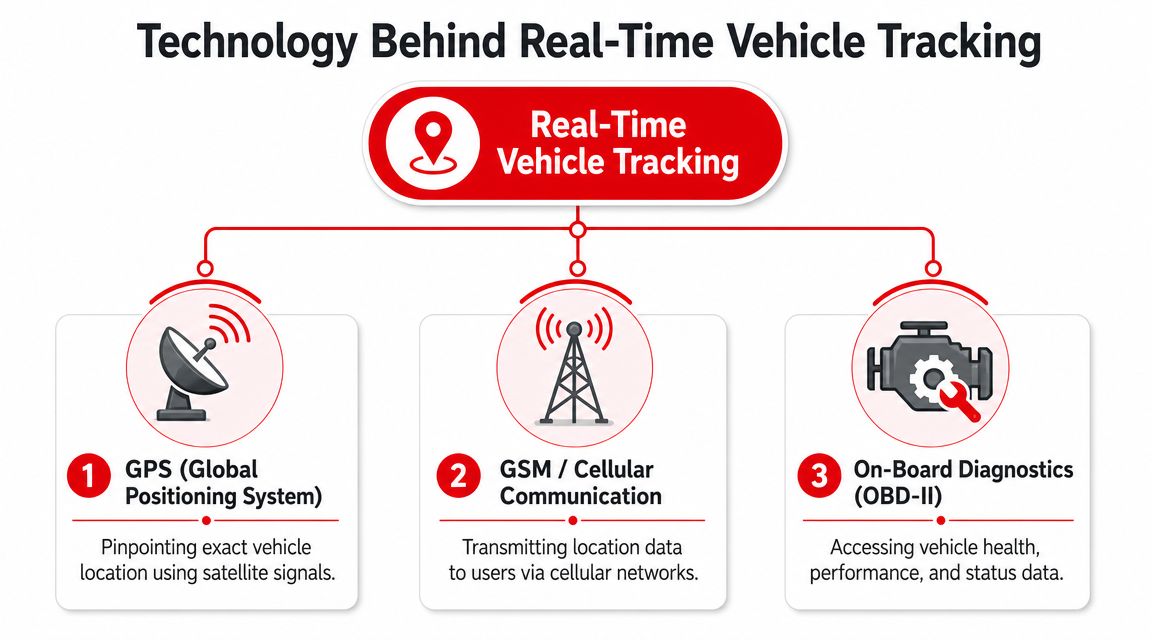
If any one of those layers is weak, the whole system slows down. And in vehicle theft, delay is often the difference between recovering a car nearby and trying to trace it hours later.
GPS shows where the vehicle is
GPS is the location layer. It listens to satellite signals and calculates the vehicle's position.
For a worried owner, that answers the first question fast. Did the car leave the driveway? Was it towed to a nearby lot? Is it still in your area, or already moving across town?
Location alone has limits, though. A moving dot on a map shows position. It does not explain why the car is moving or whether the movement is normal.
Sensors show what the vehicle is doing
The security value comes from event detection. A good tracker does more than wait for you to open an app and check the map. It watches for signs that something is wrong and reacts as those signs appear.
Common examples include:
- Unexpected movement: The vehicle changes position during hours or in places where it should be parked.
- Engine activity: The engine starts without your approval.
- Vibration or towing signs: The motion pattern suggests lifting, dragging, impact, or forced entry.
- Tamper behavior: The device loses power, is unplugged, or is interfered with.
This works like a home alarm with a map attached. GPS answers, "Where is the car?" Sensors answer, "What just happened to it?"
That difference matters because recovery starts with context. If you receive a location update much later, you may know where the car was. If you receive an alert as the engine starts or the vehicle begins moving, you know an incident is happening now.
Cellular communication gets the alert to you
The third layer is communication. After the device detects movement, tampering, or an engine event, it has to send that information off the vehicle and into your hands without much delay.
That usually happens through a cellular connection to a cloud service, which then pushes the alert to your phone. This is what turns raw sensor data into a usable warning. Without that communication path, even accurate GPS and good sensors stay trapped inside the device.
It also explains why dedicated vehicle trackers behave differently from passive item-finding tags. A car security device can keep reporting on its own through its network connection, even when your phone is nowhere near the vehicle. A passive finder often depends on another nearby device noticing it later, which is far less useful during active theft.
If you want to see the hardware features that support this kind of alerting, this overview of GPS tracker hardware and vehicle monitoring features shows the components owners usually compare.
Put together, these three layers create true real-time awareness. GPS provides place. Sensors provide context. Cellular communication provides speed. That combination is what closes the latency gap between a theft in progress and an alert you can act on while the situation is still unfolding.
Real-Time vs Near-Real-Time and Polling
You wake up at 2:13 a.m. to a phone alert that says your car just moved. That is a very different moment from waking up at 6:40 a.m., checking an app, and finding out the last update came in "a while ago."
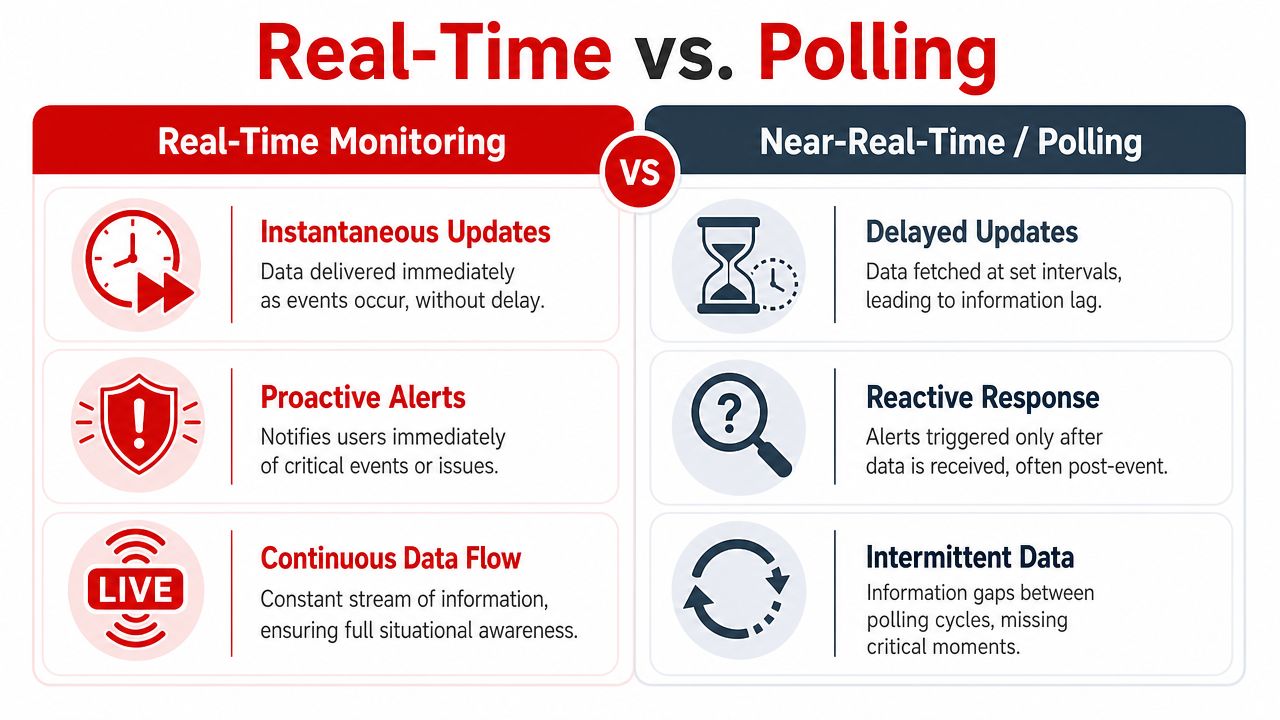
For vehicle security, the biggest difference is not whether a product can show a dot on a map. It is how long it takes before you know something is wrong. In a theft, that delay often decides whether you are interrupting an event in progress or trying to reconstruct what already happened.
Three models that sound similar but aren't
These terms get grouped together, even though they solve different problems.
A true real-time system is built to alert you as events happen. If the car is bumped, towed, started without permission, or moved, the warning is sent fast enough to support immediate action.
A near-real-time or polling system works more like a security guard who checks the parking lot every so often. If nothing is checked between those moments, nothing is reported. The car may have moved, stopped, and disappeared before the next update arrives.
A passive item-finding system serves a different purpose. It can help you recover misplaced belongings, but it usually depends on outside phones or devices passing nearby and detecting the tag later. That can be useful for a backpack or suitcase. It is a weak fit for a vehicle theft that is unfolding right now.
| Monitoring approach | How it works | What it feels like in a theft scenario |
|---|---|---|
| Real-time monitoring | Continuous awareness with immediate alerting | You learn about movement or tampering while there is still time to react |
| Polling or interval updates | The system checks at set times | You may get an update after the car is already gone |
| Passive item finding | Location depends on unrelated nearby devices noticing the item | You might see where it was noticed later, not when the theft started |
Why the latency gap changes the outcome
Seconds and minutes do not sound far apart until your vehicle is on the move.
A delayed update creates a blind spot. During that gap, a thief can leave your street, switch plates, move the vehicle into a garage, or load it onto a truck. By the time the app refreshes, the useful window to call a neighbor, notify building security, or give law enforcement a current location may already be closing.
That is why the deciding question is simple. How quickly does the system notice the event, and how quickly does it reach you?
True real-time monitoring is designed for sub-second to seconds. Polling systems work on a schedule. Passive finders may take much longer, because they wait to be noticed. Those are not small technical differences. They lead to different outcomes for recovery.
Why Bluetooth item finders aren't the same thing
A Bluetooth finder works like a lost-and-found network. A vehicle security tracker works like an alarm system with location attached.
Both can show a place on a map, which is why buyers sometimes treat them as substitutes. But for a car owner worried about theft, the better test is whether the device can spot suspicious activity on its own and keep reporting without depending on someone else walking by with a compatible phone.
After an incident, slower tools still have value. Reviewing vehicle route history and past location events can help you understand where the car traveled. But history is different from intervention. If your goal is recovery during an active theft, speed is the feature that matters most.
Practical Benefits and Common Use Cases
Monitoring's value is evident in daily life, not in product diagrams. For car owners, parents, and small business operators, the underlying advantage is identical. You stop living in the dark about your vehicle.
Industry guidance from MultiTech describes real-time monitoring as part of the shift from reactive to proactive safety management because it provides immediate insight into current conditions and supports faster decisions in emergencies and daily operations. That broader explanation of real-time monitoring in connected systems applies directly to cars, fleets, and driver oversight.
Stopping a theft attempt before it becomes a disappearance
A break-in doesn't always start with a smashed window and a siren. Sometimes it begins with unusual vibration, movement in the driveway, or an unauthorized engine start.
With real-time monitoring, the owner gets a warning while the event is happening. That doesn't guarantee a perfect outcome, but it changes the situation from passive discovery to active response. You can look outside, call a neighbor, check live location, or contact law enforcement with current information instead of a stale guess.
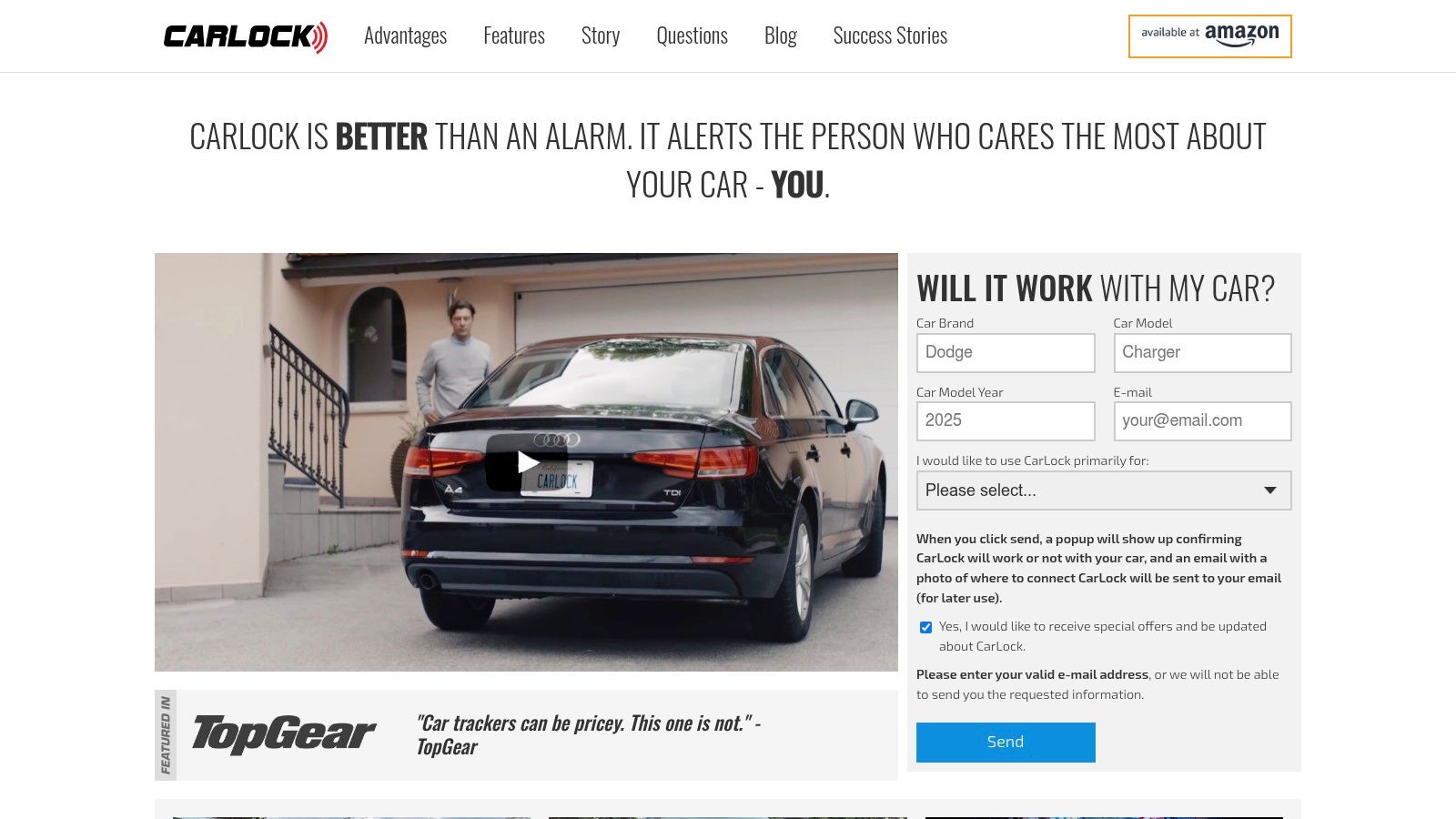
This is also where one tool can be named plainly. CarLock is one example of a system built for this kind of use, with alerts for movement, engine start, unusual vibration, tampering, and battery-related issues sent to a phone through GPS and cellular connectivity.
Helping a new driver build safer habits
Parents often start with location because they want to know where a teen driver is. Then they realize behavior matters too.
If a system reports harsh acceleration, hard braking, or aggressive cornering, the conversation changes. You no longer have to ask vague questions like, "Were you driving carefully?" You can coach with actual events in mind.
A useful review habit is checking vehicle route history and past trips after the drive. That helps parents discuss patterns without needing to hover over every minute in real time.
A monitoring system isn't only for catching bad behavior. It can also support calm, specific coaching.
Giving small fleets more accountability
For a small business, vehicle monitoring isn't just about theft. It's about oversight.
If a van leaves after hours, takes an unexpected route, or sits too long at an unplanned stop, the owner can investigate quickly. If a driver says a job took all afternoon, trip history helps verify where the vehicle was. If a company car is used outside policy, the pattern becomes visible.
That same visibility also helps with practical management:
- Usage awareness: See where vehicles go during the workday.
- Incident follow-up: Match a complaint or concern with trip records.
- Vehicle protection: Notice unauthorized movement sooner.
- Driver conversations: Use real events when addressing risky habits.
A short product walkthrough makes this easier to picture in practice:
How to Choose a Real-Time Monitoring Solution
Once you understand what real-time monitoring is, shopping gets easier. You stop comparing products by marketing labels and start comparing them by whether they solve the security problem you have.
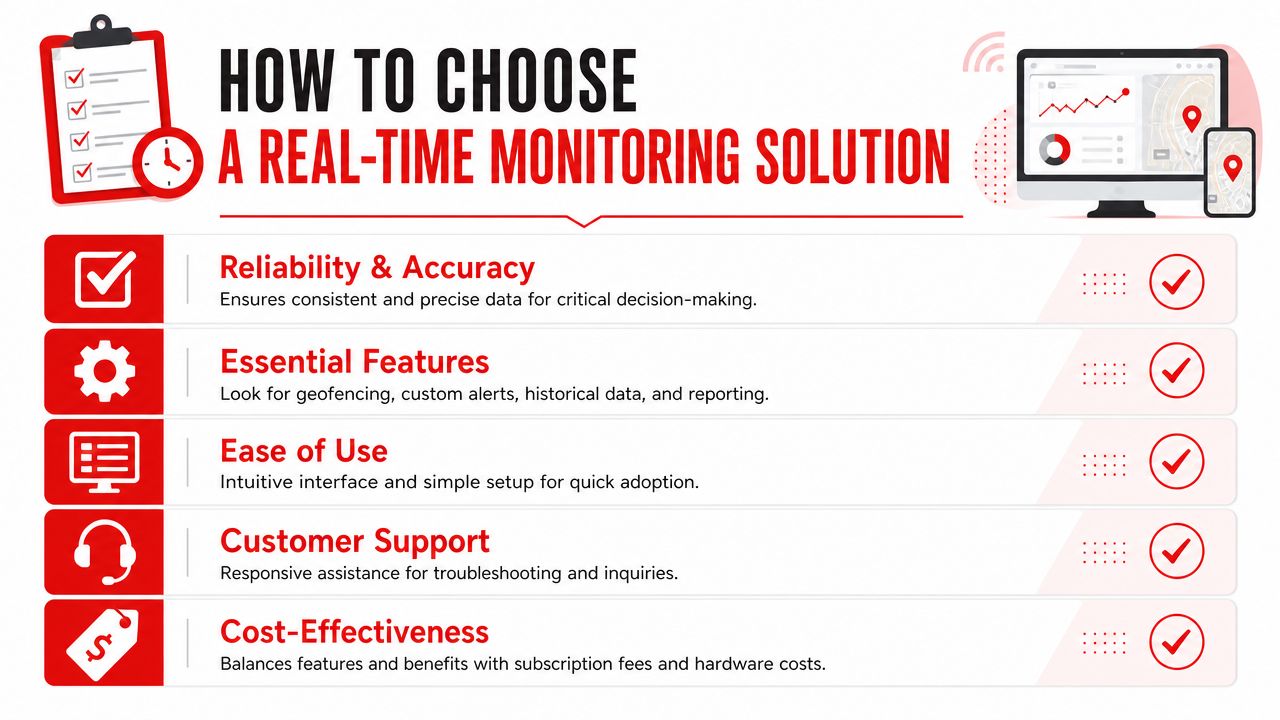
Start with the alert window you need
Splunk's explanation of real-time data as a spectrum makes an important point. "Real time" depends on the use case. Seconds may be enough for dashboards, while critical alerts for fraud or security may require sub-second response times. That is the right way to evaluate vehicle security too. Ask yourself, how fast is fast enough for my situation?
If your only goal is to review where a car went yesterday, delay may be acceptable. If you want to know when a vehicle is being moved without permission, speed becomes essential.
The checklist that matters most
Look for a system that answers these questions clearly:
What events trigger alerts
Location alone isn't enough. Look for movement, engine start, tamper or disconnect alerts, and signs of towing or vibration.How does it stay connected
Dedicated GPS and cellular communication are built for continuous reporting. Bluetooth-based finding tools serve a different purpose.What powers the device
A device connected to the vehicle behaves differently from a portable battery gadget that can lose charge, shift position, or stop reporting.What does the app show
Good security apps make event history, live location, and alert settings easy to understand under stress.What happens if someone tampers with it
A serious security setup should help you notice disconnection or interference, not disappear unnoticed.
Don't ignore privacy and day-to-day usability
A tracking system can have impressive specs and still be frustrating if the app is confusing or the alert settings are rigid.
Check whether you can control notifications, review event history easily, and understand who has access to your data. For households, that matters because spouses, parents, and teen drivers may all use the system differently. For businesses, it matters because location data affects both operations and trust.
If you're comparing real customer experiences, browsing vehicle tracker user reviews can help surface the practical issues spec sheets rarely show, such as setup clarity, app usability, and how understandable alerts feel in real life.
Buy for the decision moment, not the demo screen. The right system is the one that helps you act quickly when something unusual happens.
From Reactive Worry to Proactive Peace of Mind
The simplest answer to what is real time monitoring is this: it's a way to know what your vehicle is doing while it matters, not after the moment has passed.
That shift changes everything. Instead of discovering a problem hours later, you get a chance to respond. Instead of relying on a siren, a guess, or a delayed location update, you have immediate awareness of movement, tampering, engine starts, and other unusual events. For theft prevention, teen driver oversight, and small fleet accountability, that timing gap is often the difference between useful information and hindsight.
For many car owners, its true benefit isn't technical at all. It's emotional. You stop wondering whether your security setup only tells you bad news after the damage is done. You start knowing that if something unusual happens, you'll hear about it quickly enough to make a decision.
That is what modern vehicle protection should feel like. Less helpless waiting. More informed action.
If you want a vehicle security system built around live alerts, GPS tracking, trip history, and tamper detection, take a look at CARLOCK. It gives car owners, parents, and small fleet operators a practical way to monitor vehicle activity as it happens, with smartphone alerts designed for real-world security decisions.