

Driver’s Desk
Your Guide to a Commercial Vehicle Tracking System for 2026
Commercial vehicle theft and unauthorized use rarely look dramatic at first. A van moves after hours. A pickup leaves a jobsite and does not return on schedule. By the time someone notices, the recovery window is already shrinking.
That is why buyers need to separate tracking from security at the start.
A commercial vehicle tracking system can help with routing, dispatch, and driver oversight, but those benefits are not the same as theft protection. Plenty of products can report a location under limited conditions. Far fewer are built to keep reporting when a vehicle is out on the road, away from the owner, and potentially in the hands of someone who does not want it found.
The buying mistake I see most often is simple. Owners treat all trackers as if they do the same job. They do not. A Bluetooth tag, a plug-in fleet device, and a purpose-built cellular GPS unit may all fall under the word tracking, but the security outcome is very different. If your goal is continuous anti-theft coverage, recovery support, and clear evidence of unauthorized movement, the technology choice decides whether the system helps when pressure is highest.
Small business owners feel this trade-off more than large fleets. One missing van can interrupt jobs, strand crews, delay invoices, and leave expensive tools exposed. So the right question is not whether a device can show a dot on a map. The right question is whether it can support real-world vehicle security, consistently, with enough reliability to act on the alerts it sends.
The Rise of Commercial Vehicle Tracking
Analysts expect the vehicle tracking market to keep expanding through the rest of the decade. That growth reflects a practical shift in how businesses protect revenue, vehicles, and service capacity. Once a van or truck leaves the yard, a company either has timely visibility or it does not.
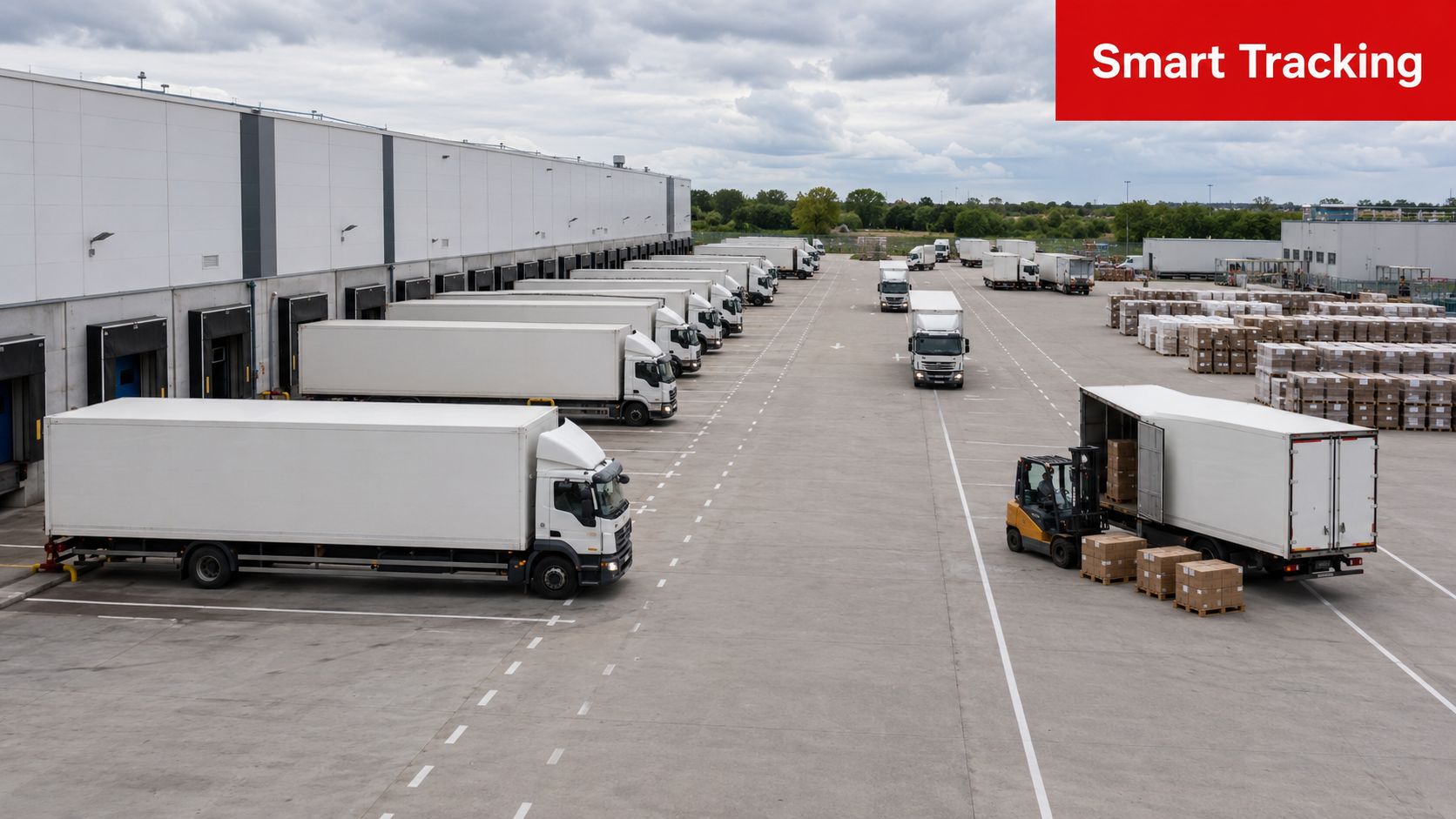
The increase in demand also says something more specific. Buyers are no longer treating tracking as a niche tool for large transport fleets. They are buying it because missed ETAs, unauthorized use, after-hours movement, and stolen vehicles create direct costs for small operators too. A delivery firm with four vans can feel one incident as sharply as a regional fleet.
What businesses buy
Most owners buy a commercial vehicle tracking system to reduce uncertainty around mobile assets. The reason varies by trade, but the pattern is consistent. They want to know where vehicles are, whether they are being used as expected, and whether they can respond fast if something goes wrong.
That usually breaks down into four practical needs:
- Operational visibility: Current location, job progress, route history, and dispatch awareness.
- Security response: Alerts for unauthorized movement, after-hours use, or a vehicle leaving a defined area.
- Driver oversight: Records that show speeding, idling, harsh driving, or patterns that raise operating costs.
- Asset accountability: Verifiable trip history when a customer disputes arrival time, a vehicle is towed, or a crew says a unit never left site.
The security piece is where many buying decisions go off course.
A general tracking tool can help with routing or admin. It may still fall short during a theft event. Security-focused systems are built for continuous reporting, alerting, and recovery support. Item finders depend on nearby devices. Basic fleet tools may prioritize utilization reports over immediate theft response. Owners who need anti-theft protection should compare products through that lens first. Security awareness around GPS vehicle trackers matters more than feature count if the main risk is losing a vehicle.
Why the category matured
Older systems often gave periodic location updates and little else. Buyers now expect live status, mobile alerts, trip records, geofences, and clear event history in one platform. That shift came from business pressure as much as from better hardware and connectivity. Owners need information they can act on quickly, not a map that only helps during a post-incident review.
I see the same pattern across trades. Florists, HVAC companies, electricians, and contractors all run into the same problem. Vehicles spend most of the day away from management, often carrying tools, stock, and customer commitments. Tracking became common because those blind spots are expensive. Security-grade tracking matters because some of those blind spots involve theft, misuse, and delayed response.
How a Commercial Vehicle Tracking System Works
Most confusion starts with the word GPS. GPS is only one part of the stack. A real commercial vehicle tracking system works because three layers operate together: hardware in the vehicle, a network that carries the data, and software that turns raw signals into something usable.
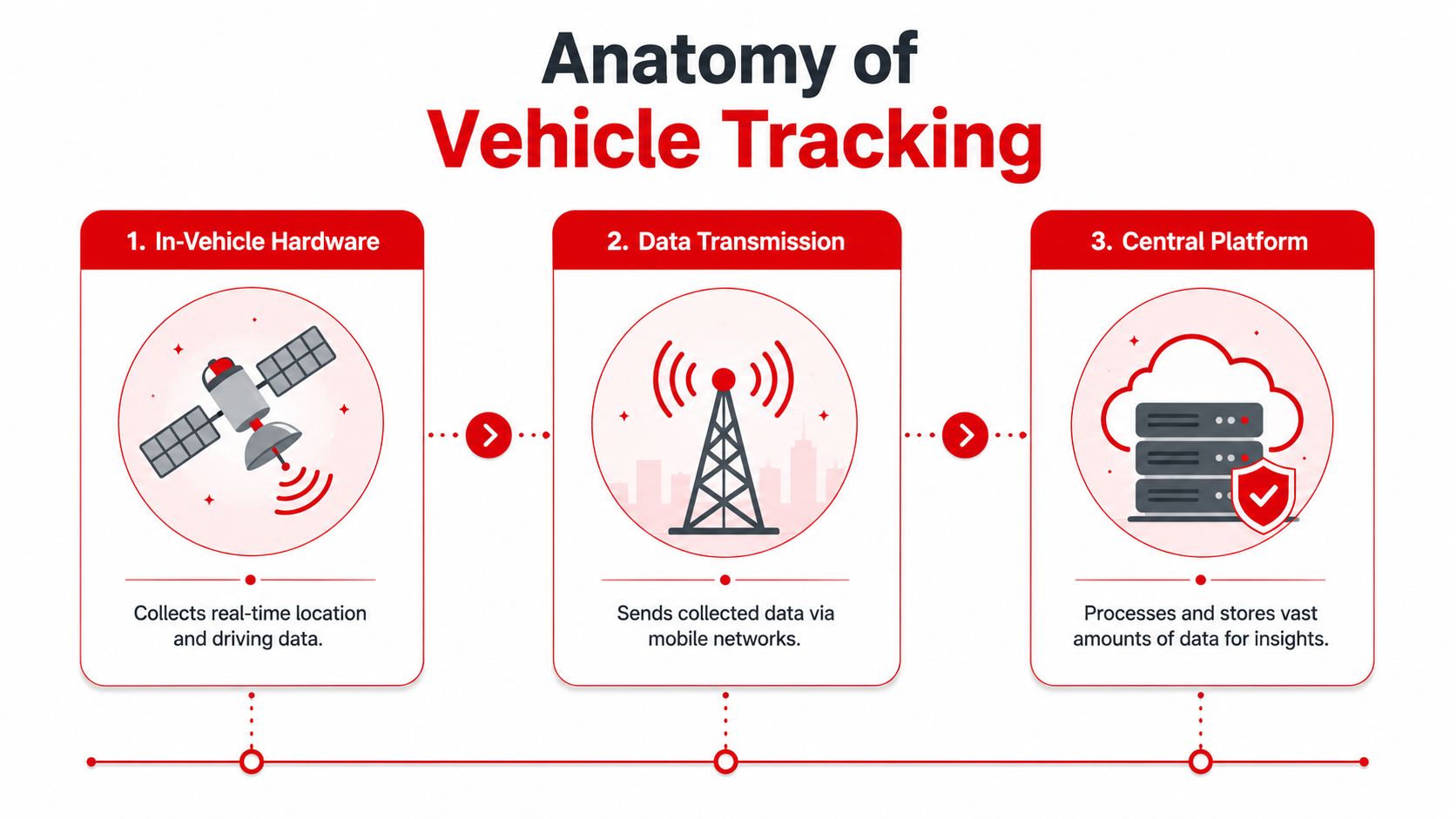
Wikipedia's overview of a vehicle tracking system architecture describes that stack as an in-vehicle hardware unit with a GNSS receiver and cellular or satellite modem, plus a connectivity layer and a software platform.
The hardware inside the vehicle
Think of the device as the sensor package. It determines location and captures vehicle-related data.
A typical unit includes:
- Positioning hardware: The GNSS receiver determines where the vehicle is.
- Communications hardware: The modem sends the data out through a cellular or satellite connection.
- Power connection: This is what separates continuous systems from temporary gadgets. If the unit has stable vehicle power, it can keep reporting without relying on a small internal battery.
That hardware split matters. GPS answers “where is it?” Connectivity answers “how does that information reach me now?”
The data path to your phone or dashboard
The second layer is transmission. Once the device collects a position or event, it has to send that information to the cloud. In most business use cases, that happens over cellular service. Satellite comes into play when vehicles operate in remote areas where mobile coverage can't be trusted.
A simple way to think about it is the same way you think about a smartphone:
- The phone knows its position
- The data plan sends information
- The app shows you what happened
A commercial tracker follows the same logic, but it's dedicated to the vehicle and built for automated monitoring rather than manual checking.
For buyers who want a simple example of how awareness features fit into day-to-day monitoring, CarLock's vehicle tracking awareness overview shows how alerts and location data are presented in a driver-facing app experience.
Before you compare devices, it helps to see the system visually:
The software layer people actually use
The third layer is the platform. It provides the practical value. Software turns location pings and telemetry into maps, trip history, alerts, and status views that an owner or fleet manager can act on.
Practical rule: If the software is weak, the tracker is weak, even if the hardware is decent.
A lot of buying decisions go wrong here. People compare only installation style or monthly price. They ignore how quickly they can interpret an alert, review a route, or confirm whether movement was authorized. In real incidents, that usability often matters more than a long feature list.
Key Features and Tangible Business Benefits
A commercial vehicle tracking system earns its keep when it changes decisions in the field, not when it fills a dashboard with data. The useful features are the ones that reduce waste, tighten response times, and make vehicle use easier to manage.
Samsara states that businesses using GPS fleet tracking can save about 15% on fuel through reduced idling and better route planning, with ROI in 3 to 6 months, according to its page on GPS fleet tracking and telematics. That's one of the clearest examples of why tracking isn't just a security tool.
Features that affect daily operations
Some functions pay off steadily, every day:
- Live location: Dispatch can see where vehicles are instead of calling for updates.
- Trip history: You can verify where a vehicle went and when.
- Idle visibility: Owners can spot waste that never appears on an invoice.
- Driver behavior signals: Harsh braking, speeding, and abrupt movement can reveal both risk and training needs.
Those features work best together. Live location helps in the moment. Route history helps after the fact. Behavior data helps prevent repeat problems.
Features that affect security
Security-focused features look different from general fleet convenience features. For vehicle protection, I'd prioritize:
- Movement alerts: Useful when a vehicle moves outside expected hours.
- Geofence activity: Helpful for yards, depots, and customer sites.
- Tamper or disconnect alerts: Critical if someone tries to disable the unit.
- Engine and activity monitoring: Valuable when unauthorized use is the concern, not only theft.
A lot of systems can show a vehicle on a map. Fewer are tuned to tell you that something suspicious just started.
Data is only useful if the alert arrives while you can still do something about it.
For businesses comparing app-level visibility and alert handling, CarLock's tracking app features are one example of how trip history, notifications, and monitoring functions are grouped in a mobile interface.
What usually works and what usually doesn't
What works is focused deployment. Start with the vehicles that matter most: highest value, highest theft risk, or highest operational impact. Configure alerts for real exceptions, not every possible event.
What doesn't work is turning on everything and drowning the owner or manager in noise. If every hard brake creates a notification, people stop looking. If every movement after hours creates an escalation without context, the system becomes background clutter.
The strongest setups use a small set of high-consequence alerts, then rely on route and behavior history for review and coaching.
Comparing Tracking Technologies for Vehicle Security
Many buyers frequently spend money on the wrong category. A tool can be valid and still be wrong for vehicle security. The important question isn't whether a device can help find something. It's whether it can support continuous anti-theft monitoring without depending on luck.
GPS and cellular systems
For real vehicle security, this is the benchmark. The tracker gets position data from satellites and sends it through a cellular connection to a platform or mobile app. Industry material summarized on Samsara's fleet tracking page notes that active systems transmit data over satellite or cellular networks, and some collect GPS data as often as every second. That same source also notes that GPS tracking is preferred for vehicles operating beyond fixed facilities, while Bluetooth is limited to short-range proximity use of roughly 10 to 100 meters.
This is why security-grade systems are viable for theft response. They don't need another person's phone nearby to function. They're designed for wide-area visibility.
Bluetooth item finders
Bluetooth tags solve a different problem. They're good at helping people locate misplaced personal items within an ecosystem of nearby devices. That's useful for keys, bags, or tools left behind. It is not the same as active vehicle security.
Their limits are practical, not theoretical:
- Range is short
- They depend on nearby participating devices
- They aren't built around vehicle tamper events
- They don't provide the kind of continuous oversight most businesses expect
If you're responsible for a van loaded with tools or a work truck parked overnight, that dependency is a major weakness.
Portable battery trackers
Portable battery units can be handy for temporary deployments, trailers, or short-term monitoring. But for full-time security, they come with obvious trade-offs.
| Technology | Strength | Main weakness for security |
|---|---|---|
| GPS plus cellular | Wide-area visibility and active reporting | Needs proper installation and ongoing service |
| Bluetooth tracker | Simple item finding | Short-range and ecosystem dependence |
| Battery-powered portable tracker | Flexible placement | Battery depletion and less dependable continuity |
A battery device can't protect you when the battery is flat, when reporting cadence drops to conserve power, or when someone removes it easily. That doesn't make it useless. It makes it a poor default for continuous theft protection.
Owners doing broader research on securing your vehicle in the UK will notice the same pattern across modern car security advice. Layered protection matters, but the tracking layer has to be built for recovery, not just convenience.
For businesses that want a security-oriented option rather than a generic locator, CarLock's vehicle security system is one example of a cellular GPS approach that focuses on movement, tamper, towing, and unauthorized engine activity.
Calculating Your ROI and Implementation Path
A tracking purchase becomes easier when you stop treating it as one big technology decision and break it into two parts. First, decide what problem you're solving. Second, match the device and reporting setup to that problem.
Start with the use case
A service company with local vans usually needs visibility, route records, and alerts for unauthorized use. A contractor may care more about overnight movement and recovery support. A long-haul operator may care more about coverage continuity.
That changes what “good value” looks like.
Use this sequence:
- Pick the vehicles first: Start with the ones whose loss or downtime hurts most.
- Choose the install style: Plug-in devices are easier to deploy. Hardwired setups can be better where tamper resistance matters more.
- Define alert priorities: Focus on movement, route exceptions, tampering, and after-hours activity before adding lower-priority signals.
Understand reporting frequency
US Fleet Tracking notes that live GPS fleet systems can report every 5 to 10 seconds, and that this denser reporting is important for theft recovery and incident analysis because it reduces the delay between an event and an alert, as described on its live GPS fleet tracking page.
That has a direct business implication. Faster reporting gives you better event resolution. It also increases data flow and can add complexity if you don't need that level of detail for every vehicle.
Denser updates are worth paying for when delay creates risk.
If your top concern is theft or route deviation, a tighter reporting cadence makes sense. If your main goal is broad utilization oversight, you may not need the highest possible frequency on every unit.
For route verification and historical review, a tool such as CarLock's route history feature shows the type of record many small operators want when checking past vehicle movement.
Build the ROI case honestly
The cleanest ROI models are usually built from a few visible categories:
- Fuel waste reduction
- Lower idle time
- Fewer unauthorized trips
- Faster response when something goes wrong
- Reduced admin time spent checking locations manually
The stolen-vehicle scenario is harder to model in advance, but owners understand its value immediately when it happens. That's why I'd avoid buying on subscription price alone. The cheapest tracker often becomes the most expensive one when it misses the event you purchased it for.
Navigating Compliance Privacy and Building Trust
Tracking can improve accountability and still create friction if the rollout is sloppy. This is one of the most ignored parts of implementation, especially in small businesses where owners assume drivers will accept monitoring because the vehicle belongs to the company.
That assumption causes trouble. The U.S. Chamber notes that fleet systems can collect sensitive data such as location, speed, and engine time, and recommends clear policies around data collection, access, retention, and use, especially for off-hours tracking and personal use, as discussed in its guide to GPS fleet tracking systems for businesses.
The policy matters as much as the hardware
A weak privacy policy creates two risks. The first is legal exposure. The second is operational resistance. Drivers who feel watched without explanation tend to distrust the system, work around it, or treat every alert as management overreach.
A workable policy should answer basic questions in plain language:
- What data is collected
- Why it is collected
- Who can view it
- How long it is retained
- What happens during personal use or off-hours periods
Use the data for coaching first
Most businesses get better long-term results when tracking data supports coaching, safety discussions, and route review before it becomes a disciplinary tool. That doesn't mean never enforcing policy. It means you don't lead with punishment.
I'd also be explicit about edge cases. Can a driver take the vehicle home? Is off-hours movement always prohibited? What happens if a manager needs access to historical routes? Those decisions should be made before the first dispute, not during it.
The fastest way to lose trust is to collect more data than you can justify.
Privacy expectations also differ by region. If you operate across multiple markets, that gap becomes more important. A transparent approach is usually safer than a silent one.
For businesses reviewing how a provider handles personal information, CarLock's privacy information is the type of page I'd expect any serious vendor to make easy to find and understand.
Buyer's Checklist for a Security-Focused Tracking System
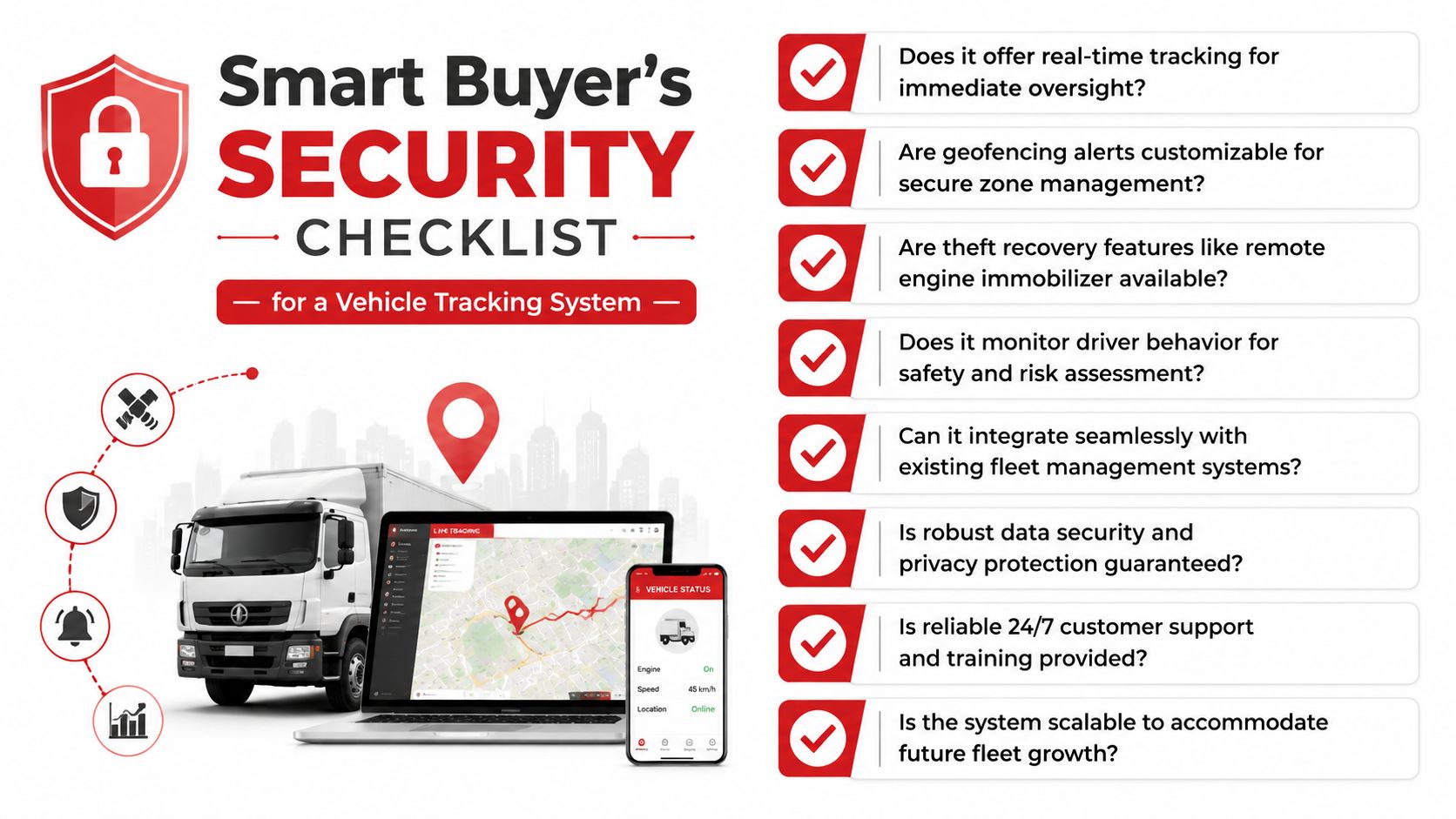
A small business doesn't need the longest feature list. It needs the right answers to a short list of security questions. If a vendor can't answer these clearly, keep looking.
The questions that expose weak systems
Ask these before you buy:
- How does the device communicate? If it relies on nearby phones or crowd-sourced detection, it isn't a true wide-area security system.
- What happens if someone unplugs or tampers with it? A silent failure is not acceptable for theft protection.
- Is the power source continuous? Temporary batteries are fine for some asset use cases, but they're a compromise for ongoing vehicle security.
- How quickly do alerts reach the user? A map update that arrives late may still be useful for reporting, but not for intervention.
- Can you review route history easily? Recovery, disputes, and unauthorized-use cases often depend on historical movement.
- Does the platform support practical alerting? You want meaningful exceptions, not constant noise.
- Is privacy handling clear? If the vendor is vague about data access and retention, treat that as a warning sign.
The buying principle behind the checklist
A commercial vehicle tracking system for security should answer one core requirement: can it detect, transmit, and report suspicious vehicle activity consistently enough for you to act?
That rules out a lot of consumer gadgets very quickly. It also narrows the field among fleet tools. Some platforms are built mostly for logistics efficiency. Some are built with stronger anti-theft logic. If theft risk is part of your buying case, choose accordingly.
Frequently Asked Questions
Why do good vehicle tracking systems usually require a subscription
Because the device isn't just buying hardware. It's paying for the cellular connection, cloud processing, alert delivery, and platform access. A no-subscription product often means reduced connectivity, fewer live functions, or a different technology category altogether.
Is installation difficult
It depends on the device type. Some systems plug into the vehicle more easily, while others are hardwired for a more permanent setup. For small fleets, ease of installation matters because rollout delays often kill adoption.
Will a tracker drain the vehicle battery
That depends on device design and how it's powered. A proper vehicle tracking product should be designed around automotive use, not improvised as a generic battery gadget. If battery health matters in your fleet, ask directly how the device behaves during extended parking.
Can I use an item finder instead of a vehicle tracker
You can, but you shouldn't confuse that with real security. Item finders help locate personal belongings. A security-focused commercial vehicle tracking system is built to monitor movement, report events, and support vehicle recovery without relying on chance proximity.
If you're comparing options and want a system built around real-time alerts, trip history, and vehicle security rather than simple item finding, CARLOCK is worth evaluating alongside other dedicated cellular GPS solutions. The key is to buy for your actual risk. If theft response and continuous oversight matter, choose a tracker designed for vehicles, not a gadget designed for lost keys.