


Driver’s Desk
What Is a Track Car and Is It Worth the Cost
A track car is generally a car built or modified for closed-circuit driving, and most beginners start with a maintained daily driver rather than a dedicated race car. That matters because the word covers a much wider range than people expect, from a road car used at an HPDE event to a heavily built machine that lives for lap sessions.
The popular advice says you need a stripped trailer queen before you can belong at the circuit. That's backwards. For most drivers, the question is how far they want to go into speed, maintenance, storage, and security, because once a car spends time on track, the ownership equation changes fast.
Defining a Track Car and the Spectrum It Covers
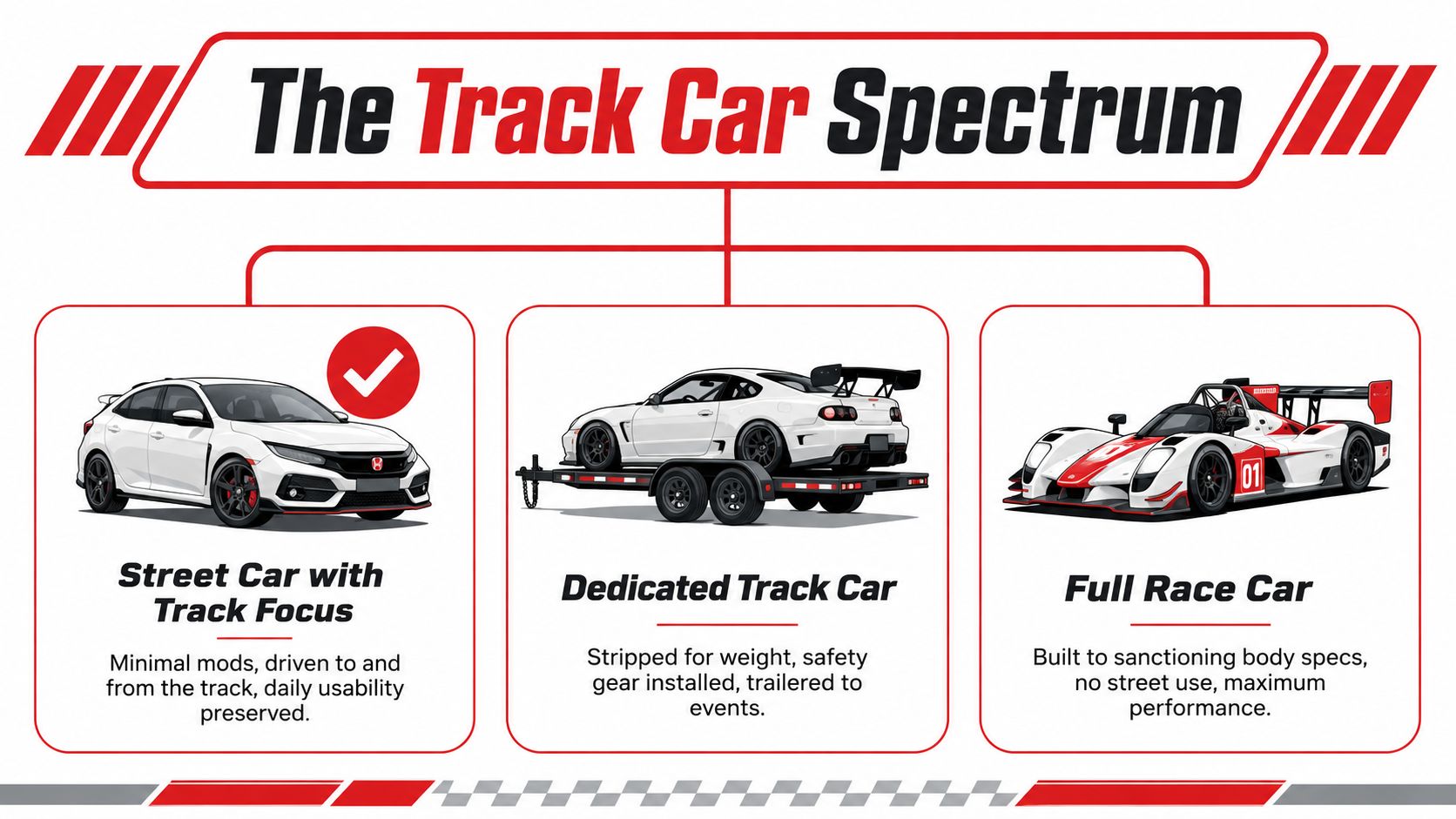
A track car isn't one single kind of vehicle. It's a broad label for any car built or modified for closed-circuit driving, and in practice that can mean anything from a road car with sensible prep to a full race machine that only comes out for sanctioned competition. Lockton Motorsports notes that many HPDE organizers will accept a car with good brakes, working seatbelts, a properly secured battery, no major fluid leaks, and no bald tires, which tells you a lot about where the entry point really sits. A car doesn't have to be caged, gutted, or trailer-only to count as a track car in the everyday enthusiast sense, and that's why the term confuses newcomers.
Where the spectrum begins
At one end sits the street car with track focus, the kind many first-timers bring to HPDE weekends. Autotrader describes a track day as an organized event where drivers pay to use their regular road car on a circuit without competitive timing, which is why a well-kept street car often makes perfect sense as a starter platform. The point isn't to build the most extreme car right away, it's to learn car control, braking, and consistency in an environment that's controlled but still demanding.
Where the spectrum ends
At the far end is the full race car, built to sanctioning-body rules and usually not intended for street use. In the middle is the dedicated track car, often trailered, stripped for weight, and fitted with safety gear and performance parts. Race Away Track Time describes track cars as using upgraded brakes, stiffer suspension, high-performance tyres, stripped interiors, and roll cages, while ATLR notes that enthusiasts often remove rear seats, floor mats, and soundproofing and add roll cages, racing seats, harnesses, fire extinguishers, kill switches, radiators, oil coolers, and intercoolers for long sessions. That middle zone is where most enthusiasts gradually end up if they stick with the hobby.
Practical rule: If the car can still go to dinner, commute occasionally, and pass basic roadworthiness checks, it's probably still on the street-car side of the spectrum, even if it's quick on circuit.
Track Car vs Street Car and What Actually Changes
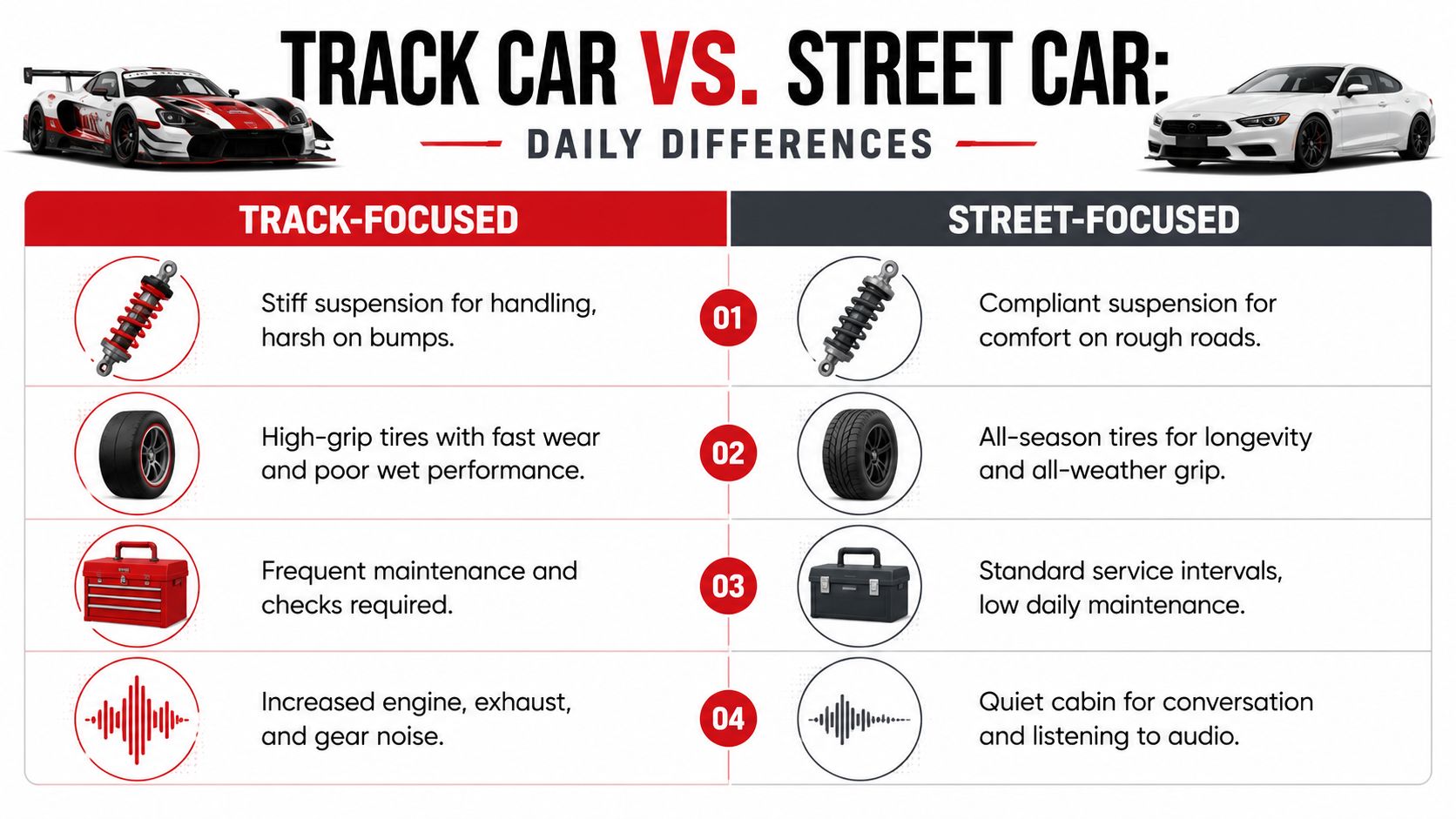
A street car and a track car can look similar from ten feet away, but the experience behind the wheel changes quickly once the car is optimized for circuit use. The steering usually feels sharper, the ride gets busier, the cabin gets louder, and the car starts asking for attention in places a normal commuter would ignore. EngineerFix describes track cars as being purpose-built for repeated high-stress driving in events like HPDE and time attack, and that focus changes nearly everything a driver feels day to day.
Comfort gives way to control
The biggest trade-off is comfort. Track-focused suspension is stiffer because the car needs to stay flatter in corners and respond quickly to steering inputs, but that same stiffness makes potholes, expansion joints, and rough pavement feel worse. Street cars, by contrast, are tuned to absorb those surfaces so you can spend an hour in traffic without thinking about your spine. Once a car lives on track, the owner usually accepts that softer, quieter, more forgiving behavior is gone or at least reduced.
Practicality takes a hit too
Tires are another clear split. High-grip track tyres can be excellent on circuit, but they wear faster and don't behave like a normal all-season tire in everyday use. Noise rises too, because track builds often amplify engine, exhaust, and gear sound instead of isolating it. Storage becomes part of the ownership story as well, since a dedicated track car usually needs more garage space, more organization, and more prep time before it ever rolls into the paddock.
A good track car is rarely the most comfortable car in the driveway. It's the one that does one job well and asks you to accept the rest.
For a driver still deciding whether to commit, a dual-purpose car is often the smarter entry point. It lets you learn the hobby without giving up daily usability too soon, and that can matter more than chasing lap time in the first season.
Common Track Car Modifications and the Logic Behind Them
The smartest track-car builds start with problems, not part numbers. A driver notices brake fade, tire overheating, vague body control, or too much cabin heat, then chooses a modification that solves that specific issue. That's the cleanest way to think about the hobby, because it stops the build from becoming an endless shopping list.
Heat management comes first
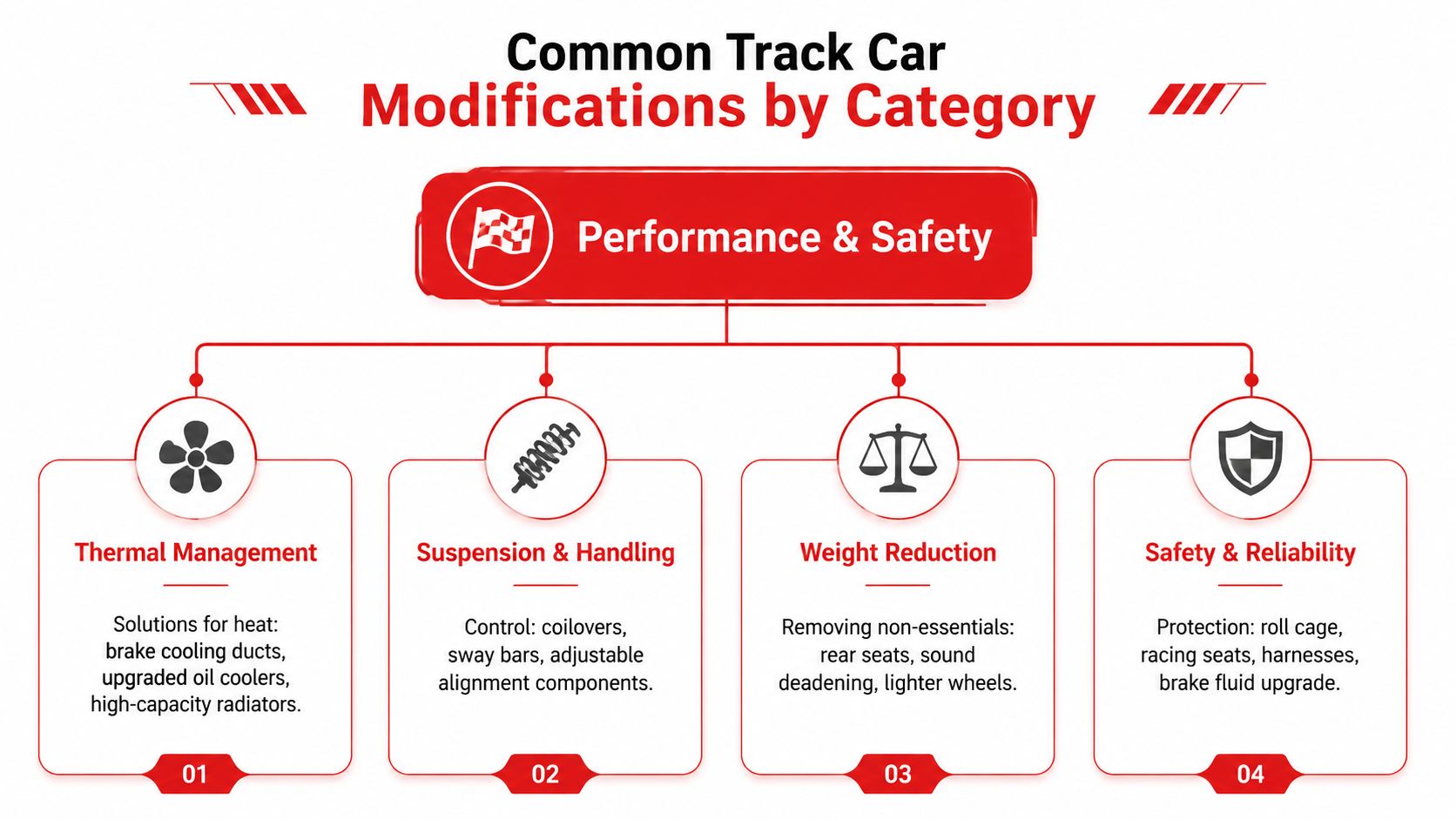
Track driving puts heat into every system. That's why people talk about brake cooling ducts, oil coolers, and high-capacity radiators before they talk about cosmetic parts. If a car stays cool, it can stay consistent, and consistency is what keeps a driver learning instead of backing off to protect the machine. Cooling upgrades also make sense because many track cars are mass-produced sports coupes or sedans, and those cars were never designed to absorb repeated full-lap abuse all day long.
Grip, handling, and safety work together
Tires and suspension are the other major change. Coilovers, sway bars, and alignment parts help the chassis respond more predictably, while high-performance tires put the car closer to the limit the driver is trying to explore. Safety gear sits in the same conversation, not because it makes the car faster, but because it lets drivers work with more confidence. Roll cages, racing seats, harnesses, and brake-fluid upgrades all show up in serious builds for the same reason, they reduce the chance that a weak link turns a test session into a problem.
If you want a useful example of how a build can become an expensive rescue project when the wrong parts fail, the VekTracer guide to 09 Mustang faults is worth a look because it helps you think about platform-specific weak points before you start buying upgrades.
Weight reduction is about repeatability
Track-focused owners also remove mass. ATLR notes that people commonly pull rear seats, floor mats, and soundproofing to cut weight, but the actual goal isn't bragging rights. Less mass helps brakes, tires, and cooling systems work less hard, which can improve repeatability over a long session. That's why a stripped interior and a sturdy safety setup often appear together, not as style choices, but as practical answers to the same problem.
For a deeper look at vehicle monitoring while you're building or storing a car, the CarLock GPS car tracker features page is useful because it shows the kind of location and alerting tools owners often want once the car becomes a higher-value weekend machine.
Real Costs of Owning a Track Car in 2026
Most first-time owners budget for the build and forget the running costs. That's the trap. Once a car is tracked regularly, the expensive part becomes the wear items, the prep time, and the downtime between events, not just the initial purchase of parts.
| Cost Category | Typical Range | Frequency |
|---|---|---|
| Tires | Varied by use and wear | Replaced as they age out or wear down |
| Brake pads and fluid | Varied by use and heat load | Repeatedly through the season |
| Oil and coolant | Varied by service interval and track stress | Checked and refreshed often |
| Wheel bearings | Varied by wear and session load | Periodic inspection and replacement when needed |
| Prep and teardown time | Personal time cost | Before and after every event |
Recent track-prep guidance from Proformance Racing School stresses recurring checks such as torque inspection, brake bleeding, tire-pressure management, wheel-bearing checks, and tire-temperature measurements before and after sessions. That list tells you what seasoned owners already know, a track car isn't a one-and-done build, it's an ongoing maintenance discipline.
The hidden cost is attention
A road car can tolerate some neglect. A track car usually can't. Heat cycles, curb strikes, heavy braking, and aggressive cornering all shorten the comfort margin you had on the street. That's why recurring consumables eventually dominate the budget, because the car is now being used in a way that puts real load into every system.
If you're deciding whether the hobby fits, don't ask whether you can afford the first build. Ask whether you can afford the second and third round of wear items.
Proformance Racing School also advises beginners to start with a car under $10,000 and says a properly maintained daily driver can work for track use, which reinforces the idea that entry can stay modest while the ongoing burden still grows. The smartest budget is the one that leaves room for the parts you'll replace, not just the ones that make good photos.
Legal and Insurance Realities You Need to Know
Track use sits in a messy middle ground. A car can be perfectly fine for the road on Tuesday and outside normal policy expectations on Saturday if it's being driven in a timed session or even a non-timed driving event, depending on the insurer and event rules. That is why people get caught out, they assume a street-legal car is automatically covered everywhere it goes.
A track day and a race are not the same thing. Autotrader UK says a track day is an organized event where drivers pay to take a regular road car onto a circuit without timing or any competitive element, and that any road-legal vehicle can be used if it's suited to the event. HPDE is usually the beginner-friendly format, while time-attack or competition formats can bring a very different insurance and equipment picture.
What insurers care about
Insurers care about use, modification level, and whether the car is still a road vehicle. The more the build moves toward stripped interiors, cages, harnesses, and other circuit-specific changes, the more likely the car stops looking like a standard private-use car. That does not automatically make it illegal, but it can change how an insurer views risk and how a road-legal inspection is handled.
If you are discussing a build with a provider, be direct about the car's actual use. The conversation should cover whether the vehicle is still road-registered, whether it's driven to events, and whether you expect track or competition use. A calm, precise explanation tends to work better than trying to simplify the car into a version that does not match reality.
Review your policy terms at our legal guide before assuming coverage applies. That step matters because small wording differences can decide whether a claim is treated like ordinary road use or something the insurer excludes.
For people looking at racing careers or moving deeper into the sport, the jobs in Formula 1 teams page is a useful reminder that motorsport runs on a lot more than driving talent alone, and that ecosystem matters when you start paying attention to how cars are used and protected.
The Security Question Most Track Car Owners Miss
A track car doesn't just face risk on track. It often spends long stretches unattended, in a paddock, in a trailer at a hotel, at a warehouse, or in a shop bay, and that changes the security picture in a way daily driving doesn't. That's where theft, tampering, and unauthorized movement become real concerns, especially when the car is valuable enough to attract attention but still looks like a normal vehicle.
Where track cars get exposed
The obvious risk is someone moving the car without permission. The less obvious one is silent interference, a disconnected battery, a tampered plug, or a vehicle that's loaded onto a tow setup while no one is watching closely. Storage also matters. A trailer, warehouse, or hotel lot creates more opportunity than a driveway you can see from a bedroom window.
A 24/7 GPS security system with cellular connectivity changes that equation because it can still report from places where a Bluetooth tracker can't realistically help. CarLock's system is built to alert owners if a vehicle is moved, started, towed, tampered with, or if the device is disconnected, and that kind of real-time visibility matters when the car isn't parked where you can hear it or see it. The CarLock car security system page is relevant here because this isn't just about tracking a stolen car later, it's about noticing abnormal activity while the car is still recoverable.
Practical rule: If your track car spends more than a weekend a month away from your direct line of sight, security should be part of the build plan, not an afterthought.
What monitoring closes the gap
Owners should think about three layers. First, physical deterrence. Second, notification. Third, recovery. GPS tracking helps most with the second and third layers because it gives location data and activity alerts that a basic alarm can't match. That matters for paddocks, trailers, shop storage, and any place where the car is away from the house but still worth protecting.
First Track Day Preparation Checklist
The first event goes smoother when you treat it like a prep process, not a test of bravery. You don't need a heroic build, but you do need a car that's safe, a driver who's ready, and gear that fits the event's expectations. The goal is to remove avoidable surprises before you get to the gate.
The car
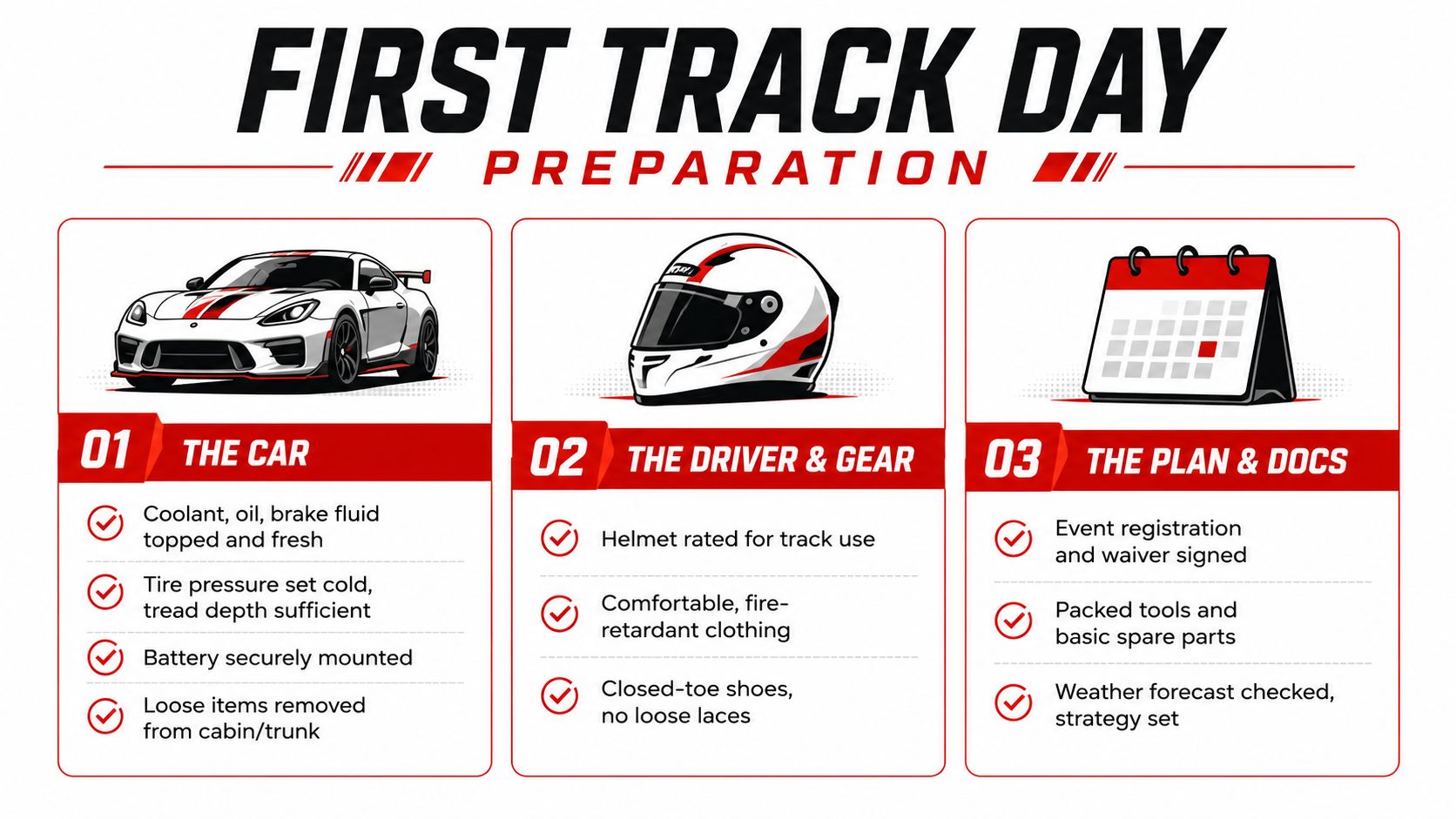
Before you leave, make sure the fluids are right, the tires are in good shape, and the battery is mounted securely. Check torque on the wheels, look for leaks, and clear loose items from the cabin and trunk so nothing can slide around under braking. A quick look at the car's overall condition is often enough to catch the obvious problems before they become session-ending problems.
The driver and gear
Bring the basics that match the event. That means a helmet rated for track use, comfortable fire-retardant clothing if the event requires it, closed-toe shoes, and whatever paperwork the organizer asked for. If you're new, ask the instructor what they expect from your line choice, mirror use, and passing behavior, because uncertainty on track usually comes from silence, not speed.
The plan and the mindset
Sleep matters. Hydration matters. So does having snacks, a notepad, and a willingness to let the instructor speak plainly about mistakes. If you're using a monitoring tool such as the CarLock vehicle health page, check it before you leave so you know the car wasn't already showing battery or alert issues before the event started.
Show up calm, not rushed. A driver who's rested and organized usually learns faster than the one trying to recover from a bad morning.
A clean checklist also keeps the day enjoyable. Track days are demanding, but they're not mysterious, and a prepared first-timer usually does better than they expected.
Is a Track Car Right for You and Where to Start
A track car makes sense if you can answer three questions. Can you afford the consumables, not just the build? Do you have a safe place to store and monitor it between events? Do you want to spend more time driving, or more time wrenching?
If the answer to the first question is shaky, start with a maintained daily driver and a low-stakes HPDE event. If storage and security are your main worries, keep the car dual-purpose longer and think carefully about where it sleeps. If you're drawn to the garage more than the circuit, a dedicated build might become a project car before it becomes a track car, and that's a different hobby.
The best first step for many people is simple. Go to one event in a roadworthy car, learn the process, and see how you feel after a full day of heat, noise, and repetition. If you still want more after that, the build path becomes much clearer.
For owners who want a way to monitor where the car is when it isn't in their driveway, the CarLock reviews page is a sensible place to see how people describe real-world use before they decide on a security setup.
If you're thinking about a track car, start by protecting the one you already own. Visit CARLOCK to see how real-time GPS tracking and vehicle alerts can fit into a build, a storage plan, or a first-season track-day routine.