

Driver’s Desk
GPS Tracker System for Car: The Ultimate 2026 Guide
Vehicle theft and unauthorized use often turn into a race against time. A tracker that updates often enough to follow movement can give you a current location instead of a stale pin dropped minutes ago.
That difference is the starting point for understanding a real GPS tracker system for car security. A proper system does two jobs at once. It figures out where the vehicle is through GPS satellites, then sends that location to your phone through a cellular network. A Bluetooth tag works very differently. It acts more like a short-range key finder that depends on nearby devices, which is why it can help locate misplaced items but cannot offer the same level of vehicle security.
The subscription model makes more sense once you see that second half of the process. The hardware finds the car. The cellular connection keeps reporting back, stores trip data, and sends alerts when something changes. You are paying for ongoing communication, not just the plastic device attached to the car.
That matters in practice. If your vehicle is moved without permission, you want a track you can follow, not a rough last-known location and guesswork. You also want records that can support police reports, help with smooth auto repairs after a claim, and show how tracking fits beside other protections such as alarm system car basics and limitations.
A feature list alone will not tell you that. The technology behind the tracker will.
Your Car Is a Target Why Old Alarms Are Not Enough
A traditional alarm is built to make noise. That's the whole job. If someone bumps the car, opens a door, or triggers a sensor, the siren goes off and hopes a nearby person cares enough to react.
Most of the time, that's a weak plan.
You already know the everyday pattern. A car alarm sounds in a parking lot. People glance over, then keep walking. Drivers assume it's a false alarm. Neighbors hear it in the middle of the night and wait for it to stop. Noise alone doesn't give you location, movement history, or proof of where the car went.
That's why many owners now pair audible deterrence with active monitoring. If you want a quick look at how alarm systems fit into a broader security setup, CarLock has a helpful explainer on alarm system car basics and limitations.
The gap between deterrence and response
A siren may scare off an amateur thief. It doesn't help much if someone tows the vehicle, disconnects power, or moves it fast enough that you discover the theft after the fact.
A GPS tracker system for car security changes the job from passive warning to active response. Instead of only asking, “Did something happen?” you can ask:
- Where is the car now
- When did it start moving
- Which route did it take
- Did it leave a known area unexpectedly
Those questions matter even after recovery. If you're dealing with a theft, vandalism, towing dispute, or collision aftermath, documentation can make the next steps easier. If you ever have to coordinate with insurance, this guide to smooth auto repairs after a claim is useful because it walks through what owners often need after the immediate incident is over.
Old alarms try to attract attention. Modern tracking tries to give the owner usable information.
What concerned owners usually miss
Many people think of car security as a one-layer decision. Alarm or no alarm. Lock or no lock. That's outdated thinking.
Real security usually means combining deterrence with visibility. A steering wheel lock may discourage tampering. An alarm may create pressure. A GPS-based system gives you awareness after the event starts. For a worried parent, that might mean confirming a teen driver's route. For a fleet owner, it might mean checking unauthorized after-hours use. For a theft scenario, it means having something more actionable than “it was here last night.”
How a GPS Tracker System for Cars Really Works
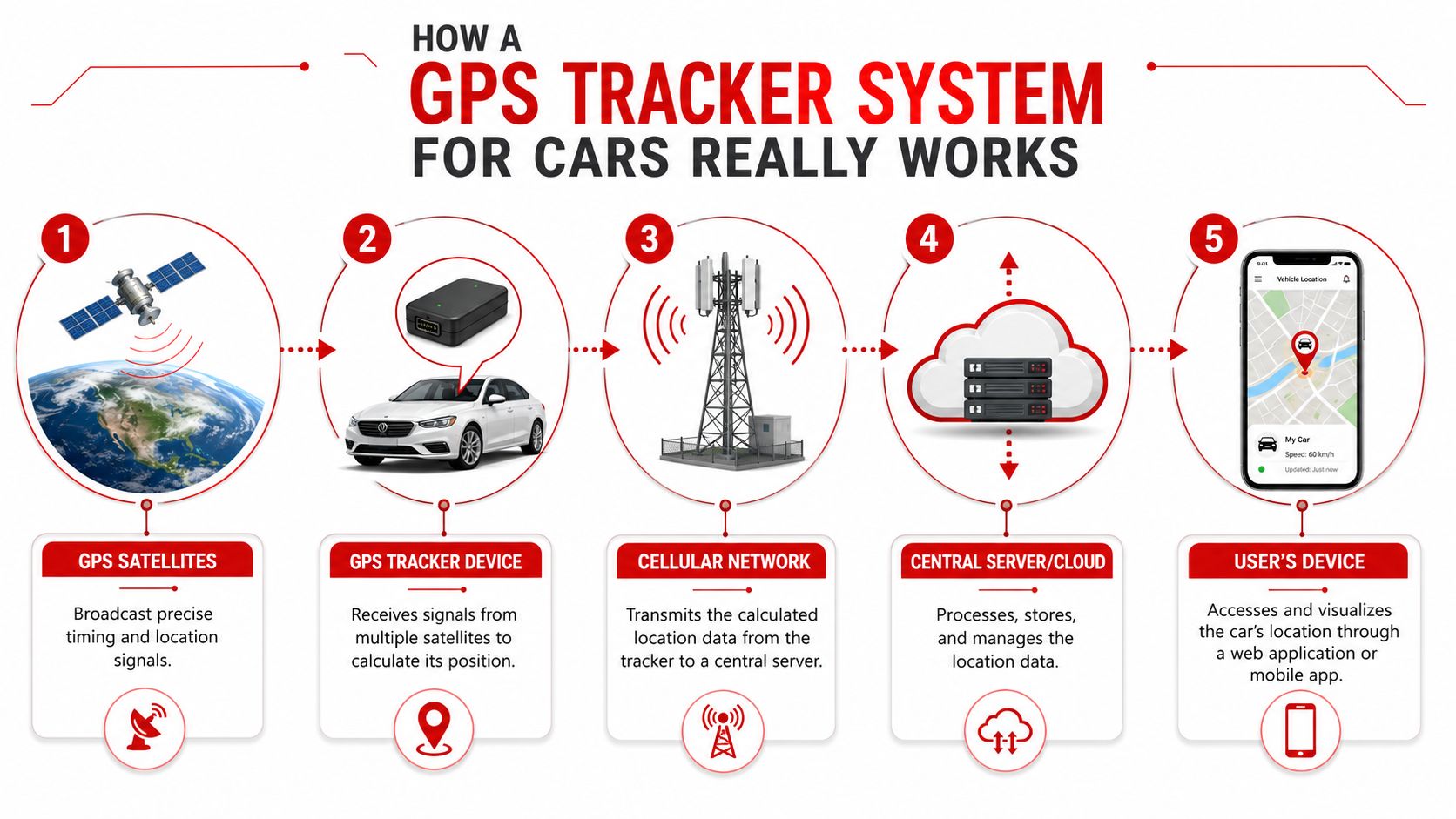
The easiest way to understand a GPS tracker system for car use is this: GPS gives the device its eyes. Cellular gives it its voice.
The tracker first figures out where the car is. Then it has to tell you.
That second part is where many buyers get confused. GPS alone does not deliver location updates to your phone. It only helps the device determine position.
For a deeper companion read, CarLock also explains how does a GPS tracking system work in practical terms.
The five parts that make the system useful
A technically well-engineered car GPS tracker system is usually built from five parts: a GNSS receiver or antenna, a cellular or satellite modem, an onboard power source or vehicle power tap, a backend server, and a user-facing app or web platform, as described by Intellias in its breakdown of GPS car tracking architecture.
Here's what each one does in plain English:
| Part | What it does | Why it matters |
|---|---|---|
| GNSS receiver | Listens for satellite signals | Calculates the car's position |
| Modem | Sends data over a network | Delivers location to the platform |
| Power source | Keeps the tracker running | Allows continuous operation |
| Backend server | Processes and stores incoming data | Turns raw coordinates into usable history and alerts |
| App or web dashboard | Shows the owner the information | Makes the system practical day to day |
Why GPS alone isn't enough
A lot of people assume “GPS tracker” means the device talks directly to their phone through the satellites. That isn't how most car trackers work.
Consider the following:
- Satellites are the street signs
- The tracker is the driver reading them
- The cellular network is the phone call back to you
Without that network connection, the tracker may know where it is, but you don't.
That's also why active and passive systems are different. An active tracker sends positions out over a network so you can see them remotely. A passive logger stores points for later download. For theft response, that difference is huge. If a thief drives off, a passive logger may still have useful data later, but it can't help you react in near real time.
Practical rule: If your main concern is theft recovery, you want active reporting, not just stored trip logs.
Why signal quality matters in the real world
Not every environment is equally friendly to tracking. Dense city streets, garages, mountains, and heavy tree cover can make positioning harder. Intellias also notes that multi-GNSS receivers, which combine systems like GPS with GLONASS or Galileo, improve lock speed and tracking stability in tougher conditions.
That matters because a car doesn't live in perfect lab conditions. It moves between open highways, neighborhoods, parking decks, and urban corridors. A good system is built for those transitions, not just clear skies.
Choosing Your Device The Three Types of GPS Trackers
The device type you choose shapes how much protection you get. Two trackers can both say “GPS” on the box and still perform very differently in a theft situation.
Most buyers are deciding between three forms: OBD-II plug-in, hardwired, and battery-powered. The easiest way to understand them is to ask one practical question first. Where does the tracker get its power, and how easy is it for someone else to remove it? That answer affects convenience, concealment, and whether the system keeps reporting when you need it most.
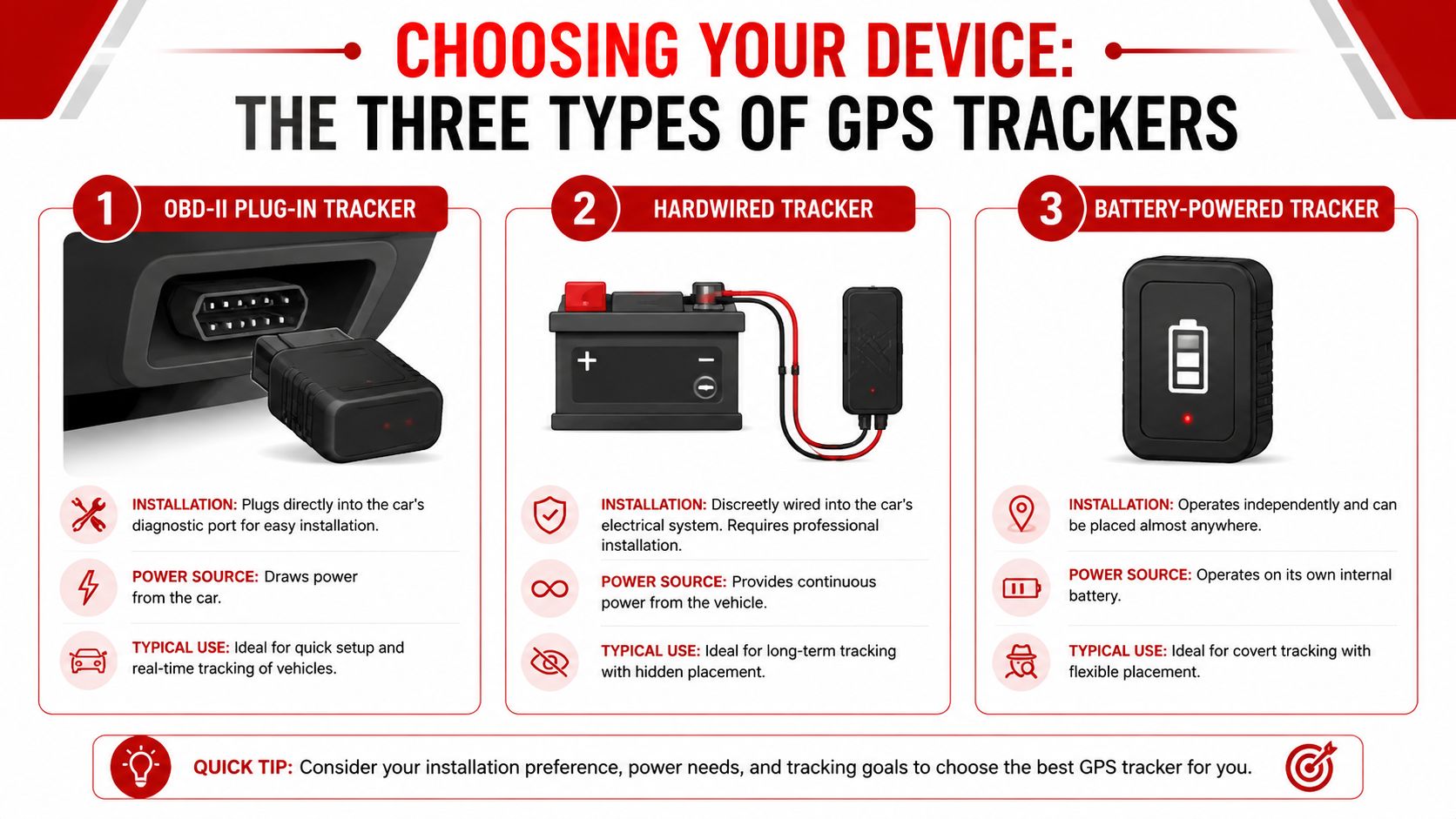
If you want a quick side-by-side view of setup styles, CarLock has a useful guide to plug-and-play, hardwired, and battery-powered car tracking installation options.
OBD-II plug-in trackers
OBD-II trackers plug into the diagnostic port that sits under the dash in most newer vehicles. They are popular because setup is fast, power is constant, and many owners can install one in minutes.
Good fit:
- Family cars
- Teen driver monitoring
- Owners who want quick installation
Trade-offs:
- Easy to spot
- Easy to unplug
- Less discreet for anti-theft use
That last point matters more than many people expect. An OBD tracker works well for visibility and driving alerts, but it is not the best choice if your main concern is a thief finding the device quickly and disabling it.
Hardwired trackers
Hardwired units connect to the vehicle's electrical system and are usually tucked behind trim panels or under the dashboard. They take more effort to install, but that effort buys you something important. The tracker is harder to notice and harder to remove casually.
Good fit:
- Long-term vehicle security
- Fleet vehicles
- Owners who want a more concealed setup
Trade-offs:
- Installation is more involved
- Many owners prefer professional help
- Moving the device to another car is less convenient
If OBD trackers are like a visible doorbell camera, hardwired trackers are closer to a hidden security sensor. For theft recovery, that difference can matter a lot.
Before looking at more pros and cons, here's a quick visual demo:
Battery-powered trackers
Battery-powered models do not draw from the car at all. That gives you flexible placement, which can help when wiring is not practical or when you want a more covert location.
Good fit:
- Temporary use
- Covert placement
- Situations where wiring isn't practical
Trade-offs:
- Needs recharging or battery replacement
- Can stop reporting if neglected
- Battery management becomes part of ownership
This category often sounds more secure because it can be hidden almost anywhere. The catch is simple. A hidden tracker with a dead battery does nothing for you. For a car owner who wants steady protection and fewer maintenance tasks, power reliability usually matters more than creative placement.
What the specifications actually tell you
The product page often highlights maps, alerts, and app screenshots. The more useful question is whether the hardware fits your reason for buying a tracker in the first place.
If your goal is driver awareness, an OBD device may be enough.
If your goal is vehicle security, concealment and steady power matter more. That is why hardwired systems often justify a monthly subscription more clearly than buyers first expect. You are not just paying for a dot on a map. You are paying for an active device that stays powered, sends its location over the cellular network, and keeps reporting back when the car is no longer near you.
Battery-powered units sit in the middle. They can work well in specific cases, but ownership includes one more routine to remember.
A simple rule helps here:
- Choose OBD-II if ease of setup matters most
- Choose hardwired if theft resistance and hidden installation matter most
- Choose battery-powered if flexibility matters most and you will keep up with charging
If you want the tracker to protect the car itself, not just log trips, choose the device type based on power reliability and how easily it can be found.
Decoding the Must-Have Features of a Modern System
A car tracker becomes useful when the software turns location points into decisions. That's why feature lists shouldn't be read as marketing extras. The good ones solve specific problems.
One of the clearest examples is trip history. Independent guidance from PAJ GPS says a good car tracker should store historical records for at least 100 days, and modern systems commonly include geofencing, tamper alerts, speed logs, and harsh-braking and acceleration alerts for behavior monitoring, as explained in its guide to GPS tracking and travel history.
For another practical feature checklist, see CarLock's article on the top features every GPS car tracker should have.
Real-time tracking that supports action
A map dot sounds simple. In practice, it's the difference between uncertainty and direction.
If a vehicle moves when it shouldn't, real-time visibility helps the owner decide what to do next. That could mean confirming whether a family member borrowed the car, checking whether a tow was legitimate, or sharing current movement with authorities in a theft situation.
The point isn't novelty. The point is response.
Trip history that tells the story afterward
Live visibility helps in the moment. Trip history helps after the event.
A strong record should let you review:
- Routes taken
- Timestamps
- Miles traveled
- Stop locations
- Start and stop times
That matters more than many buyers realize. A stolen car may be abandoned before it's recovered. A family car may be used outside agreed boundaries. A business vehicle may be driven after hours. Historical playback gives context when the live event is already over.
A good tracking system helps twice. First during the incident, then during the reconstruction.
Geofencing as a virtual perimeter
Geofencing is one of the most practical features in vehicle security because it mirrors how people think about their cars.
You don't just care where the car is in the abstract. You care whether it leaves places where it should be safe.
Examples include:
- Home at night
- A workplace lot during business hours
- A school parking area
- A fleet yard after closing
A geofence creates a virtual perimeter around those locations. If the car enters or exits unexpectedly, the system can alert you. That turns a tracker from a passive map into a watchman with boundaries.
Tamper and behavior alerts
Modern vehicle tracking has expanded beyond simple location logging. PAJ GPS notes that many systems now include tamper alerts, speed logs, and harsh-braking and acceleration alerts.
These features serve different users in different ways:
| Feature | Security use | Everyday use |
|---|---|---|
| Tamper alerts | Warn if someone tries to disable the device | Reveal unplugging or interference |
| Speed logs | Flag risky or unusual movement | Useful for teen drivers or company vehicles |
| Harsh-driving alerts | Show aggressive use of the vehicle | Supports coaching and accountability |
A parent may use these to monitor a new driver. A small business may use them to oversee vehicle handling. A theft-conscious owner may care most about movement and tamper warnings.
What separates a locator from a security system
A basic locator answers one question: “Where is the car?”
A fuller system answers several:
- Where is it now
- Where has it been
- Did it cross a boundary
- Was the device disturbed
- Was the driving behavior unusual
That's the difference between checking on a car and actively protecting it.
GPS Trackers vs Bluetooth Finders A Critical Security Decision
Many buyers often make the wrong comparison at this stage.
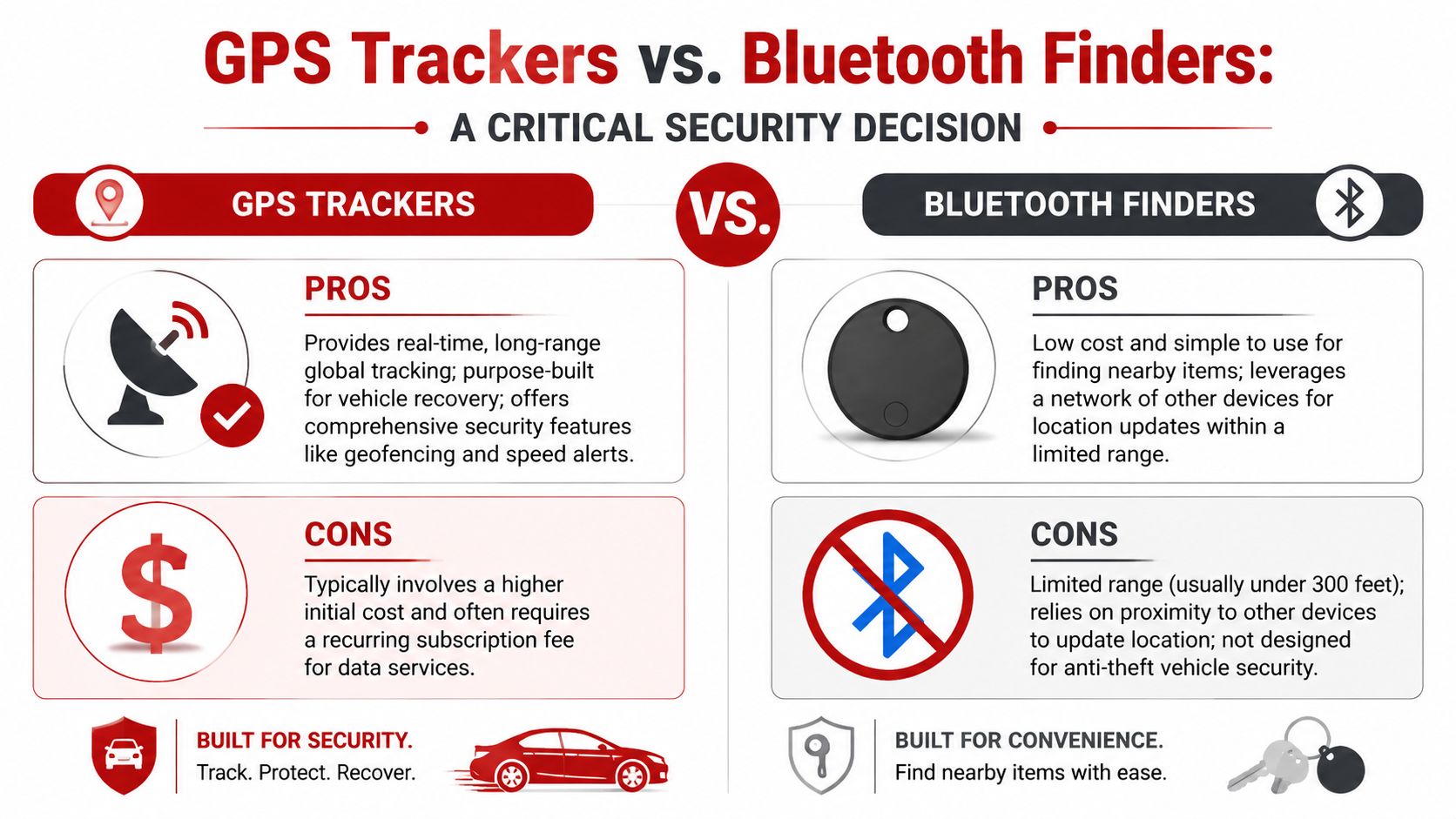
They see a low-cost Bluetooth tag and ask whether it can do the same job as a dedicated vehicle tracker. It usually can't, because the technologies are built for different purposes.
Dedicated GPS trackers require a monthly subscription for cellular connectivity, while Bluetooth-based item finders can fail in remote areas or when the car is moving because they depend on nearby devices rather than direct satellite and cellular tracking, as explained in this comparison of hidden car GPS trackers and coverage trade-offs.
If you're thinking broadly about modern theft methods, CarLock also has a useful article on Bluetooth relay attacks on cars and how thieves use technology.
Bluetooth is for proximity, not vehicle recovery
Bluetooth finders are excellent for certain jobs. Keys under a couch. A bag left at the office. Luggage nearby.
A moving car is different.
A Bluetooth finder typically depends on nearby devices to help update location. That means performance can fall apart when:
- The vehicle is moving quickly
- The car is in a remote area
- No participating devices are nearby
- You need continuous independent reporting
For serious anti-theft use, those are not minor weaknesses. They are core failure points.
Why subscriptions exist in the first place
This is the part many companies skip or gloss over.
People often ask, “Why should I pay monthly when a Bluetooth tag has no subscription?” The honest answer is that the monthly fee usually pays for the parts that make true vehicle security work:
- Cellular data transmission
- Backend servers
- Stored trip records
- App access and alert delivery
- Continuous communication between tracker and platform
A Bluetooth tag avoids most of those costs because it isn't providing independent, always-on wide-area tracking. It's a different product category.
The right question isn't “Does it have a fee?” It's “What service does that fee buy?”
A simple scenario shows the difference
Here's a practical comparison.
| Situation | GPS tracker | Bluetooth finder |
|---|---|---|
| Car leaves your driveway at night | Designed to report movement and location remotely | May not provide useful independent tracking |
| Vehicle travels through a remote area | Intended to keep reporting through its own tracking architecture | Can fail if no nearby devices help locate it |
| You need route history later | Built for trip review and alerts | Usually not built as a full telematics history tool |
That's why a Bluetooth tag can be a convenience accessory, while a dedicated GPS tracker system for car security is a protection tool.
One category is built for keys. The other is built for cars.
There's nothing wrong with using a Bluetooth finder for low-stakes item finding. The mistake is expecting it to serve as a substitute for a real vehicle security system.
If the outcome you care about is recovering a car, detecting unauthorized movement, or receiving alerts when the vehicle is tampered with, you need the technology designed for that job.
Installation Subscriptions and Privacy What to Expect
Buying a tracker is only part of the decision. You are also choosing how the device will be installed, how it will stay connected, and who will be able to see your car's movements over time.
Those practical details matter because a car tracker is not a one-time gadget. It is an ongoing security service.
Installation is a tradeoff between easy access and hidden placement
The three common installation styles create three very different ownership experiences.
An OBD plug-in device is the simplest to set up. It plugs into the diagnostic port many drivers already use for scan tools. That makes it convenient, but it can also make the device easier to spot and remove.
A hardwired unit takes more effort to install, often with professional help, but it is usually the better choice for owners who care about concealment. Hidden hardware is harder for a thief to find quickly, and time matters during a theft.
A battery-powered unit gives you flexibility in placement. The tradeoff is maintenance. If you forget to recharge it, the tracker cannot help when you need it most.
A good way to frame the choice is simple. If your main goal is convenience, plug-in often wins. If your main goal is theft resistance, hidden installation usually makes more sense.
The subscription pays for the part you cannot see
This is the part many buyers question first, and for good reason. A tracker that reports your car's location beyond Bluetooth range needs more than a GPS chip inside the box. It also needs a communication path and a service platform working in the background.
GPS works like your car listening for directions from satellites. That only tells the device where it is. To send that location to your phone, the tracker usually uses a cellular connection, much like a phone sending a text. The monthly fee typically supports that connection, along with the app, alert delivery, stored trip history, and the servers that keep everything running.
Car and Driver found in its review of GPS tracker testing and performance benchmarks that reporting speed and accuracy shape how useful a tracker feels in daily use and during a possible theft event. Faster updates can give an owner earlier warning that something is wrong.
That ongoing service usually includes:
- Cellular data for location reporting
- Cloud storage for trips and events
- Mobile app access
- Push alerts and notification processing
- Account support and software upkeep
The better question is not “Why is there a fee?” It is “What service am I paying to keep active?”
That distinction also helps separate a true vehicle security system from a simple item finder. A Bluetooth tag can help you locate nearby belongings. A GPS tracker for a car depends on a wider network and a live platform, which is why the business model looks different.
Privacy should be clear before you install anything
Location data is sensitive because it can reveal routines. Home. Work. School pickup. Weekend habits. A trustworthy provider should explain its privacy controls in plain language, not bury them under vague promises.
Before you buy, check these points:
- Who can log in to the account
- Whether you can limit or customize alerts
- Whether more than one user can view the vehicle
- How trip history is stored and who can see it
- Whether account access and device settings can be managed easily
Those answers tell you how the tracker will fit into real life, whether you are protecting a family car, watching over a teen driver, or monitoring a business vehicle.
CARLOCK is one example in this category. It is built for vehicle monitoring and can send smartphone alerts for events such as movement, engine start, unusual vibration, and device disconnection. Whether you choose that product or another one, judge the provider by how clearly it explains installation, subscription costs, alert handling, and account privacy.
If a company cannot explain its fees and data practices in plain language, choose a different provider.
Your Practical Checklist for Buying the Right GPS Tracker
By this point, most buyers don't need more theory. They need a short decision filter.
Use this checklist when comparing any GPS tracker system for car protection, family monitoring, or fleet oversight.
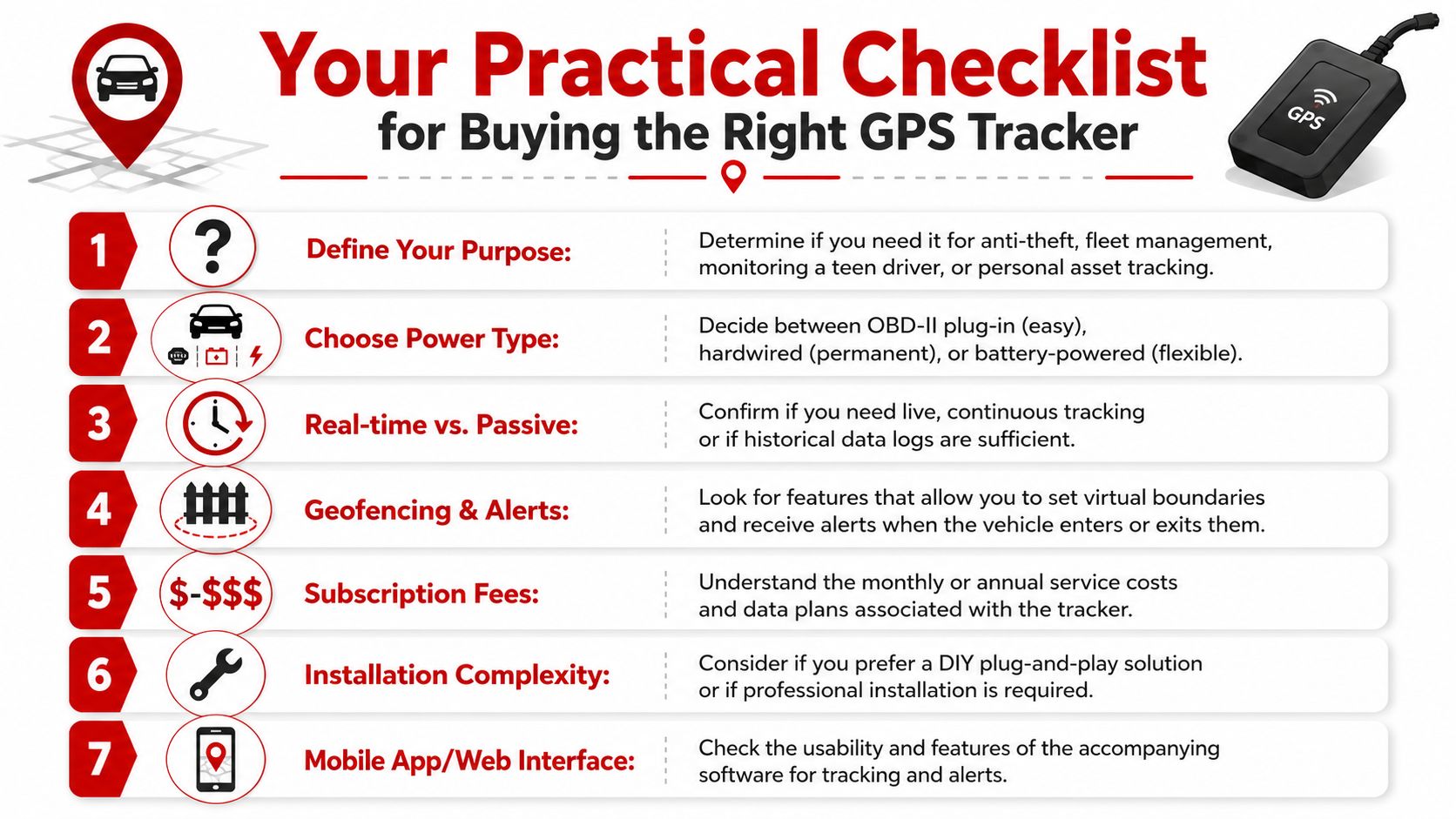
The seven questions that matter most
What's your real purpose If your main concern is theft recovery, focus on active tracking, alerts, and concealment. If you're monitoring a teen driver, ease of installation and behavior alerts may matter more.
Which power type fits your routine OBD plug-in, hardwired, and battery-powered devices each make sense in different situations. Pick the one you will maintain.
Do you need live tracking or only stored logs For security use, live reporting is usually the safer bet.
Does it include geofencing and tamper alerts Those two features often separate a simple locator from a real security tool.
How transparent is the subscription You should know what the fee includes, especially connectivity, alerts, and app access.
How usable is the app If the mobile experience is confusing, important alerts may get ignored.
Can it help both during and after an incident The strongest systems support immediate alerts and useful historical review.
A good buying decision usually comes down to one principle: don't compare products only by sticker price. Compare them by whether they can still help when your car is moving, out of sight, and no longer where you left it.
If you want a security-focused option to compare against others, CARLOCK offers a real-time GPS car tracker and smart car security system with smartphone alerts for movement, engine start, vibration, towing-related activity, disconnection, and trip monitoring. It's worth considering if you want a tool designed specifically for vehicle security rather than general item finding.