

Driver’s Desk
Realtime Tracking Devices: A Complete Guide to Vehicle Security
Staring at an empty parking spot where your car should be is a heart-stopping moment nobody wants to experience. Traditional car alarms? They just make a lot of noise that most people have learned to tune out. A study by the Progressive Policy Institute found that fewer than 1% of respondents report taking action, like calling the police, when they hear a car alarm. This widespread "alarm fatigue" makes them more of a public nuisance than a real deterrent.
This is where realtime tracking devices completely change the game for vehicle security.
Your Vehicle’s Digital Watchdog
Think of a realtime tracker not as a loud alarm, but as a silent, digital watchdog that's always on duty. It's not there to make a scene; it's there to communicate directly and discreetly with you, the owner.
If a thief breaks a window, tries to hotwire the engine, or even attempts to tow your car away, the device's built-in sensors detect that unauthorized activity immediately. Instead of a blaring siren that gets ignored, you get a quiet, specific, and actionable alert right on your smartphone.
Proactive Alerts Before It’s Too Late
The real power of these devices is their proactive nature. A subtle vibration from a shattered window or the engine starting when it shouldn't can trigger an instant notification. This early warning is everything—it gives you a critical window of time to act before your vehicle is gone for good.
According to the National Insurance Crime Bureau (NICB), a vehicle is stolen every 39 seconds in the United States. That staggering statistic underscores why proactive security is more important than ever. Realtime trackers flip the script from passive defense to active, hands-on monitoring, which massively boosts your chances of preventing theft or recovering your vehicle.
This instant line of communication fundamentally changes your role in your car's security. You're no longer just a bystander hoping someone else notices an alarm. You become the first line of defense, armed with your car's exact location and the critical knowledge that something is wrong. You can see just how a complete GPS car security system puts this powerful layer of protection in your hands.
More Than Just an Anti-Theft Gadget
While theft prevention is a primary benefit, the applications for realtime trackers extend far beyond that. Their versatility makes them incredibly useful in various everyday scenarios.
- Peace of Mind for Any Car Owner: Whether parked in a busy downtown garage, a quiet suburban street, or an unfamiliar neighborhood, you'll always have the confidence of knowing exactly where your vehicle is and that it's secure.
- Safety for New Drivers: For parents, these devices are invaluable. The CDC reports that motor vehicle crashes are a leading cause of death for U.S. teens. You can get alerts for harsh braking, speeding, or if your teen driver goes outside a pre-set "safe zone," helping you coach them to be safer on the road.
- Protection for Business Assets: If you run a business with a fleet of vehicles, trackers are essential. They help protect your valuable assets, monitor employee driving behavior for safety and liability, and even help you optimize routes to reduce fuel costs.
Ultimately, realtime tracking has become a modern necessity for vehicle owners. It delivers a level of security, awareness, and control that older, passive systems simply cannot match.
How a Realtime Tracker Protects Your Car: From Orbit to Your Pocket
Ever wondered what's happening inside that little device plugged into your car? It's not magic, but a sophisticated system of integrated technologies. To truly appreciate why these trackers are so effective, you need to understand the tag-team of technologies working behind the scenes. It's a seamless flow of information from satellites in space, down to your car, and then straight to your smartphone.
Think of it as a three-part security detail. Each part has a specific job, and when they work together, you get the kind of instant, reliable protection that provides genuine peace of mind.
Core Technologies in a Realtime Tracking Device
At first glance, a vehicle tracker is a small, unassuming box. But inside, several key components are constantly working to keep your car safe. Each piece of technology plays a vital role in detecting a threat and communicating it to you instantly.
Here's a breakdown of what's inside and its function:
| Technology Component | Primary Function | How It Protects Your Vehicle |
|---|---|---|
| GPS Receiver | Pinpoints Location | Constantly communicates with satellites to determine your car's exact coordinates. If it moves, you know where it's going. |
| Cellular Modem & SIM | Transmits Data | Sends location data and sensor alerts over 4G/5G networks to secure servers, which then push them to your phone. |
| Accelerometer | Senses Movement | Detects vibrations from a window breaking, the engine starting unexpectedly, or the car being bumped or jostled. |
| Gyroscope | Measures Tilt & Angle | Senses if the vehicle is being lifted or towed away, triggering an alert before it's even driven off. |
This combination of technologies is what elevates a modern tracker from a simple location beacon to an active security system that senses threats and communicates them immediately.
Pinpointing Your Vehicle With GPS Precision
First up is the foundation of it all: the Global Positioning System (GPS). Every tracker has a sensitive GPS receiver inside, acting like a hyper-accurate digital compass. Instead of just pointing north, it’s constantly listening for signals from a network of satellites orbiting the Earth.
Currently, there are over 31 active GPS satellites in the U.S. constellation, blanketing the globe. For your tracker to get a solid fix on its location, it needs to receive signals from at least four of them. By measuring the minute differences in the time it takes for each signal to arrive, the device can calculate its precise longitude and latitude—often with an accuracy of just a few feet.
This process, called trilateration, is what lets your app show your car's icon precisely on a map, whether it’s parked in a multi-level garage or cruising down the freeway. Without it, you’d be flying blind.
Relaying the Information Over Cellular Networks
Knowing your car's location is useless if that information stays locked inside the vehicle. That’s where the second piece of the puzzle comes in: the cellular connection.
Every realtime tracker essentially contains its own tiny, built-in cell phone. It has a SIM card and a modem that connect to reliable mobile networks, such as 4G LTE or 5G, to transmit all that GPS and sensor data out into the world.
This data travels from your vehicle to secure cloud servers, which act as the system's central nervous system. The servers process everything and then push the alerts and location updates straight to your smartphone app. If you want a deeper look at this, you can learn more about how the CarLock cloud connects these systems seamlessly.
This simple flowchart illustrates just how fast that security loop works.
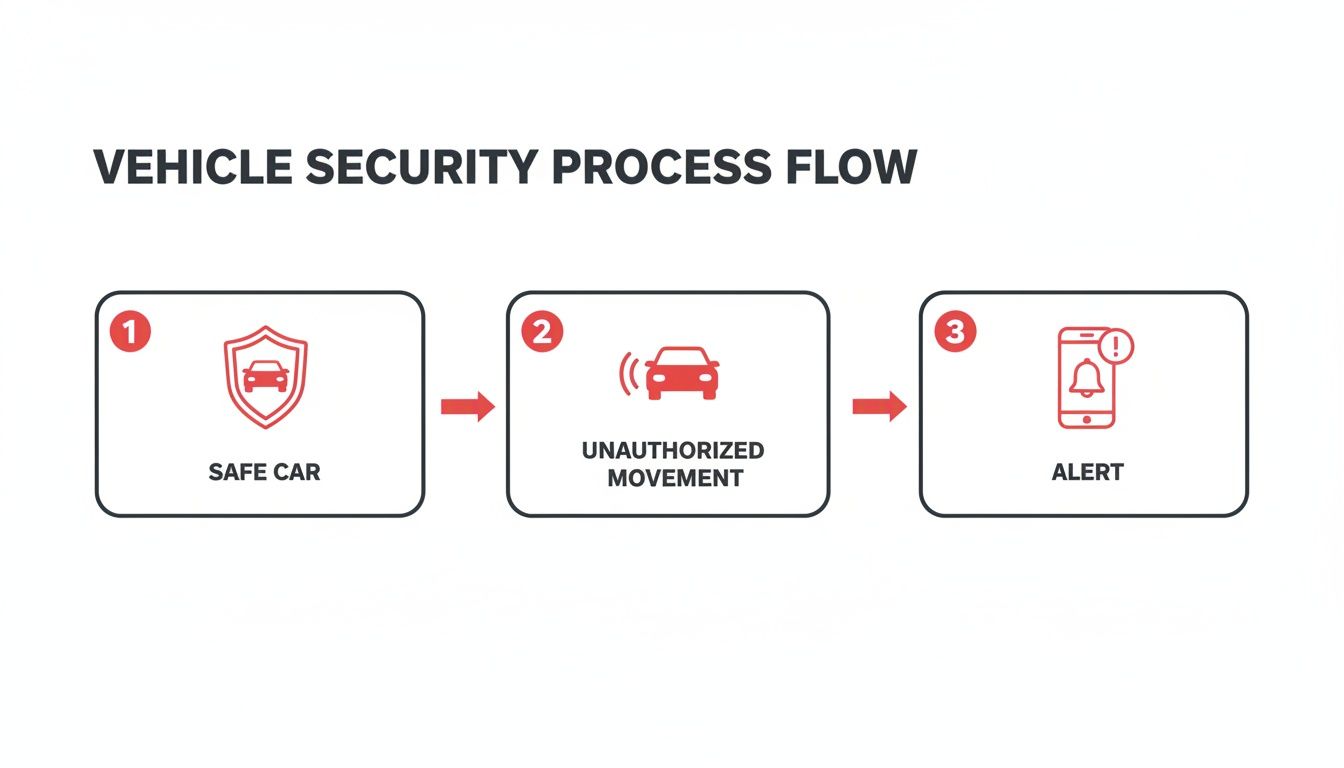
From the moment a threat is detected to the second you get that notification, the entire process takes just a few seconds.
Detecting Trouble With Onboard Sensors
The final layer is what makes a tracker truly proactive. We’re talking about the onboard sensors—the system’s digital nerve endings. These are designed to detect physical disturbances, giving you a warning long before a thief has a chance to drive away.
Advanced onboard sensors are what separate a simple location tracker from a true anti-theft system. They provide the crucial early warnings needed to prevent a theft from ever being completed, turning passive monitoring into active, real-time protection.
The most important sensors include:
- Accelerometers: These are highly sensitive to movement and vibrations. An accelerometer can detect the jolt of a window being smashed, the rumble of the engine starting unexpectedly, or the car being bumped or towed.
- Gyroscopes: These components measure the car’s orientation and angular velocity. If someone tries to lift your vehicle onto a tow truck, the gyroscope will immediately detect the change in angle and trigger an alert.
When any of these sensors are tripped, a signal is fired off through the cellular network, up to the cloud, and down to your phone as an instant push notification. It’s this powerful trio—GPS location, cellular data, and smart sensors—that creates a complete security net around your car, keeping you connected and in control.
What to Look For in a Real-Time GPS Tracker
Choosing the right tracker isn't just about seeing a dot on a map. It’s about investing in a complete security system that helps you prevent theft, not just react to it. A basic tracker might eventually show you where your car was abandoned, but a smart one tells you the moment trouble starts. That proactive alert is everything.
To get the best value and protection, you need to look past simple GPS pings and focus on the alerts and monitoring tools that give you an edge. These are the features that separate passive tracking from active, real-time protection.
Instant, Multi-Type Alerts
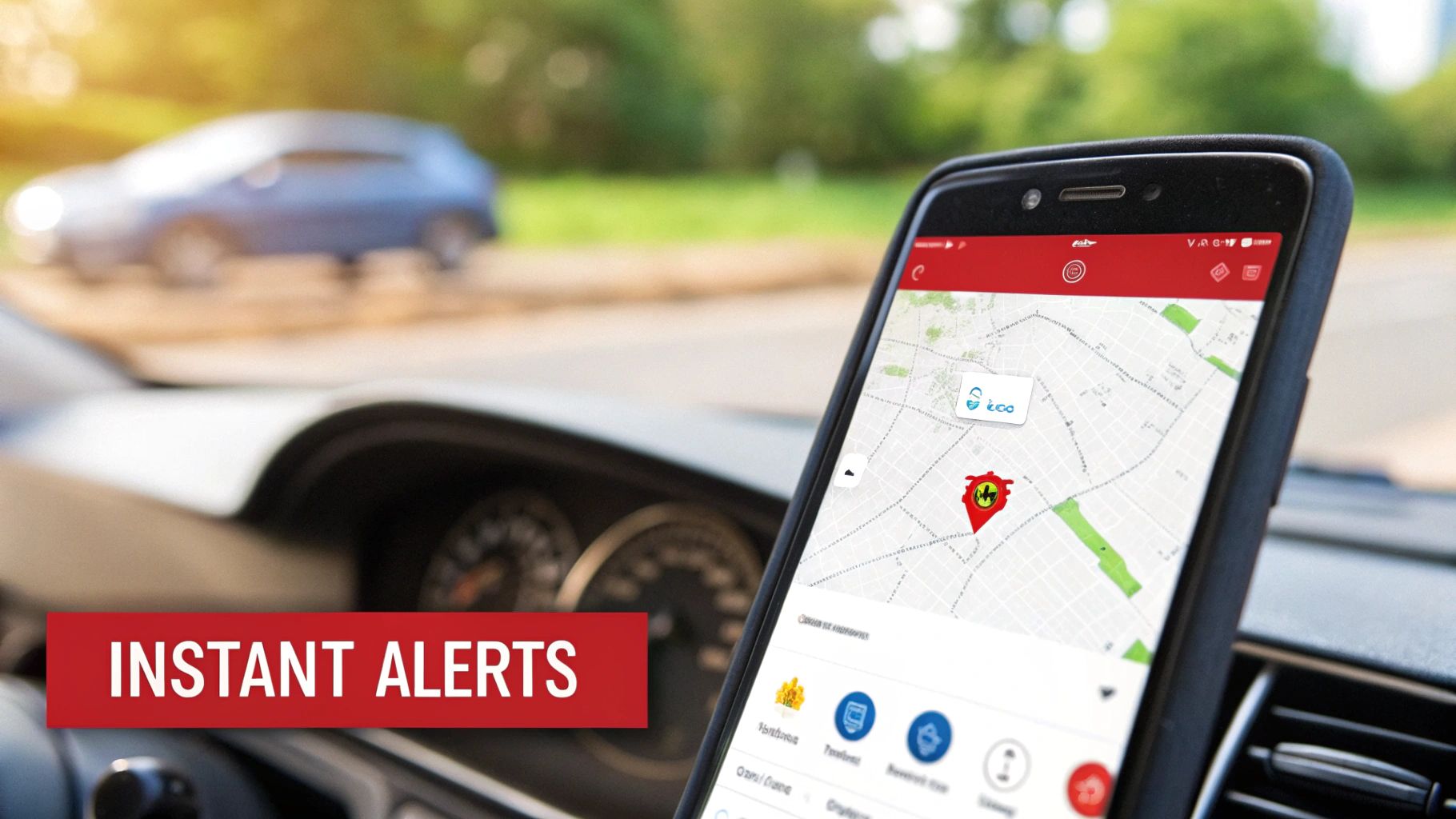
The single most critical feature of any security-focused tracker is its ability to send immediate, specific alerts straight to your phone. A generic "movement detected" notification is one thing, but the best devices provide a range of alerts that help you understand precisely what's happening.
Look for a device that notifies you of distinct events, such as:
- Vibration Detected: This is your first line of defense. It’s the alert triggered by the jolt of a window breaking or a door being forced open.
- Engine Started: You need to know the second your car’s engine turns on when you're not in it. This alert differentiates a potential break-in from a full-blown theft in progress.
- Device Disconnected: A savvy thief will look for the tracker and try to unplug it. An alert that the device has lost power is a massive red flag that someone is tampering with your vehicle.
These granular alerts provide crucial context, allowing you to decide whether to check on your car or contact the police immediately. You can see how these alerts create a complete security net by exploring the full range of CarLock's device-specific features.
Geofencing: Your Virtual Boundaries
Another essential feature is geofencing. This is a powerful tool where you draw a virtual perimeter on a map around important locations, and you get an alert anytime your car enters or leaves that area.
For example, you could set a geofence around your office parking lot. If your car leaves that area between 9 a.m. and 5 p.m. without you, you'll receive an instant notification. It's perfect for ensuring your car stays put while you're at work, or for setting up a "safe zone" around your home or your teenager's school.
Geofencing transforms your tracker from a reactive tool into a proactive guard. It automates the monitoring process, so you don't have to constantly check your app—the system watches over your vehicle for you and only notifies you when a predefined rule is broken.
Detailed Trip History and Driver Monitoring
Beyond just security, the best real-time trackers offer incredible insight into how your vehicle is being used. A detailed trip history log doesn't just show you past routes; it records start and end times, mileage, and idling duration.
This data is invaluable for business owners monitoring company vehicles or for parents encouraging responsible driving habits. Some trackers take it a step further by monitoring driving behavior and sending alerts for:
- Harsh Acceleration: Lets you know about aggressive, fuel-wasting driving.
- Hard Braking: A strong indicator of tailgating or distracted driving.
- Sharp Cornering: Flags when a driver is taking turns too quickly, increasing rollover risk.
This isn't just about being a backseat driver. This information helps promote safer driving habits that can reduce fuel consumption, lower maintenance costs, and minimize wear and tear over time.
Minimal Impact on Your Car's Battery
A common concern is that a GPS tracker will drain the car battery. While this is a real risk with low-quality, poorly designed devices, reputable trackers are engineered for extreme efficiency. They sip power, drawing a minuscule amount of current when the vehicle is parked.
Most will enter a low-power "sleep mode," waking up only to check in periodically or if a sensor (like the vibration alert) is triggered. The rest of the time, they’re dormant, with a negligible impact on a healthy battery.
The global market for GPS tracking devices is projected to grow from $2.8 billion in 2022 to over $7.4 billion by 2030, largely driven by the rise in vehicle theft. Data consistently shows that vehicles with hidden trackers have a recovery rate of over 85%, a stark contrast to the 50% recovery rate without one. This effectiveness is so well-established that many insurance providers offer discounts of 15-30% for installing an approved anti-theft tracking device.
Where Tracking Devices Make a Real Difference
The technology packed into a real-time tracker is impressive, but its true value lies in solving real-world problems. This includes everything from stopping a car thief in their tracks to ensuring a newly licensed teenager is driving safely. These devices are more than just a dot on a map; they offer genuine peace of mind and are a game-changer for personal security, family safety, and business operations.
Let's start with the most powerful application: anti-theft and vehicle recovery. When your car is stolen, every second counts. A quality tracking device can turn a potential total loss into a rapid recovery by providing law enforcement with the exact location of your vehicle in real time.
Protecting Your Property and Getting it Back Fast
Without a tracker, the odds of seeing a stolen car again are grim. With one installed, however, the recovery rate skyrockets. It is, without a doubt, the single most effective tool you have against car thieves.
Imagine your car disappears from a crowded parking lot. Instead of merely filing a police report and hoping for the best, you can provide law enforcement with a live, moving pin on a map. This removes the guesswork, allowing them to intercept the vehicle—often within minutes or hours—which minimizes potential damage and dramatically increases the chances of apprehending the culprits. You can learn more about how CarLock’s vehicle tracking system adds this critical layer of security.
Keeping Your Family Safe
Trackers aren't just for theft. They're an incredible tool for families, especially when a teenager first gets their driver's license. Every parent knows the anxiety of handing over the keys for the first time. A tracker can ease that stress by providing a simple, non-intrusive way to monitor their safety.
You can set up a geofence to get a quiet notification when they arrive safely at school or a friend's house. But modern trackers go much further, offering insights into their actual driving behavior.
- Speed Alerts: Get a notification if the car exceeds a speed limit you've set.
- Location Sharing: You can check in on a long road trip without distracting them with constant calls and texts.
- Harsh Driving Notifications: Alerts for sudden braking or aggressive acceleration can open the door for a constructive conversation about safe driving habits.
This isn't about spying. It's about coaching responsibility and ensuring your children are safe during their most vulnerable years behind the wheel.
A Must-Have for Small Businesses and Fleet Owners
For any business with company vehicles, those cars and trucks are more than just transport—they're vital assets. Real-time tracking is a cornerstone of modern fleet management, helping companies protect their investments, boost efficiency, and reduce operating costs.
By monitoring vehicle locations, a business can prevent unauthorized personal use, deter employee misuse, and rapidly recover stolen trucks or equipment. That level of oversight is essential for protecting the bottom line.
But the benefits extend beyond security. Tracking data is the key to smart logistics and efficient route optimization. It helps dispatchers make better decisions, reduces vehicle idling time, and leads to significant fuel savings. The commercial telematics market is projected to reach over $158 billion by 2028 for this reason.
Businesses that adopt this technology see tangible results. Fleet managers frequently report fuel cost reductions of 20-30% and productivity increases of over 15%. With increasing regulatory demands for accountability, it's estimated that approximately 80% of U.S. commercial trucking firms now depend on GPS tracking for their operations.
Understanding the Legal and Privacy Rules of Vehicle Tracking
Real-time tracking devices provide incredible power to protect your property, but this power comes with serious legal and ethical boundaries. Navigating these rules is straightforward once you understand the core principle: you have the right to track property you own.
Legal issues arise when you install a tracker on a vehicle that does not belong to you without permission.
The entire legal framework hinges on two key concepts: ownership and consent. If the car is legally yours, you are generally permitted to install a monitoring device. It is when you begin tracking someone else's car without their knowledge that you risk violating privacy laws.
Common Scenarios and Legal Boundaries
Let's break down how this applies in the real world. The legality of using a tracker often depends on the relationship between the vehicle owner and the driver.
Here are a few clear-cut situations:
- Your Personal Vehicle: You can absolutely track your own car. This is the primary intended use for most consumers—theft recovery and personal peace of mind.
- A Car Driven by Your Child: As the legal owner of the vehicle your teenager is driving, you have the right to install a tracker. This is a common and widely accepted practice for parental monitoring.
- Company-Owned Vehicles: Employers can legally track vehicles that belong to the company. Best practice dictates transparency; businesses should have a written policy informing employees that company vehicles are monitored for safety, efficiency, and security purposes.
The Importance of Consent
The situation becomes legally complex when consent is absent. For instance, placing a tracker on a spouse's car during a contentious divorce could lead to charges such as stalking or harassment, depending on local laws.
The bottom line is this: using a real-time tracker to follow someone's movements without their knowledge is a significant invasion of privacy and is almost always illegal. The law protects an individual's reasonable expectation of privacy.
Laws can vary significantly between states and countries, so it is always prudent to ensure you are compliant with your local regulations. For a detailed overview, you can review our legal and privacy documentation to better understand your rights and obligations.
Ultimately, a real-time tracker is a tool for protecting your assets and the people you care about. As long as you respect the principles of ownership and consent, you can use this technology responsibly, effectively, and—most importantly—legally.
Installation and Smartphone Integration Made Simple
Forget the old stereotypes about installing tracking devices. The days of complex wiring, drilling into your dashboard, and paying for professional installation are largely gone. Modern trackers are designed for simplicity and speed, allowing you to get up and running in minutes.
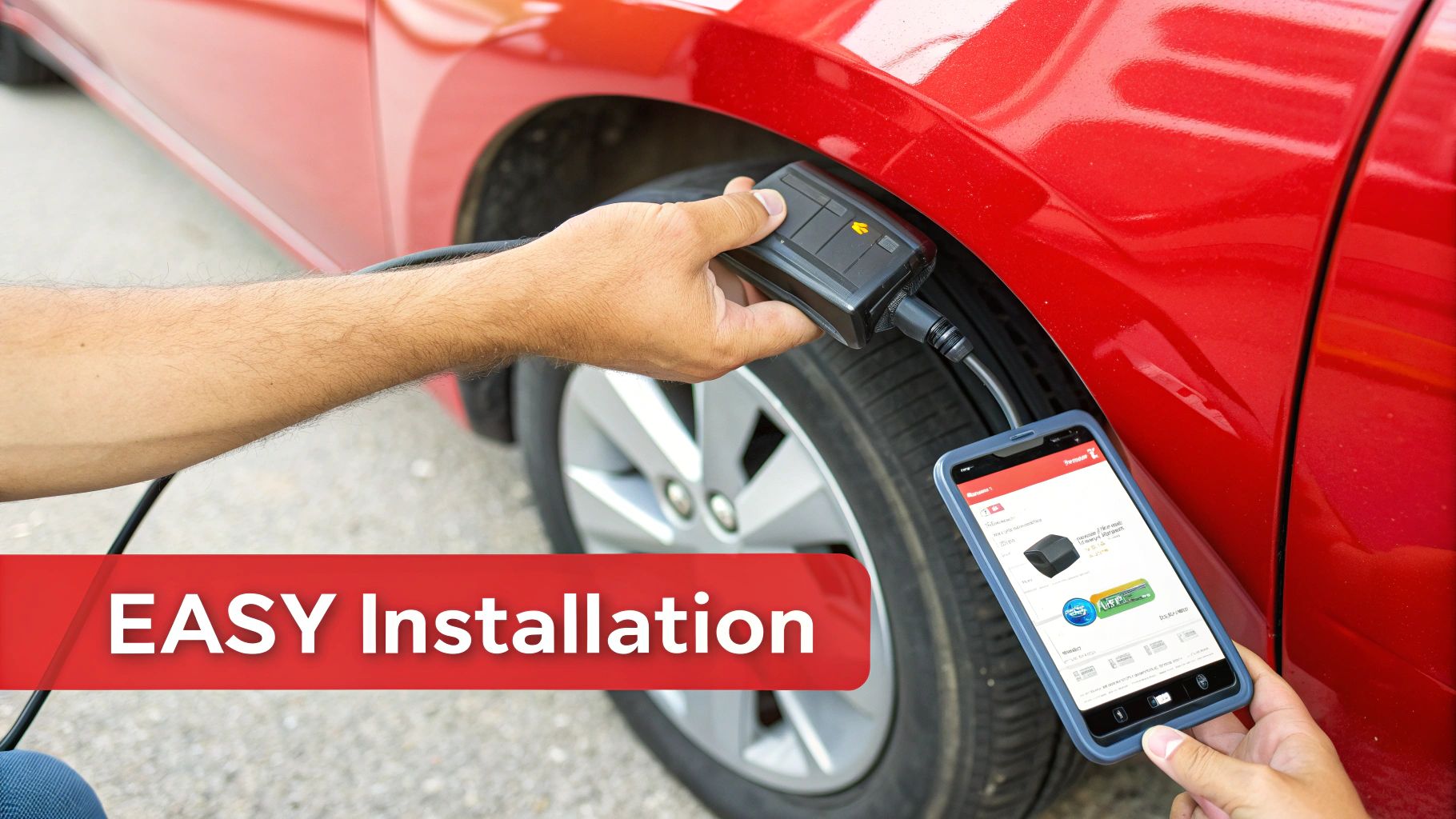
The majority of leading trackers on the market today are plug-and-play. They connect directly to your car's On-Board Diagnostics (OBD-II) port, which has been a standard feature on every vehicle sold in the United States since 1996. Simply locate the port—it's usually under the dashboard near the steering column—and plug the device in. It’s as easy as plugging in a phone charger. No tools, no mess, no technical expertise required.
Your Smartphone as a Command Center
Once the device is plugged in, the real power is unleashed on your phone. The companion smartphone app brings the tracker to life, transforming your phone into a 24/7 command center for your vehicle's security. This seamless integration is what elevates a modern tracker from a passive gadget to an active security system.
The real power of a modern tracking system isn't just the hardware in your car. It's the instant, always-on link between that device and the smartphone in your pocket. That connection gives you the power to know what's happening and react immediately, often before it's too late.
With the app, you are no longer a passive bystander hoping a car alarm will do its job. You become an active participant, receiving critical alerts and information right when you need it most.
Putting Total Control at Your Fingertips
A well-designed tracking app is intuitive, putting all the most important features just a tap away. This is where you configure alerts and settings to match your specific needs, customizing the system to work for you.
Here’s a look at what you can typically control directly from the app:
- Live Location View: Pinpoint your car's exact location on a map in real time, often with accuracy down to a few meters.
- Instant Alert Management: Get immediate push notifications for suspicious activity, like the engine starting, unusual vibrations, or the device being unplugged.
- Trip History Logs: Review previous drives with detailed reports showing the route, distance, and exact start and end times for every trip.
- Geofence Configuration: Create virtual perimeters around important locations like home, work, or your child's school. You'll receive an alert the moment your vehicle crosses one of these boundaries.
This powerful combination—a simple physical installation and a feature-rich mobile app—is what makes real-time tracking such an accessible and effective tool for any car owner today.
Got Questions? Here Are the Answers
It's smart to have questions before choosing a real-time tracker. After all, you’re making an important decision to protect a valuable asset, and you want to be confident in your choice.
We've compiled answers to the most common questions we hear to help clarify any confusion and demonstrate the value of a high-quality tracker.
Will a GPS Tracker Kill My Car Battery?
This is a primary concern for many, and it's a valid one. The good news is that modern real-time tracking devices are engineered to be extremely energy-efficient.
When your car is turned off, a well-designed tracker enters a low-power "sleep" mode. It wakes up only when it detects a triggering event, like a vibration or movement, using a minuscule amount of power. For any healthy car battery, this current draw is negligible. In fact, the best trackers even monitor your car's battery voltage and can alert you if it gets low—a feature most traditional car alarms lack.
Do I Have to Pay a Monthly Fee?
Yes, and this fee is crucial for the device's functionality. The monthly subscription maintains the tracker's cellular connection, keeping it ready to protect your vehicle 24/7. Think of it like a cell phone—it needs a data plan to transmit and receive information.
That fee covers the cost of the cellular data the device uses to send you instant alerts and location updates. Be highly skeptical of trackers that promise "no monthly fees." They are almost always passive data loggers that record information but cannot alert you in real-time when a theft is in progress.
How Accurate Is the GPS Location?
Modern GPS trackers are remarkably precise. They don't just rely on a single signal; they triangulate their position using data from a network of over 30 active satellites in the GPS constellation, often supplementing that with cellular tower data (Assisted GPS or A-GPS) for even better accuracy in urban areas.
This allows the device to pinpoint your car’s location to within approximately 5 to 10 meters (or 15 to 30 feet). That level of accuracy is more than sufficient for law enforcement to locate a vehicle on a specific street, in a parking garage, or hidden in a crowded lot. It’s this combination of immediate alerts and pinpoint accuracy that makes all the difference when you need it most.
Ready to secure your vehicle with the industry's leading real-time tracker? CarLock provides the instant alerts, precise location data, and peace of mind you need. Learn more and protect your car today.